ZESCO: When a Nation's Power Grid Runs Dry
ZESCO Limited
In 2024, ZESCO Limited saw its available power generation collapse from 3,777 MW to 1,040 MW — a 72% loss — after a historic drought drained Lake Kariba to less than 5% of usable storage, triggering US$22 million per month in emergency power imports and a 115% emergency tariff increase.1, 2, 3 The drought, which southern Africa's meteorological agencies classified as the worst mid-season dry spell in over a century, left Zambia's national power deficit at 1,360 MW before imports and 950 MW after them.4, 1 The Energy Regulatory Board approved emergency tariff increases of up to 115% for large commercial and industrial customers, effective November 2024, projecting US$15 million per month in additional revenue from retail customers to help cover import costs.3 By the time the IMF completed its Fourth Review of Zambia in December 2024, ZESCO's total outstanding debt had reached US$2.6 billion.5
ZESCO, Zambia's state-owned electricity utility, generates approximately 83% of its power from hydroelectric dams fed by the Zambezi River system, making the company's revenues, costs, and solvency inseparable from seasonal rainfall and river flows.6, 7 The utility's installed capacity of 3,777 MW is spread across four main hydropower stations — Kariba North Bank, Kafue Gorge Upper, Kafue Gorge Lower, and Itezhi-Tezhi — with the 1,080 MW Kariba North Bank facility on the Zambezi serving as the single largest source.8, 1 In peak periods, Zambia's grid must supply 2,400 MW to households and businesses, meaning that even modest reductions in water availability can open a supply gap that ZESCO must fill with expensive imports from South Africa's Eskom or from independent power producers.1, 9 The company's 2020 Integrated Report acknowledged the structural risk plainly: "We have learnt our lessons with bad experiences relying on a single source of energy."10
Deforestation across the Upper Zambezi Basin has degraded roughly 4.4 million hectares of forest — about 14% of the basin — over the past three decades, reducing the watershed's capacity to regulate river flows and amplifying the severity of droughts that reach ZESCO's turbines.11 Research quantifying ecosystem flow regulation at 14 locations across the Zambezi Basin found that intact miombo forest covering more than 70% of a catchment reduces flood peaks by 37-68%, while floodplains reduce flood flows by 10-60% and increase dry-season low flows — the very flows on which hydropower generation depends.12 Roughly 70-73% of the Zambezi's flow upstream of the Barotse Floodplain originates in Angola's highlands, where major forest loss is under way, with a further 2.8 million hectares predicted to be lost over the next decade.13, 11 A vicious feedback loop compounds the problem: ZESCO's load shedding pushes households to cook with charcoal, accelerating the deforestation that degrades the water flows on which the utility depends.1
ZESCO's vulnerability to drought is not new: a 2015 dry spell forced expensive emergency power imports, produced load shedding that destabilised economic growth, and left the company with over US$200 million in unpaid import arrears.14, 10 The 2015-2016 drought drove load shedding of up to 15 hours per day across residential areas, and the company's own report stated that the "prolonged power cuts effected in the years starting from 2015 destabilised economic growth, affected small to medium enterprises, stalled job creation and subsequently dampened the efforts to combat poverty."10, 2 By 2018, ZESCO reported annual losses of K2.8 billion, and by 2019, pre-tax losses had swollen to ZMW 5.9 billion (US$423 million).15, 16 Each drought episode added layers of debt: emergency imports procured at triple ZESCO's average selling price, mounting arrears to independent power producers, and foreign-exchange losses of US$432 million between 2018 and 2020 as the Kwacha depreciated against the dollar.14
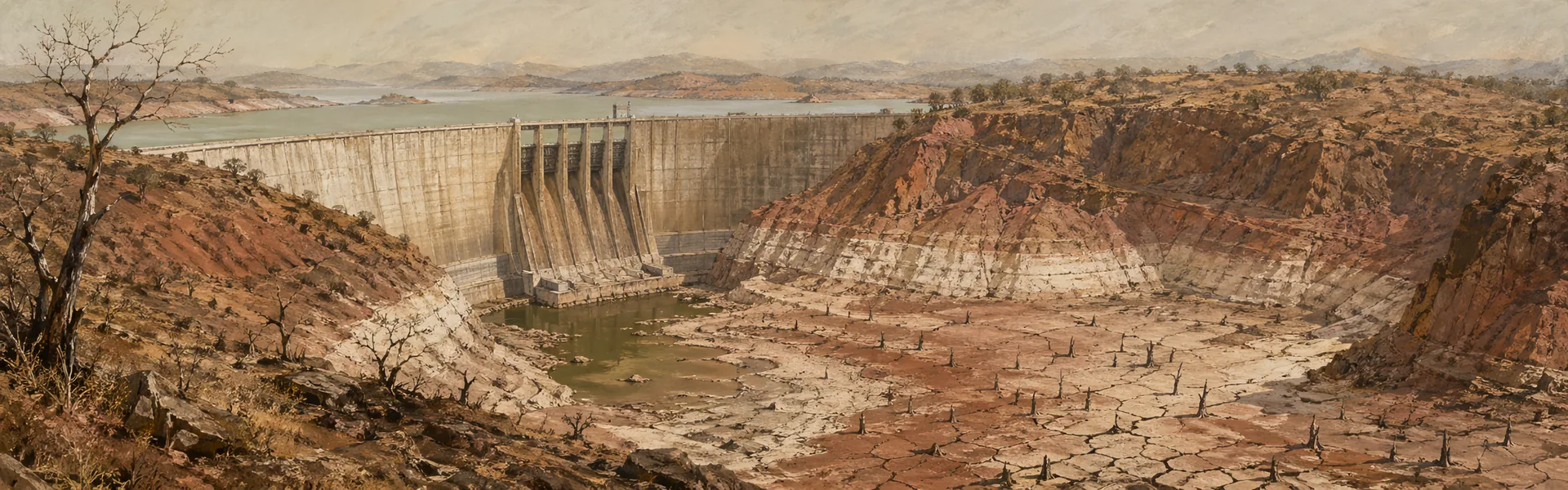
The 2024 crisis dwarfed all precedents: Lake Kariba's usable water column shrank from its 13-metre design depth to roughly 1.26 metres by August, and then to just one metre by October, cutting the 1,080 MW Kariba North Bank station to just 98 MW on Zambia's side — a 91% reduction from a single facility.8, 7, 6 The Zambezi River Authority had warned of below-normal inflows for the 2023-2024 hydrological year as El Nino conditions intensified, and the 2023-2024 El Nino was subsequently classified as the fifth most powerful on record.17, 7 Lake Kariba's live storage had already fallen from 25% in September 2023 to 7.7% in September 2024, before dropping further to 4.9% by October.6, 7 The IMF's Fourth Review put the situation starkly: "The Kariba dam, covering about 80 percent of the national electricity supply in good times, generates less than 10 percent of normal output."5
Load shedding escalated from eight hours per day in March 2024 to 21 hours by September, leaving households and businesses with as little as three hours of electricity daily and forcing ZESCO to import 410 MW from neighbouring countries.7, 4, 18 Some areas experienced blackouts lasting entire days, with the luckiest households receiving five hours of supply.1, 19 ZESCO was running only one generating unit at Kariba North Bank by late 2024.7 The national shortfall reached nearly 1,300 MW, and while regional imports were critical, ZESCO's own management acknowledged they "may not be sufficient to fully balance supply and demand."6, 20 The manufacturing sector bore a direct impact: small and medium enterprises curtailed operations, and the IMF noted that "prolonged power outages due to load shedding" had "notably hindered growth in the non-mining sector."20, 21
The financial damage extended far beyond import bills: ZESCO accumulated US$2.6 billion in total outstanding debt by September 2024, up from US$2.1 billion at end-2022, while the tariff gap between its purchase cost and selling price widened to a ratio of three to one.5, 22 The company's 2022 Integrated Report disclosed that its average cost of power purchases was US$0.09/kWh, against an average retail tariff of just US$0.03/kWh — meaning every kilowatt-hour purchased from independent producers deepened the loss.22 Total debt had already reached US$3.5 billion by September 2021, driven by the combination of import costs, US$1.1 billion in arrears to independent power producers, and forex losses.14 ZESCO's outstanding loans contributed 5.5% of Zambia's total overseas debt, making the utility's financial health a sovereign credit concern.16
Zambia's broader economy absorbed the shock directly, with GDP growth collapsing from 5.4% in 2023 to 1.2% in 2024 and total economic losses from the energy crisis estimated at US$1.3 billion — equivalent to 5% of GDP.23, 1 The IMF revised its growth forecast for Zambia downward twice during 2024, from an initial projection of 4.8% to 2.3% in June and finally to 1.2% by year-end.23 Quarterly GDP figures told the same story of progressive deterioration: 2.5% in the first quarter, 2.2% in the second, and 1.7% in the third.23 The withdrawal of 400 MW from power exports cost ZESCO approximately US$370 million per month in lost revenue, while domestic electricity imports nearly doubled from roughly 70,800 MWh to 128,800 MWh.7 The drought simultaneously devastated agriculture, affecting over nine million people across 84 districts.23
ZESCO's own risk disclosures acknowledge the problem: the company's 2022 Integrated Report ranks climate change as its number-one enterprise risk, noting that "the Corporation's electricity generation business is predominantly hydro and is susceptible to the effects of climate change" and that droughts are "occurring with increasing frequency."22 This candour contrasts with the company's limited progress in reducing its exposure. Rainfall across the Zambezi Basin has declined by 20%, daily minimum temperatures have risen by 2.6 degrees Celsius, and drought events have shifted from a once-in-a-decade phenomenon to occurring once every three years.6 By March 2026, Lake Kariba's usable storage had recovered to 17.5%, compared with 9.2% at the same date in 2025 — an improvement, but still well below the levels needed for full generation.24
The government and international lenders have responded with a diversification strategy targeting 30% non-hydro renewables by 2030, backed by a US$700 million World Bank programme, but solar currently contributes just 0.7% of national output and only 125 MW has been commissioned.1, 4, 25, 26 The World Bank's NEAT programme, approved in March 2024, provides an initial US$100 million IDA grant aimed at enhancing financial sustainability and climate resilience in the electricity sector.25 Zambia has removed import duties and value-added taxes on solar equipment, and a 1 GW power-purchase agreement has been signed with SkyPower Global.1, 26 The government's target is 1,000 MW of solar capacity — enough to power approximately four million homes — but closing the gap between 125 MW commissioned and 1,000 MW targeted represents a formidable deployment challenge against a backdrop of fiscal stress and sovereign debt restructuring.1, 26
ZESCO's crisis illustrates how a utility that concentrates its generation capacity on a single natural input — river flow feeding reservoirs — transforms a drought into a balance-sheet emergency, with costs that compound through import bills, debt accumulation, tariff shocks, and sovereign economic damage. The company recognised the risk in its own filings, experienced a severe warning in 2015, and still entered the 2024 drought with 83% hydropower dependence and negligible solar capacity. For investors and creditors assessing nature-related financial risk, ZESCO offers a straightforward case: when a company's entire revenue model depends on a natural system whose reliability is declining, the question is not whether the next crisis will arrive but how large the accumulated debt will be when it does.
Footnotes
-
Yale Environment 360, "Zambia drought hydro solar power," 2024. https://e360.yale.edu/features/zambia-drought-hydro-solar-power ↩
-
International Growth Centre (IGC), "The social cost of electricity price increases in Zambia," 2020. https://www.theigc.org/blogs/social-cost-electricity-price-increases-zambia ↩
-
Xinhua, "Zambia to raise power tariffs," 2024. https://english.news.cn/africa/20241011/3e54ed02eb244ca58413d3bedeed4f8c/c.html ↩
-
Presidential Delivery Unit, Zambia, "Zambia's Energy Minister addresses ongoing energy crisis," 2024. https://www.pdu.gov.zm/blog/zambias-energy-minister-addresses-ongoing-energy-crisis ↩
-
IMF, Fourth Review under the Extended Credit Facility, Zambia, December 2024. https://www.imf.org/-/media/files/publications/cr/2024/english/1zmbea2024002-print-pdf.pdf ↩
-
African Arguments, "Zambia faces 21-hour power cuts as Lake Kariba dries up," 2024. https://africanarguments.org/2024/09/zambia-faces-21-hour-power-cuts-as-lake-kariba-dries-up/ ↩
-
Pulitzer Center / MNNCIJ, "Zambia's power shortages worsen as drought deepens," 2025. https://pulitzercenter.org/stories/zambias-power-shortages-worsen-drought-deepens ↩
-
Down to Earth, "Climate change: Zambia to shut down hydropower plant as Kariba dries up," 2024. https://www.downtoearth.org.in/africa/climate-change-zambia-to-shut-down-hydropower-plant-as-kariba-dries-up ↩
-
Diggers News, "Kapala explains ZESCO's $3.5bn debt," 2021. https://diggers.news/local/2021/10/18/kapala-explains-zescos-3-5bn-debt/ ↩
-
ZESCO Limited, Integrated Report 2020. https://www.zesco.co.zm/assets/documents/annual_reports/ZESCOIntegratedReport2020-20220818113110.pdf ↩
-
Web search synthesis: Upper Zambezi deforestation data, 2024. ↩
-
McCartney, M.P. et al., "Quantifying the ecosystem services provided by reservoirs in the Zambezi Basin," IWMI Research Report 148, 2013. https://cgspace.cgiar.org/items/9a4b869c-f1c0-44f7-9147-3c7a93b8e5a8 ↩
-
Lourenco, T. et al., "Hydrological connectivity in the Upper Zambezi," Hydrology and Earth System Sciences, 2025. https://hess.copernicus.org/articles/29/4557/2025/ ↩
-
Diggers News, "Kapala explains ZESCO's $3.5bn debt," 2021. https://diggers.news/local/2021/10/18/kapala-explains-zescos-3-5bn-debt/ ↩
-
Lusaka Times, "ZESCO in K2.8 billion loss in 2018," 2019. https://www.lusakatimes.com/2019/11/21/zesco-in-k2-8-billion-loss-in-2018-nkhuwa/ ↩
-
Finance Uncovered, "Zambia's sovereign debt crisis: how foreign creditors have all the power," 2022. https://www.financeuncovered.org/stories/zambia-sovereign-debt-crisis-zesco-economic-recovery ↩
-
Zambezi River Authority, "Water allocation for power generation at Kariba, 2023/2024 hydrological year." https://www.zambezira.org/media-centre/press-release/water-allocation-power-generation-kariba-20232024-hydrological-year ↩
-
Moneyweb / Bloomberg, "Historic drought cuts Zambia's power supply to three hours a day," 2024. https://www.moneyweb.co.za/news/south-africa/historic-drought-cuts-zambias-power-supply-to-three-hours-a-day/ ↩
-
Borgen Project, "Zambia's energy crisis," 2024. https://borgenproject.org/zambias-energy-crisis/ ↩
-
VOA News, "Electricity in short supply as Zambia deals with drought-driven energy crisis," 2024. https://www.voanews.com/a/electricity-in-short-supply-as-zambia-deals-with-drought-driven-energy-crisis/7786511.html ↩
-
IMF, Staff completes mission to Zambia, October 2024. https://www.imf.org/en/news/articles/2024/10/16/pr24374-zambia-imf-staff-completes-mission ↩
-
ZESCO Limited, Integrated Report 2022. https://www.zesco.co.zm/assets/documents/annual_reports/ZESCO-Integrated-Report-2022.pdf ↩
-
Diggers News, "A reflection of Zambia's economic performance in 2024," 2025. https://diggers.news/guest-diggers/2025/01/20/a-reflection-of-zambias-economic-performance-in-2024/ ↩
-
Zambezi River Authority, Lake Levels, accessed March 2026. https://www.zambezira.org/hydrology/lake-levels ↩
-
World Bank, "World Bank boosts support for Zambia's electricity sector," 2024. https://www.worldbank.org/en/news/press-release/2024/03/15/world-bank-boosts-support-for-the-financial-sustainability-reliability-and-resilience-of-afe-zambias-electricity-sector ↩
-
Web search synthesis: ZESCO solar deployment data, 2024. ↩