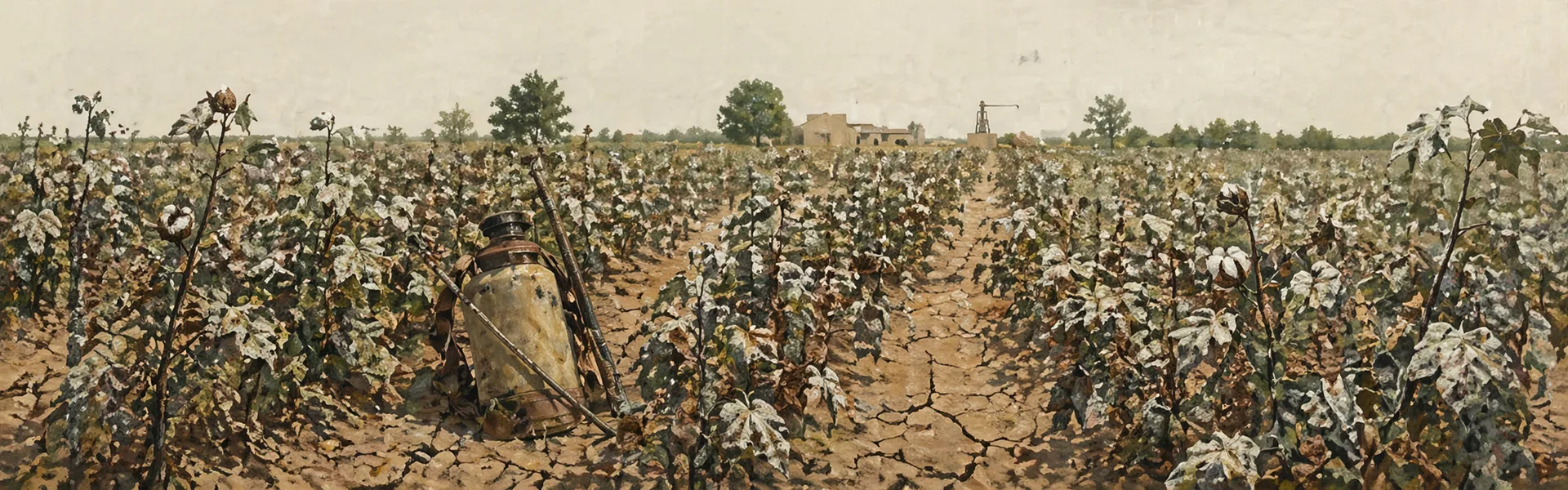
Punjab's Cotton Collapse: When Pesticides Destroyed the Pest Control
Vardhman Textiles
In 2015, cotton growers across Punjab, India lost an estimated 40% of their harvest -- output falling to a record low of 433 kg of lint per hectare -- after the collapse of natural pest control triggered the worst whitefly outbreak in the region's history, exposing downstream buyers including Vardhman Textiles, India's largest integrated textile company, to a supply shock rooted in ecological degradation.1 The whitefly (Bemisia tabaci) ravaged 136,000 of Punjab's 450,000 hectares of cotton acreage, destroying yields across one of India's most productive growing regions.1 For the textile industry, the episode demonstrated a dependency that rarely appears in corporate risk registers: the cotton supply chain's reliance on communities of predatory insects that keep crop pests below economically damaging levels. When those predator populations were wiped out -- not by climate change or habitat loss, but by the very pesticides applied to protect the crop -- the result was the agricultural equivalent of an autoimmune disorder.
Vardhman Textiles operates as India's largest integrated textile manufacturer, converting raw cotton into yarn, fabric, and garments across mills in Ludhiana, Punjab, and sourcing the fibre from the North Indian cotton belt -- a region where cotton production depends on reliable water, healthy soils, and a functioning community of predatory insects that keep crop pests in check.2 The company's vertically integrated model -- spanning spinning, weaving, dyeing, and garment manufacture -- means that disruptions to the cotton supply feed directly into production volumes and raw material costs, which typically account for more than half of operating expenses.3 In FY2016, Vardhman consumed Rs 2,053 crore (approximately $305 million) of raw cotton, making the company one of the largest single purchasers of Indian cotton.3 Its geographic footprint in Punjab, the epicentre of the 2015 outbreak, would suggest acute exposure to any regional crop failure.
Conventional cotton farming in Punjab actively undermines the biological pest control it depends on: broad-spectrum insecticides kill the predators alongside the pests, creating a feedback loop in which each spray cycle leaves the crop more vulnerable to the next outbreak.1, 4 Cotton already consumes a disproportionate share of the world's insecticides -- an estimated 24% of global insecticide use is applied to just 2.5% of arable land -- and Punjab's cotton farmers had adopted particularly aggressive spraying regimes, mixing pyrethroids with organophosphates in tank combinations designed to kill everything on contact.1, 4 The problem is that "everything" includes the ladybird beetles, lacewings, parasitoid wasps, and spiders that naturally suppress whitefly populations. Each spraying cycle reduced the predator population, requiring heavier spraying the following season, which reduced predator populations further. The result was a ratchet effect: escalating chemical inputs delivering diminishing biological protection, with the crop growing more ecologically fragile each year.
By 2015, years of indiscriminate insecticide use had eliminated populations of 16 species of natural predators -- seven insect predators, two parasitoid species, and seven spider species -- that historically suppressed whitefly below economically damaging levels.1, 4 Research published in the Journal of Pest Science documented the mechanism in detail: sub-lethal doses of broad-spectrum insecticides, applied in tank mixtures that farmers believed would provide superior control, were more toxic to the slow-reproducing predator species than to the fast-reproducing whitefly.1 The predators, which require stable habitat and multiple generations to rebuild populations, were being eliminated by chemicals that merely slowed the pest temporarily. Farmers, observing whitefly numbers rebound after each application, responded by spraying more frequently and at higher concentrations -- accelerating the destruction of the natural controls that could have suppressed the pest without chemical intervention.4
With its natural controls destroyed, the whitefly population surged above economic threshold levels for more than six continuous weeks, ravaging 136,000 hectares of Punjab's 450,000 hectares of cotton acreage and driving regional productivity to its lowest recorded level.1 The outbreak was not a gradual decline but a population explosion: whitefly numbers, unchecked by any significant predation, increased exponentially through the growing season. Punjab's cotton productivity collapsed to 433 lint kg per hectare, a figure without precedent in the state's agricultural records.1 Farmers who had invested in seed, fertiliser, and irrigation watched entire fields turn white with whitefly infestation, the plants' leaves curling and photosynthesis failing as the insects fed on sap and excreted honeydew that attracted secondary fungal infections. The scale of the damage prompted emergency interventions by the Punjab Agricultural University and state government, but by the time advisory notices reached farmers, the predator-prey imbalance was too far advanced for remediation within the growing season.
Vardhman Textiles, despite being headquartered in Punjab and sourcing heavily from the affected region, reported no financial damage from the outbreak: net profit rose 82% to Rs 653 crore (from Rs 359 crore the prior year), cotton procurement costs fell 10% to Rs 2,053 crore, and EBITDA margin expanded 436 basis points to 23.51%.3 The company's annual report credited a "superior cotton sourcing strategy" for the cost improvement, a reference to its ability to draw on unaffected growing regions in Gujarat, Maharashtra, and central India -- states where whitefly pressure was lower and yields were normal.3 The 150-page annual report contained zero mentions of "whitefly," "pest," "infestation," "crop failure," or "crop loss," despite the outbreak being the worst in Punjab's history and Vardhman being headquartered in the affected state.3 For Vardhman's management, the crisis was a sourcing logistics problem, handled by redirecting purchases -- not a material risk event.
The absence of company-level impact does not diminish the nature-risk lesson; rather, it reveals where in the value chain the risk concentrates -- at the farm gate and among smaller, regionally dependent processors who lack the sourcing reach to substitute away from a localised crop failure.3 Punjab's cotton farmers bore the full cost of the ecological collapse: lost harvests, wasted input expenditures, and in many cases crippling debt from crop loans taken against expected yields that never materialised. Smaller ginning and spinning operations tied to local supply were forced to curtail production or purchase cotton at elevated prices from distant markets, absorbing freight costs that larger buyers could negotiate away. Vardhman's insulation illustrates a principle familiar in commodity markets: scale and geographic diversification allow large buyers to arbitrage regional disruptions, but the disruption itself remains real and the costs are borne by those with less flexibility.
The 2015 Punjab outbreak recurred in modified form within a decade, confirming that the underlying ecological degradation -- the loss of natural pest control capacity -- had not been remediated by the intervening years of awareness and policy attention.1 Research documenting the second outbreak found that while government advisory programs had modestly improved spraying practices, the predator populations had not recovered to pre-crisis levels, and whitefly resistance to available insecticides had increased.1 The recurrence underscores a pattern common to ecological degradation: once a natural control system is disrupted beyond a threshold, recovery is slow even if the degrading practice is reduced, because the predator species require stable conditions across multiple reproductive cycles to rebuild population density. For cotton-dependent companies, this means the risk of future outbreaks remains elevated across the North Indian cotton belt.
Across the border in Pakistan, the cotton sector faced an analogous but distinct ecological shock when the 2022 monsoon floods -- amplified by decades of deforestation and floodplain encroachment that had stripped away natural flood buffering -- destroyed 40-45% of the national cotton crop and forced mills including Nishat Chunian to shut down 51,360 spindles.5, 6 Pakistan's forest cover had declined from an estimated 30% of land area to approximately 4%, and systematic conversion of floodplains and wetlands to agricultural and urban use had removed the natural absorption capacity that historically moderated monsoon surges along the Indus basin.6 When extreme rainfall arrived in mid-2022, water that would have been absorbed by forests and spread across wetlands instead channelled directly into cotton-growing districts. The destruction was concentrated in Punjab and Sindh provinces, which account for the bulk of Pakistan's cotton production.
Pakistan's textile exports declined 14.8% year-on-year in January 2023, with approximately 200 mills in the Multan textile hub alone closing or operating at partial capacity, demonstrating that when ecological buffers fail at landscape scale, even large manufacturers cannot source their way around the disruption.5, 6, 7 Unlike the Punjab whitefly case, where Vardhman could substitute cotton from unaffected Indian states, the Pakistan floods destroyed production across the country's entire primary growing region, leaving no domestic alternative. Nishat Chunian's spindle shutdowns were not a sourcing choice but a supply absence: the cotton simply did not exist in sufficient quantity at any domestic price. The company's exposure illustrates the difference between a localised ecological shock -- which large buyers can arbitrage -- and a landscape-scale collapse of natural infrastructure, which no amount of sourcing flexibility can offset.
The two cases illustrate a common pattern: the textile sector's cotton supply chain depends on ecological services that the sector's own upstream practices are degrading, and the financial consequences are migrating up the value chain as the degradation deepens. In India, the destruction of natural pest control by the pesticides meant to replace it turned Punjab from one of the country's most productive cotton regions into its most vulnerable. In Pakistan, the removal of forests and floodplains that buffered monsoon floods turned the Indus basin from a fertile growing region into a flood corridor. In both cases, the degradation was gradual, spanning decades, and the consequences emerged as sudden shocks -- the familiar pattern of slow erosion producing abrupt failure that characterises ecological tipping points.
For investors and lenders assessing textile-sector exposure, the lesson is that nature dependencies are not evenly distributed across a value chain: a large, diversified buyer like Vardhman can absorb a regional ecological shock today, but the shock itself signals progressive deterioration of the natural capital base on which the entire sector ultimately depends.3, 1 The question is not whether a specific company reported a loss in a specific year, but whether the ecological systems underpinning its raw material supply are on a trajectory of decline -- and whether that trajectory will eventually produce a disruption too large or too widespread to source around. Punjab's whitefly outbreak and Pakistan's flood-driven crop failure suggest that for South Asian cotton, that trajectory is well advanced.
Footnotes
-
Baksh, H. et al., "Investigating the second whitefly population outbreak within a decade in the cotton growing zone of North India," Journal of Pest Science, 2024. https://pmc.ncbi.nlm.nih.gov/articles/PMC11227808/ ↩
-
Dhawan, A.K. et al., "Natural enemies of whitefly, Bemisia tabaci (Gennadius) on cotton in Punjab, India," ResearchGate, 2019. https://www.researchgate.net/publication/331706565_Natural_enemies_of_whitefly_Bemisia_tabaci_Gennadius_on_cotton_in_Punjab_India ↩
-
Vardhman Textiles Limited, "Annual Report 2015-16," 2016. https://www.vardhman.com/Document/Report/Financials/Archives/Annual/Vardhman%20Textiles%20Ltd/Annual_Report_2015-16.pdf ↩
-
"Whitefly pest attacks cotton crop in Punjab," Business Standard, July 2016. https://www.business-standard.com/article/pti-stories/whitefly-pest-attacks-cotton-crop-in-punjab-116071100638_1.html ↩
-
"Pakistan's textile industry lays off 7 million workers, threatens to shut down," Pakistan Today / Profit, January 2023. https://profit.pakistantoday.com.pk/2023/01/10/pakistans-textile-industry-lays-off-7-million-workers-threatens-to-shut-down/ ↩
-
"Pakistan floods leave cotton industry in tatters," Context News, 2022. https://www.context.news/climate-risks/pakistan-floods-leave-cotton-industry-in-tatters ↩
-
"Pakistan's textile sector continues to suffer six months after severe floods," Kuehne+Nagel, March 2023. https://mykn.kuehne-nagel.com/news/article/pakistans-textile-sector-continues-to-suffer-16-Mar-2023 ↩