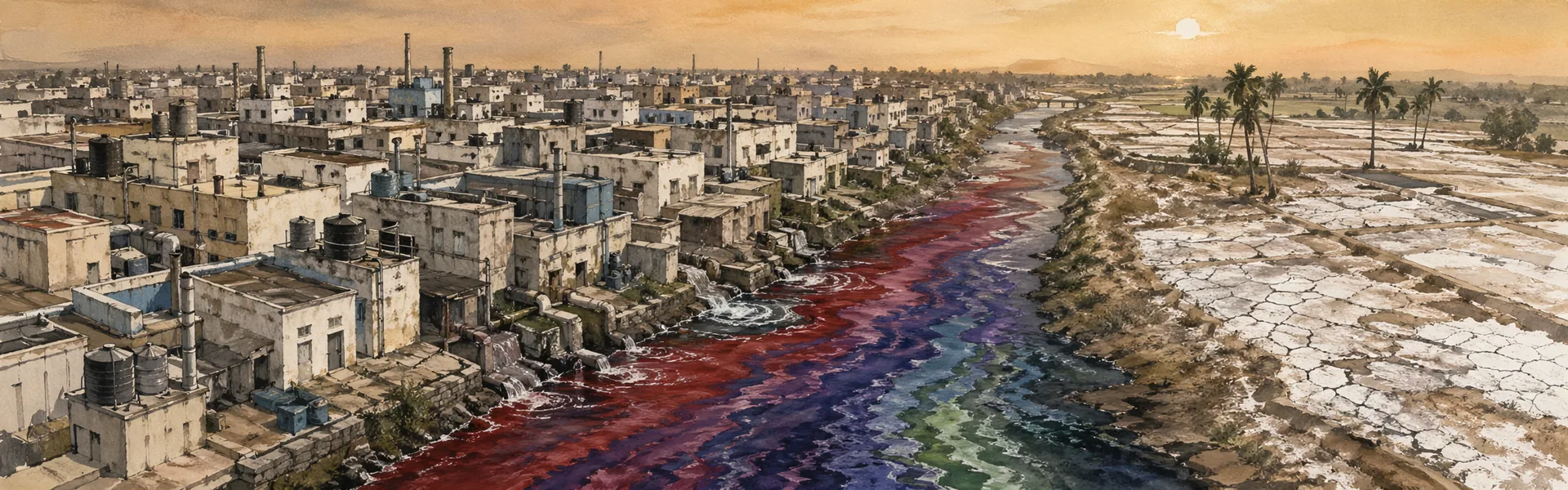
Tirupur's Textile Dyers: When an Industry Poisons Its Own Water Supply
Tirupur dyeing industry cluster
In 2011, Tirupur's dyeing industry — a cluster of more than 700 units generating $3 billion in annual textile exports — lost an estimated $10 million per day after a court-ordered shutdown forced every factory to cease operations because decades of wastewater discharge had destroyed the river the industry depended on.1, 2 The shutdown lasted more than a year for most units. To regain the right to operate, the cluster spent $200 million on water-treatment infrastructure, accepted a permanent 12-15% increase in the cost of dyed fabric, and watched gross profit margins at individual units fall from roughly 30% to 15%.3, 4, 5 The Tirupur case is a study in deferred costs: an industry that treated water as a free input for decades was eventually forced to pay for it all at once.
Tirupur's dyeing and bleaching units formed India's largest knitwear-processing cluster, consuming over 130 million litres of river and groundwater daily to transform raw fabric into finished garments for global export.6, 7 The small city in Tamil Nadu had earned the nickname "The Dollar City of South India," employing roughly 500,000 people in the hosiery sector, generating annual foreign-exchange earnings of approximately $2 billion, and accounting for more than half of India's knit-based textile exports.8, 9 Dyeing and bleaching are extraordinarily water-intensive: a single cotton t-shirt requires approximately 2,700 litres of water across the farming and processing chain.6 The cluster drew its supply from the Noyyal River and from groundwater wells that, by 2003, had to reach more than 300 metres below the surface as the water table dropped at roughly 15 metres per year.10 Water was not a peripheral input; it was the industry's central operating requirement, and there was no substitute.
For decades, the same factories discharged roughly 90 million litres of untreated chemical effluent per day back into the Noyyal River and surrounding aquifers, systematically destroying the freshwater supply on which their operations depended.11 The effluent contained high concentrations of dissolved solids — ranging from 900 to 6,600 milligrams per litre — along with chlorides and heavy metals including chromium, copper, zinc, and lead from the sodium chloride and synthetic dyes used in the bleaching process.11 Some units expanded their machinery to ten times the permitted capacity, generating wastewater volumes far beyond what existing treatment infrastructure could handle.12 Agricultural land within a two-kilometre corridor along the river became unproductive, affecting nearly 28,500 hectares across 68 villages and forcing almost 29,000 farmers to shift from diverse cultivation — rice, sugarcane, groundnut, turmeric — to whatever could survive contaminated irrigation water.10, 13 A downstream dam built in 1992 for agricultural irrigation became a storage basin for textile waste; when it was flushed in August 2005, more than 400 tonnes of dead fish surfaced and land within a 20-kilometre radius of Tirupur lay barren.5, 10, 1 The industry was consuming and contaminating the same water source simultaneously.
India's courts intervened with increasing severity over fifteen years, progressing from pollution-control orders in 1996 through a zero-discharge mandate in 2006 to a complete industry shutdown in January 2011.5, 12, 14 The Supreme Court first ordered dyeing units to close if they could not stop polluting in 1996, but enforcement was weak and the industry continued expanding.5 A 2006 Madras High Court directive required treatment plants to achieve zero liquid discharge by July 2007, imposing escalating fines on non-compliant effluent.11 The factories' own trade association acknowledged publicly that it was unable to treat all the effluent despite installing new treatment capacity.12 By 2009, the Supreme Court ordered $7.6 million in environmental remediation and declared that not a drop of industrial waste should reach the Noyyal.14, 15 Each deadline passed unmet, and each judicial intervention raised the stakes.
When the Madras High Court ordered all 700-plus units and 20 treatment plants closed on 28 January 2011, the cluster went dark within weeks, displacing an estimated 200,000 workers and sending dyeing costs up 20-30% across India.12, 16, 2 Electricity to the factories was disconnected. In a sector that directly employed some 400,000 people and supported another 200,000 indirectly, the shutdown rippled through the local economy almost immediately.16 The court rejected the factory owners' request for an extended implementation timeline on 25 March 2011, leaving no route to a gradual transition.16 Delivery times for textile orders jumped from 10-12 days to 30-40 days as manufacturers scrambled to redirect production to smaller dyeing hubs in Mumbai, Ahmedabad, Ludhiana, and Kolkata.2 The disruption was not confined to Tirupur: because the cluster processed such a large share of India's knitwear, its sudden removal overwhelmed competing facilities nationwide, driving up costs for the entire domestic garment supply chain.2
Reopening required the industry to invest more than $200 million in zero-liquid-discharge treatment infrastructure, permanently raising the cost of dyed fabric by 12-15% and halving individual unit owners' gross margins from roughly 30% to 15%.3, 4, 5 The 18 common treatment plants alone consumed 10 million units of electricity per month, adding $6 million in monthly energy costs to an industry that had previously paid nothing to treat its waste.6 Individual dyeing units faced monthly treatment bills of $12,000-15,000 on annual turnover of roughly $1.5 million — equivalent to 10-12% of revenue.5 The government eventually provided a $40 million interest-free loan, convertible to a grant, but this covered less than a fifth of the total capital expenditure, and the treatment-plant operators still faced defaulting on their bank borrowings.3 On top of the infrastructure spending, the courts ordered the industry to pay $11 million in compensation to nearly 29,000 affected farmers, plus $1.7 million for dam-cleaning operations — environmental liabilities that continued to accrue as the industry struggled to pay.13
Tirupur's exports stagnated at roughly $2.4 billion during the shutdown years, while a quarter of its fabric processing migrated permanently to factories in neighbouring Karnataka that operated without pollution-control mandates and at 20% lower cost.4, 17 The competitive displacement was structural, not temporary: factories in villages near Mysuru could undercut Tirupur on price precisely because they were not bearing the cost of treating their own effluent — replicating the externality model that Tirupur itself had followed for decades.17 Some exporters also shifted operations to Ludhiana and Surat, where dyeing represented a smaller share of total production costs.16 Because dyeing accounts for roughly a quarter of the total cost of finished fabric, a 20% gap in treatment-related overheads translated directly into lost orders.16 The stagnation erased years of export growth, with revenues frozen at levels the cluster had first reached before the shutdown.4
At one treatment-plant consortium — the Rayapuram facility — 17 of 31 member companies closed permanently, and the financial damage was compounded by $60-80 million in foreign-exchange derivatives losses that had already weakened the cluster before the shutdown.5, 8 One-fifth of Tirupur's exporters had exited by 2010 under the combined pressure of rising compliance costs and a doubling of cotton prices.8 The closures fell disproportionately on smaller units, which lacked the capital to install their own individual treatment systems and depended on shared facilities whose costs were rising.5 The Tamil Nadu Pollution Control Board subsequently closed an additional 54 units for non-compliance even after reopening was permitted, further narrowing the cluster.18 Tirupur's industrial base emerged materially smaller than it had been before the crisis.
Phased reopening began in mid-2012 at 15-30% capacity, and although exports eventually doubled to $4.8 billion by 2015-16, the recovery came with a permanently higher cost base that shrank Tirupur's share of India's textile processing.1, 4, 16 R. Gopalakrishnan's company, which had its own individual treatment plant, was the first to restart — just 10 days after the shutdown order — but it was an outlier with $88.4 million in revenue and the capital to invest independently.1 Most units waited more than a year. By 2013, over 400 units had obtained regulatory permission to resume, but actual operating capacity remained well below pre-shutdown levels.6 The treatment systems now recycle 92% of process water, saving the cluster 100 million litres per day — a genuine environmental achievement.1, 6 The cluster's treatment systems won international water-reuse awards in 2014 and 2015, validating the technology.4 But the recognition could not undo years of lost revenue or restore the businesses that had closed permanently.
Tirupur demonstrates that when a water-intensive industry treats freshwater as a free input and externalises pollution costs, the eventual regulatory correction imposes infrastructure spending, margin compression, and competitive displacement that far exceed the savings from decades of non-compliance. The industry spent $200 million to regain the right to use water it had once consumed for free — and even then, a quarter of its production had permanently relocated to jurisdictions willing to tolerate the same pollution that Tirupur had been forced to clean up.17 For investors and lenders assessing nature-related financial risk, the lesson is direct: an enterprise that degrades the natural resource it depends on is not avoiding costs but accumulating them, and the bill arrives with interest.
Footnotes
-
Al Jazeera, "Green innovation saves the textile industry in India," 2016. https://www.aljazeera.com/features/2016/4/11/green-innovation-saves-the-textile-industry-in-india ↩
-
DNA India, "Dyeing costs shoot up 30% as 700 Tirupur units shut shop," 2011. https://www.dnaindia.com/business/report-dyeing-costs-shoot-up-30-as-700-tirupur-units-shut-shop-1528343 ↩
-
The News Minute, "On the verge of closure, Tirupur dyeing industry gets Rs 200 cr reprieve from govt," 2017. https://www.thenewsminute.com/tamil-nadu/verge-closure-tirupur-dyeing-industry-gets-rs-200-cr-reprieve-govt-55287 ↩
-
Indian Textile Journal, "Tirupur was the first industrial cluster to implement ZLD in India." https://indiantextilejournal.com/tirupur-was-the-first-industrial-cluster-to-implement-zld-in-india/ ↩
-
Scroll.in, "Can the courts save India's rivers from pollution? Tirupur shows the answer is no," 2016. http://scroll.in/article/812470/can-the-courts-save-indias-rivers-from-pollution-tirupur-shows-the-answer-is-no ↩
-
The Alternatives, "Can Tiruppur's Comeback Save Indian Textiles?" 2016. https://thealternatives.in/tiruppur-comeback-indian-textiles/ ↩
-
Central Pollution Control Board, Assessment of ZLD in Tirupur. https://cpcb.nic.in/openpdffile.php?id=UmVwb3J0RmlsZXMvNDEwXzE0OTU3MTQzMzZfbWVkaWFwaG90bzQ1MjIucGRm ↩
-
Business Today, "Problems in Tirupur: The Knitwear Capital of India," 2011. https://www.businesstoday.in/magazine/features/story/problems-in-tirupur-the-knitwear-capital-of-india-19585-2011-02-21 ↩
-
Supreme Court judgment (detailed), Tirupur Dyeing Factory Owners Association v. Noyyal River Ayacutdars Protection Association, 2009. https://lextechsuite.com/Tirupur-Dyeing-Factory-Owners-Association-Versus-Noyyal-River-Ayacutdars-Protection-Association-and-Others-2009-10-06 ↩
-
The Wire, "Tiruppur: Dyeing, Bleaching, and a Dark Spot on Groundwater," 2020. https://science.thewire.in/economy/agriculture/australian-open-tiruppur-dyeing-bleaching-groundwater-contamination-agriculture-noyyal-river/ ↩
-
Supreme Court judgment, Tirupur Dyeing Factory Owners Association, 2009. https://indiankanoon.org/doc/197754/ ↩
-
Down to Earth, "Tirupur dyeing units told to close," 2011. https://www.downtoearth.org.in/environment/tirupur-dyeing-units-told-to-close-33025 ↩
-
Supreme Court judgment (detailed), 2009. https://lextechsuite.com/Tirupur-Dyeing-Factory-Owners-Association-Versus-Noyyal-River-Ayacutdars-Protection-Association-and-Others-2009-10-06 ↩
-
UNEP Case Law, Tirupur Dyeing Factory Owners Association v. Noyyal River. https://leap.unep.org/en/countries/in/national-case-law/tirupur-dyeing-factory-owners-association-versus-noyyal-river ↩
-
The News Minute, 2017. https://www.thenewsminute.com/tamil-nadu/verge-closure-tirupur-dyeing-industry-gets-rs-200-cr-reprieve-govt-55287 ↩
-
Down to Earth, "Towards zero discharge," 2011. https://www.downtoearth.org.in/environment/towards-zero-discharge-33489 ↩
-
Yarns and Fibers, "Tirupur garment makers increasingly shifting to Mysuru for fabric dyeing." https://www.yarnsandfibers.com/news/textile-news/tirupur-garment-makers-increasing-shifting-to-mysuru-for-fabric-dyeing/ ↩
-
India Environment Portal / TNPCB, "TNPCB closes down 54 dyeing units in Tirupur." http://admin.indiaenvironmentportal.org.in/news/tnpcb-closes-down-54-dyeing-units-tirupur ↩