Renault-Nissan: When Wetlands Disappeared, the Factory Floor Flooded
Renault-Nissan Alliance
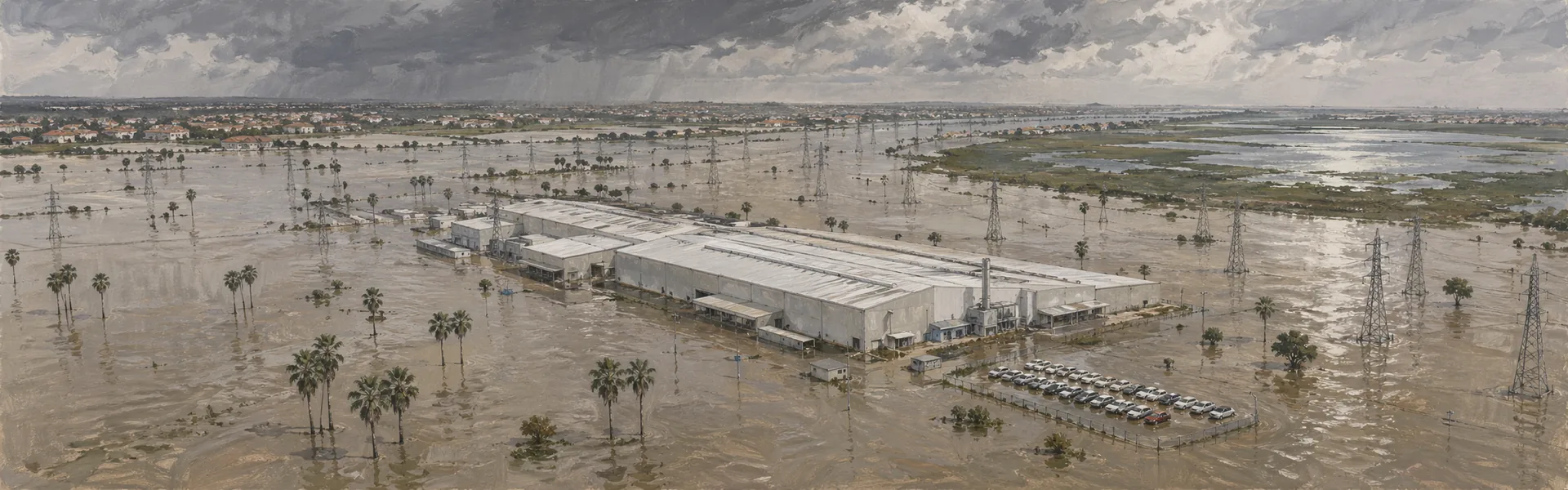
In 2015, the Renault-Nissan Alliance lost production of 10,000 cars at its Chennai manufacturing plant after decades of wetland destruction eliminated the natural flood absorption that had protected southern India's largest automotive corridor.1 The Oragadam plant shut down in early December as floodwaters inundated the industrial zone, with 1,800 cars immediately affected and several hundred more stranded in transit on flooded roads.2 The disruption was not confined to one manufacturer: Hyundai, Ford, BMW, and Daimler all halted Chennai operations, and the cumulative production loss across the auto sector reached Rs 150-180 crore in the first wave alone.1, 2 What drove the flooding was not rainfall of historically unprecedented intensity, but the progressive destruction of the marshlands and wetlands that had for centuries absorbed Chennai's monsoon downpours before they could reach the city's industrial and residential zones.
Renault-Nissan's Oragadam plant -- a 480,000-unit-capacity facility employing nearly 6,000 workers and representing a net book value of 86.6 billion yen -- sits in a low-lying industrial corridor whose viability depends on the surrounding wetland system absorbing and channelling monsoon rainfall before it reaches factory floors.3, 4 The plant, opened in 2010, combines Renault and Nissan production lines under the Alliance Production Way and represents a cornerstone of both companies' India strategy.3 Nissan's India production reached 227,178 units in the fiscal year ending March 2016, an 8% increase on the prior year -- figures that masked the December shutdown because the losses were small enough relative to annual output to be absorbed without triggering a formal disclosure.4 Chennai's appeal as a manufacturing location rested in part on its labour pool, port access, and the presence of more than twenty Fortune 500 companies in the Oragadam corridor. But the corridor's physical viability depended on something less visible in site-selection models: a network of marshlands, lakes, and drainage channels that had historically prevented monsoon rainfall from pooling in the flat terrain where factories now stood.
The same urbanisation that made Chennai an attractive manufacturing hub systematically destroyed the wetland infrastructure that made the location safe. The city's wetland coverage fell from roughly 80% in the 1980s to just 15% by 2015.5 The Pallikaranai marshland -- Chennai's largest surviving wetland and the ecosystem most directly responsible for absorbing monsoon water south of the city -- shrank from 2,450 hectares in 1991 to approximately 600 hectares by 2015, a 75% loss.6 In 2008, the Madras High Court had explicitly recognised the marshland as a "natural flood-control option," ruling that preserving it would be more economically sensible than investing in post-damage mitigation.6 The warning was ignored. The Old Mahabalipuram Road IT Corridor was built across the marsh, the city's metro rail cut through it, two garbage dump yards were sited within it, and untreated sewage was discharged into what remained.6, 7 Across the wider Chennai metropolitan area, over 5,500 hectares of wetlands were converted to commercial land, with only 10% of original wetlands remaining by 2015.8 Between 1989 and 2016, 195 housing colonies were approved on 175 hectares of waterbodies.8 Satellite analysis showed that vegetation cover across the Chennai metropolitan area declined from 70% to 36% between 1991 and 2013, while built-up area rose from 30% to 64%.8
In November 2015, Chennai received approximately 1,200 mm of rainfall -- 300% above the monthly norm of 407 mm -- and on 1 December alone, 290 mm fell in a single day.8 These were heavy rains, but meteorological records stretching back to 1813 show no long-term increase in annual rainfall over the period.5 The flooding was catastrophic not because the weather was unprecedented, but because the landscape had lost its capacity to absorb water. A Care Earth Trust study documented the direct correspondence between the increase in built-up area and the decrease in wetlands and waterbodies across the decades.5 The neighbourhoods worst hit -- Velachery, Pallikaranai, Thoraipakkam -- "were wetlands converted into real estates and sold to IT companies," as experts told The News Minute.7 The water that would once have pooled harmlessly in marshland now had nowhere to go but through roads, homes, and factory floors.
Renault-Nissan's Oragadam plant shut down from at least 1 December through 5 December, with 1,800 cars immediately affected on the production line and several hundred more stranded in transit on impassable roads.1, 2 Bloomberg reported total lost output of 10,000 vehicles.1 The disruption cascaded across the corridor: every major automaker in the Chennai belt suspended operations. The auto industry's cumulative production loss in the November wave alone was estimated at Rs 150-180 crore.2 Supply chains fractured as component suppliers, many of them small and medium enterprises clustered around the Oragadam zone, suffered their own flooding. The physical damage to vehicles, machinery, and inventory compounded the production losses. For Renault-Nissan, the shutdown represented a modest fraction of annual India output -- enough to recover from operationally, but significant enough to expose the assumption embedded in the plant's location: that the natural drainage infrastructure which had made the site viable would continue to function.
The Chennai floods ranked as the world's eighth most expensive natural disaster of 2015.9 Total economic losses were estimated at $3 billion by reinsurance broker Aon Benfield and $3.5 billion by Munich Re, making the event second only to the Nepal earthquake in global cost that year.10, 5 Insurance claims alone reached an estimated Rs 4,800 crore.11 Over 20,000 small and medium industrial units reported aggregate losses exceeding Rs 140 billion.9 The scale of insured losses -- variously estimated at $300 million by India's General Insurance Corporation and $755 million by academic researchers -- prompted a structural repricing of flood risk across the Indian insurance market.10, 12 General insurance policy issuance in India rose 74% from 118 million in 2014-15 to 206 million by 2021-22, a trajectory partly shaped by the Chennai experience.11
Neither Renault nor Nissan disclosed the Chennai flood as a material operational risk in their annual financial statements. Renault's 2015 annual report mentioned the event only in its corporate social responsibility section, noting that staff distributed "survival kits and food rations to the victims of the floods."3 Nissan's sustainability report similarly described "flood relief activities" -- donating blankets and encouraging employee donations -- without referencing production losses.13 Nissan's securities report for the fiscal year acknowledged flood risk in generic terms, stating that the company "addresses preventive measures and the improvement of emergency response systems to prepare for risks other than earthquakes, including fires, typhoons, floods and epidemics."4 The production impact was invisible in annual figures. This disclosure pattern -- treating a nature-dependency event as a humanitarian story rather than an operational risk -- left investors without the information needed to assess whether the same vulnerability could produce larger losses in a future monsoon season.
Nissan responded by expanding its business continuity planning to include flood risk for the first time in fiscal 2016, adding floods, labour strikes, and terrorism to supplier resilience surveys that had previously covered only earthquakes and tsunamis.14 The company expanded the scope of these surveys globally and strengthened its insurance programme to cover not only property damage but also business interruption and contingent business interruption "due to accidents, taking into consideration the global expansion of the supply chain."14 At the Chennai plant itself, Nissan built a rainwater harvesting reservoir and installed wastewater recycling equipment -- measures that addressed water management on-site but did not restore the off-site wetland systems whose degradation had caused the flooding.13 Nissan's own sustainability report acknowledged the broader dependency, stating that "humankind depends on a number of ecosystem services, including provision of food and fresh water, climate regulation and protection from natural disasters" and that "the automotive industry must recognize both its impact on ecosystems and its dependence on these services."13 The language was aspirational. No concrete action linked the company's Chennai experience to an investment in restoring the wetland buffer that its operations depend on.
The Chennai case illustrates a pattern increasingly visible in manufacturing site selection: companies locate facilities to capture the economic advantages of rapidly urbanising regions, but that same urbanisation degrades the natural systems -- wetlands, floodplains, drainage channels -- whose functioning made the location viable in the first place. Renault-Nissan did not destroy the Pallikaranai marshland; that destruction was driven by real estate developers, IT corridor construction, and municipal waste dumping. But the company's manufacturing investment was premised on a landscape whose capacity to manage monsoon water was being steadily dismantled. The Madras High Court had identified the risk seven years before the flood. Meteorological data confirmed that the rainfall itself was not anomalous. The loss was not caused by an act of nature but by the removal of the natural infrastructure that had historically made such rainfall manageable. For investors and risk managers evaluating manufacturing assets in flood-prone regions, the question is whether the wetlands, forests, and drainage systems that buffer those assets are being maintained -- or whether the same development that creates the economic opportunity is quietly eliminating the ecological conditions on which it depends.
Footnotes
-
Bloomberg, "Chennai Floods to Disrupt India Car Production, Auto Group Says," December 2015. https://www.bloomberg.com/news/articles/2015-12-11/chennai-floods-to-disrupt-india-car-production-auto-group-says ↩
-
ET Auto, "Chennai rains: Automakers forced to shut down production, face Rs 180 crore loss," November 2015. https://auto.economictimes.indiatimes.com/news/industry/chennai-rains-automakers-forced-to-shut-down-production-face-rs-180-crore-loss/49820147 ↩
-
Renault Group, Annual Report 2015. https://www.annualreports.com/HostedData/AnnualReportArchive/g/groupe-renault_2015.pdf ↩
-
Nissan Motor Co., Securities Report FY2015. https://www.nissan-global.com/EN/IR/FINANCIAL_RESULTS/ASSETS/FR/2015/PDF/fr2015.pdf ↩
-
Environment & Society Portal, "Of Rains and Floods: A Case of Chennai, 2015." https://www.environmentandsociety.org/arcadia/rains-floods-case-chennai-2015 ↩
-
Mongabay India, "Chennai's fight to preserve its wetlands and stay above water," December 2021. https://india.mongabay.com/2021/12/chennais-fight-to-preserve-its-wetlands-and-stay-above-water/ ↩
-
The News Minute, "Swallowing Pallikaranai marsh: Chennaiites are refusing to learn from 2015 floods," 2016. https://www.thenewsminute.com/tamil-nadu/swallowing-pallikaranai-marsh-chennaiites-are-refusing-learn-2015-floods-46251 ↩
-
Suriya & Mudgal, "Urban Flood Susceptibility Analysis of Chennai City," Scientific Research Publishing, 2017. https://www.scirp.org/journal/paperinformation?paperid=75958 ↩
-
Business Standard, "Chennai floods are world's 8th most expensive natural disaster in 2015," December 2015. https://www.business-standard.com/article/current-affairs/chennai-floods-are-world-s-8th-most-expensive-natural-disaster-in-2015-115121100487_1.html ↩
-
FloodList, "Cost of Tamil Nadu Floods: 347 Lives, $3 Billion," 2016. https://floodlist.com/asia/cost-tamil-nadu-floods-347-lives-3-billion-dollars ↩
-
Insurance Manager, "Insurance Claims Drop 30-35% During Chennai Floods Compared to 2015." https://www.insurancemanager.org/insurance-claims-drop-30-35-during-chennai-floods-compared-to-2015/ ↩
-
ResearchGate, "A Case Study on Impact of Chennai Floods: Supply Chain Perspective," 2016. https://www.researchgate.net/publication/309194370_A_Case_Study_on_Impact_of_Chennai_Floods_Supply_Chain_Perspective ↩
-
Nissan Motor Co., Sustainability Report 2016. https://www.nissan-global.com/EN/DOCUMENT/PDF/SR/2016/SR16_E_All.pdf ↩
-
Nissan Motor Co., Risk Management Report 2017. https://www.nissan-global.com/EN/DOCUMENT/PDF/SR/2017/SR17_E_RiskMgnt.pdf ↩