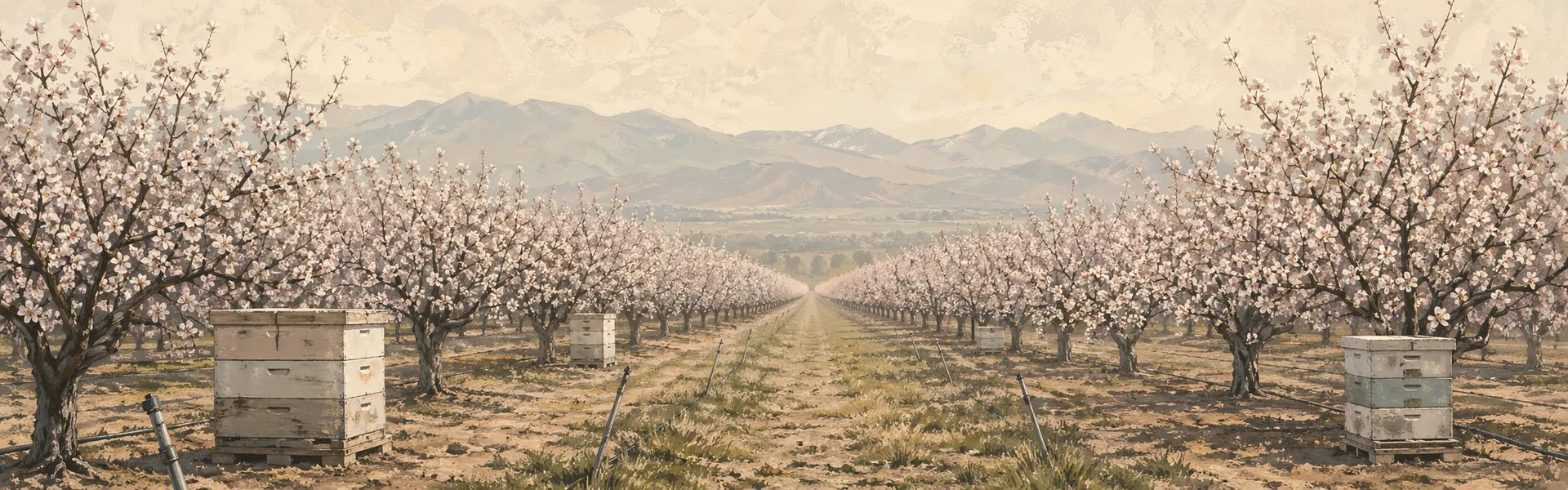
The Wonderful Company: When the Bees Stop Coming
The Wonderful Company
In 2015, The Wonderful Company — operator of the world's largest almond orchards — acquired a beekeeping firm for an undisclosed sum after chronic honeybee colony losses quadrupled hive rental costs from $50 to over $200 per colony, adding an estimated $14 million in annual pollination expenses to its 46,000-acre almond operation.1, 2, 3 The privately held company, controlled by Stewart and Lynda Resnick, manages more than 125,000 acres and produces 450 million pounds of nuts annually, generating approximately $4 billion in total revenue.1, 4 Pollination — a cost that barely registered on almond growers' budgets two decades ago — had become a strategic threat serious enough to drive a major agricultural company into vertical integration with a beekeeping operation. The acquisition was an explicit acknowledgment that a biological input, not a commodity market or a regulatory change, had become the binding constraint on the company's core business.
The Wonderful Company's almond division depends entirely on managed honeybee pollination — a biological input with no substitute at commercial scale — requiring approximately 92,000 rented hives to arrive within a single three-week window each February.2 Most commercial almond varieties are self-incompatible: trees cannot pollinate themselves and require insects to transfer pollen between compatible varieties planted in alternating rows.5 The USDA assigns almonds a bee dependency ratio of 1.0, meaning that "in the complete absence of managed honey bees, yields for currently planted varieties would fall by 100 percent."6 The standard stocking rate is two colonies per acre, and the bloom window is non-negotiable — if hives are not in place when the flowers open in mid-February, the crop is lost for the entire year.5, 6 No other major commodity crop has this degree of absolute dependence on a single biological service delivered within such a narrow timeframe.
California's almond acreage nearly tripled between 1997 and 2024, from fewer than 500,000 acres to 1.4 million, concentrating demand for virtually every managed honeybee colony in the United States into a narrow annual bottleneck that made the industry uniquely exposed to pollinator supply disruption.7, 8 By 2024, almond pollination required approximately 2.7 million colonies — 99% of the 2.73 million colonies available nationwide as of January that year.8 Around 85% of all commercial colonies in the country visit California almonds each season, trucked from as far as Florida, the Dakotas, and Maine.7 Almonds accounted for 82% of all US pollination service expenditures and 61% of all colony rentals in 2016.6 The California almond industry, valued at $4.8 billion, produces 80% of the world's supply, but this dominance rests on the annual mobilisation of nearly the entire national stock of a living organism.9, 10
The supply side of that equation has been deteriorating for decades: US managed honeybee colonies fell from six million in 1947 to 2.5 million, while annual colony loss rates doubled from a historical 15% baseline to a 14-year average of 41.4%, driven primarily by parasitic Varroa destructor mites, pesticide exposure, and habitat loss.10, 11 Colony Collapse Disorder, first identified in 2006, marked the beginning of chronic elevated losses, with winter mortality averaging roughly 29% — nearly double the pre-2006 rate of 10-15%.10, 12 Beekeepers have partially offset the decline by splitting surviving colonies and purchasing replacement queens, but this intensive rebuilding raises their own costs and produces weaker hives.12
For almond growers, the collision of rising acreage and shrinking bee supply translated directly into cost escalation: hive rental fees more than quadrupled from roughly $50 per colony in 2003 to $209 in 2025, lifting pollination from a minor line item to roughly 20% of operating costs.3, 5, 13 Until 2004, almond pollination fees were only slightly higher than fees for other crops; between 2004 and 2006, they more than doubled in real terms.14, 15 By 2016, almond growers paid $165 per colony, roughly triple the $55 average for other pollinated crops.6 The total annual industry pollination bill reached an estimated $400 million, up from approximately $290 million in 2015.7, 16 Pollination's share of beekeeper revenue shifted correspondingly — from 11% of beekeeper income in 1988 to 41% by 2016, with almonds alone providing roughly one-third of total US beekeeper revenue.6 The almond sector had effectively repriced an entire agricultural service industry.
The Wonderful Company, with 46,000 almond acres requiring two colonies per acre, faced an estimated annual pollination bill of $18-19 million at current rates — roughly four times the $4.6 million it would have paid at 2003 prices — and its president publicly expressed concern about the long-term supply of bees.2, 3, 8 Joe MacIlvaine, then president of Paramount Farming, stated plainly: "We're concerned about the supply of bees for the long term."2 The concern was not merely about price. Beekeepers often did not know the extent of their winter losses until January — weeks before the February bloom — creating last-minute supply uncertainty that no amount of advance contracting could fully eliminate.16 For a company with $4 billion in revenue and tens of thousands of acres of permanent tree crops that take five years to reach full production, a single season of inadequate pollination represented a material risk to capital already deployed in the ground.4
In February 2015, Paramount Farming (the Wonderful Company's agricultural subsidiary) acquired Headwaters Farm, a Florida-based beekeeping operation with 20,000 hives and more than 40 employees, renaming it Wonderful Bees — a vertical-integration move that covered less than a quarter of the company's 92,000-hive requirement but signalled the severity of the supply risk.1, 2 The company also invested in research on blue orchard bees as supplementary pollinators, hedging against further honeybee decline.2 Paramount's press release framed the acquisition in unusually candid terms for a corporate announcement: "The survival and availability of bees doesn't just impact our almond crop; it impacts the domestic food supply as a whole."1 The company committed to investigating "bee nutrition, bee health, bee parasites, the genetic contribution to the breeding stock" — language more typical of a research institution than a farming company, reflecting the depth of the biological challenge.2
Paramount was not alone in this strategic shift: other almond growers also began acquiring beekeeping operations, and industry analysts at Global AgInvesting warned that food companies with large capital investments in nut orchards would increasingly need to control their own pollinator supply chains.17 One almond grower explained the logic: "We wanted to secure our own supply and secure the quality of the hives."16 The quality concern was substantive — weaker colonies, rebuilt hastily after winter losses, deliver fewer foraging bees per hive, reducing pollination effectiveness even when the contracted number of colonies arrives.16 Global AgInvesting's assessment was blunt: "Food companies, especially those with high amounts of capital invested in production assets such as nut producers, could increasingly maneuver to acquire their own bee companies in order to protect their investments."17 The pollination market was transitioning from a straightforward service contract into a supply-chain risk that justified backward integration.
The almond industry's own expansion has compounded the pollinator stress it depends on mitigating: concentrating 85% of all US commercial bee colonies into California's Central Valley each February subjects hives to nutritional stress, disease transmission, and pesticide exposure that accelerate the very colony losses driving up rental costs.7, 12 The mass convergence of colonies from across the country facilitates the spread of Varroa mites and the viruses they carry, as hives from different operations sit side by side in orchards.12 Almond orchards in bloom offer a three-week monoculture diet — nutritionally limited compared to the diverse forage bees require — before the colonies are trucked onward or returned to home apiaries.7 The feedback loop is clear: more almond acres demand more bees, the concentration of bees accelerates losses, and higher losses push up the rental costs that drive further acreage expansion to cover fixed costs.
The 2024-2025 season delivered the worst colony losses on record — 55.6% of all managed colonies and 56.2% among commercial beekeepers — with an estimated 1.6 million hives lost, prompting one industry researcher to call the losses "unprecedented, definitely higher than we've ever seen before, even with colony collapse disorder."11, 18 Winter losses alone reached 40.2%, the highest since monitoring began in 2007-2008, exceeding the 17-year average of 29.3% by more than ten percentage points.11 The economic toll was estimated at $600 million, partly attributable to lost almond pollination capacity.18 Colony demand for the 2025 almond bloom was projected at 2.8 million — a 3.5% increase from 2024 — even as the supply base contracted sharply.8 For growers like The Wonderful Company, the arithmetic was stark: record colony losses colliding with rising acreage meant that pollination fees, already at $209 per colony, faced further upward pressure in a market where the physical supply of the required input was shrinking.
Self-fertile almond varieties offer a partial hedge, but even the leading variety, Independence, produces 60% higher fruit set and 20% higher kernel yield with bee access, meaning commercial viability still depends on pollination services; as of 2024, self-fertile varieties accounted for only 7.1% of California's almond orchards.19, 8 New orchard plantings take five to seven years to reach full production, and growers who have already invested in conventional varieties face decades of continued pollination dependency from trees already in the ground. The technological hedge is real but distant, and does not address the cost and supply pressures facing current production.
The Wonderful Company's pollination predicament illustrates a financial risk that extends well beyond a single firm: when an entire industry's production depends on a biological service that the same industry's growth and practices are degrading, the resulting cost escalation and supply fragility become structural rather than cyclical.6, 17, 11 Honeybees contribute more than $15 billion annually to US agricultural production, and pollinator decline is not confined to almonds — but the almond sector's extreme concentration of demand makes it the canary in the coalmine for pollination-dependent agriculture.10, 18 For investors and lenders assessing nature-related financial risk in agricultural portfolios, The Wonderful Company's decision to buy a beekeeping operation is the clearest possible signal: when a $4-billion company concludes that it must vertically integrate into the production of a biological input it previously rented on the open market, the market for that input has entered a structural deficit. The question is no longer whether pollinator decline affects agricultural balance sheets, but how fast the costs will compound.
Footnotes
-
The Wonderful Company, "Paramount Farming enters beekeeping industry," press release, 2015. https://www.wonderful.com/press/paramount-farming-enters-beekeeping-industry--1727/ ↩
-
KVPR, "Major Valley almond grower gets into bee and honey business," 2015. https://www.kvpr.org/post/major-valley-almond-grower-gets-bee-and-honey-business ↩
-
Obama White House, "Fact Sheet: The Economic Challenge Posed by Declining Pollinator Populations," 2014. https://obamawhitehouse.archives.gov/the-press-office/2014/06/20/fact-sheet-economic-challenge-posed-declining-pollinator-populations ↩
-
Wikipedia, "The Wonderful Company." https://en.wikipedia.org/wiki/The_Wonderful_Company ↩
-
SARE, "Pollination Costs and Benefits: Almonds." https://www.sare.org/publications/managing-alternative-pollinators/chapter-one-the-business-of-pollination/pollination-costs-and-benefits-almonds/ ↩
-
USDA Economic Research Service, "Driven by Almonds, Pollination Services Now Exceed Honey as a Source of Beekeeper Revenue," Amber Waves, July 2018. https://www.ers.usda.gov/amber-waves/2018/july/driven-by-almonds-pollination-services-now-exceed-honey-as-a-source-of-beekeeper-revenue ↩
-
Stanford, "Bees for Hire: California Almonds Become Migratory Colonies' Biggest Task," 2018. https://andthewest.stanford.edu/2018/bees-for-hire-california-almonds-become-migratory-colonies-biggest-task/ ↩
-
farmdoc daily, University of Illinois, "Where Have All the Honey Bees Gone? To California Almond Orchards," February 2025. https://farmdocdaily.illinois.edu/2025/02/where-have-all-the-honey-bees-gone-to-california-almond-orchards.html ↩
-
IFIS, "California's Almond Trade: Exploiting the Bee Population." https://www.ifis.org/blog/californias-almond-trade-exploiting-bee-population ↩
-
Obama White House, "Fact Sheet: The Economic Challenge Posed by Declining Pollinator Populations," 2014. https://obamawhitehouse.archives.gov/the-press-office/2014/06/20/fact-sheet-economic-challenge-posed-declining-pollinator-populations ↩
-
Apiary Inspectors of America / Bee Informed Partnership, "US Beekeeping Survey 2024-2025." https://apiaryinspectors.org/US-beekeeping-survey-24-25 ↩
-
Conversable Economist, "A Bee Industry Update: Colony Collapse Disorder and Almond Pollination," August 2018. https://conversableeconomist.com/2018/08/23/a-bee-industry-update-colony-collapse-disorder-and-almond-pollination/ ↩
-
West Coast Nut, "Almond Pollination Season Outlook," January 2024. https://wcngg.com/2024/01/10/almond-pollination-season-outlook-how-to-cut-pollination-expenses-other-considerations/ ↩
-
USDA ERS, "Chart of Note: Almond Pollination Fees." https://ers.usda.gov/data-products/charts-of-note/chart-detail?chartId=89588 ↩
-
ScienceDaily, "Bee population decline threatens US almond industry," October 2019. https://www.sciencedaily.com/releases/2019/10/191005134022.htm ↩
-
Modern Farmer, "Almond Farmers Are Turning Into Beekeepers," April 2015. https://modernfarmer.com/2015/04/almond-farmers-turning-into-beekeepers/ ↩
-
Global AgInvesting, "Paramount Farming Buys Leading U.S. Beekeeping Company," 2015. https://www.globalaginvesting.com/paramount-farming-buys-leading-u-s-beekeeping-company/ ↩
-
InvestigateTV, "Honeybee colonies face unprecedented losses; 2025 becomes worst year on record," October 2025. https://www.investigatetv.com/2025/10/22/honeybee-colonies-face-unprecedented-losses-2025-becomes-worst-year-record/ ↩
-
Nature Scientific Reports, "Self-fertile almond variety pollination study," 2020. https://www.nature.com/articles/s41598-020-59995-0 ↩