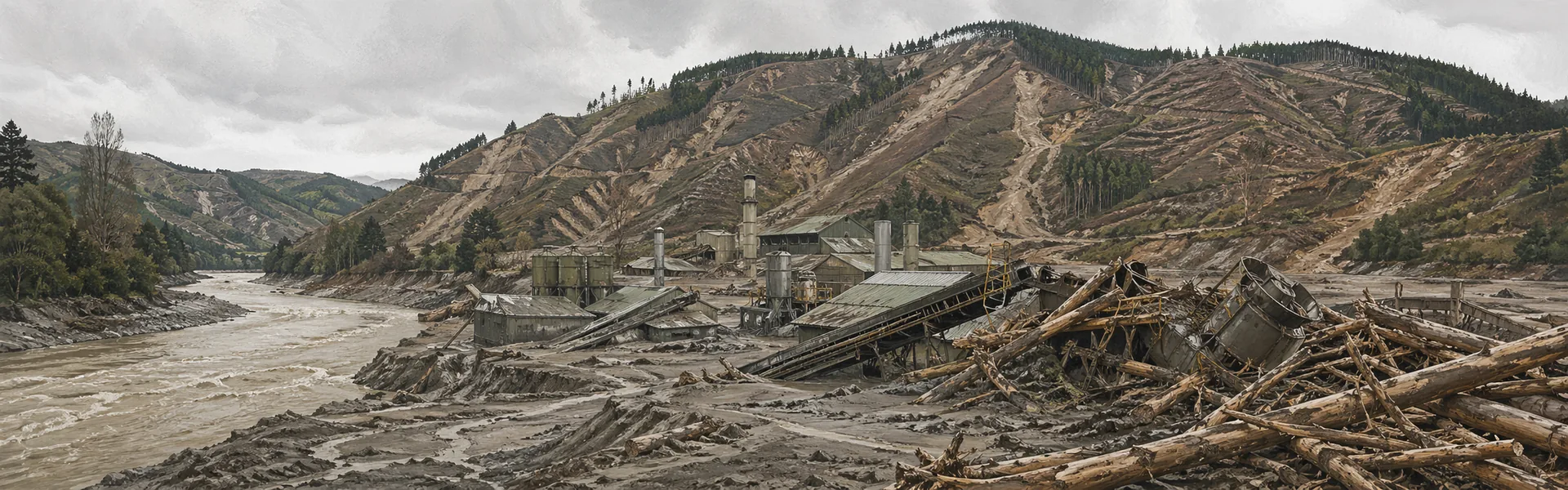
Pan Pac Forest Products: When the Watershed Breaks
Pan Pac Forest Products
In 2023, Pan Pac Forest Products faced total costs of NZ$280 million — with net losses exceeding NZ$200 million after insurance — when Cyclone Gabrielle inundated its Whirinaki pulp and timber complex, shutting down operations for up to 21 months.1, 2 The cyclone, New Zealand's costliest non-earthquake natural disaster, sent the Esk River surging over the mill's flood defences on 14 February 2023.3 Over 750,000 cubic metres of silt buried the facility, destroying electrical systems, displacing heavy equipment, and rendering the site unsafe to enter for weeks.2, 4 The damage exceeded the value of an entire year's revenue and consumed roughly a third of the company's total asset base.2
Pan Pac's entire industrial operation was purpose-built on the banks of the Esk River in Hawke's Bay, making the company fundamentally dependent on the surrounding watershed's ability to absorb extreme rainfall and prevent the river from overwhelming its site. Established at Whirinaki in 1971, the mill was sited specifically because the Esk River provided a large water source for pulp production.5 The facility produces 220,000 tonnes of bleached chemi-thermomechanical pulp annually with a daily capacity of 850 tonnes, alongside 530,000 cubic metres of lumber from two sawmills.6 Pan Pac employs 440 staff directly at Whirinaki plus over 400 forestry contractors, and its direct, indirect, and induced contribution to regional GDP is NZ$541 million — equivalent to 6.3 per cent of all GDP in Hawke's Bay.5, 2 Stop banks around the site were engineered for a one-in-500-year flood event, but the company's flood protection assumed that the upstream catchment would continue to attenuate peak river flows as it had historically.7
Pan Pac's own forestry practices — clear-felling radiata pine on steep hillsides across 33,000 hectares of plantation on a 30-year rotation — degraded the very watershed capacity on which the mill's survival depended.5, 8 The company is the largest forestry grower in Hawke's Bay, with cutting rights to plantation forests at five locations including the Esk forest, harvesting approximately 1,000 hectares per year in plantations that are "almost exclusively radiata pine."8 Clear-fell harvesting on steep, erosion-prone land creates what researchers call a six-to-eight-year "window of vulnerability" during which replanted seedlings provide negligible soil protection.9 Each harvest cycle strips the hillsides of the root networks and canopy cover that slow rainfall runoff and hold soil in place. Over decades, this rotational logging progressively weakened the catchment's natural capacity to buffer the mill against extreme weather.
When Cyclone Gabrielle struck on 14 February 2023, the Esk River's peak flow more than doubled any recent recorded event, overtopping the mill's stop banks and submerging the entire site under two metres of water and silt.10, 4 The Esk River reached a peak flow exceeding 2,175 cubic metres per second at Waipunga Bridge — surpassing the 1938 flood record of 2,000 cubic metres per second and more than doubling the 2018 event.10 Water overtopped the stop banks by approximately 750 millimetres.4 The flood destroyed the site's electrical infrastructure — power distribution systems and control systems were submerged, with the majority of electrical rooms located at ground level.4, 11 Large pieces of equipment were displaced hundreds of metres, and debris from the Esk River continued to block process water pumps long after the floodwaters receded.11
Post-cyclone research revealed that exotic plantation forestry across the Esk catchment was markedly less effective at preventing landslides than indigenous forest, and that 5.7 million tonnes of soil eroded from the catchment during the storm.12 A rapid land-damage assessment by Manaaki Whenua — Landcare Research found that in northern Hawke's Bay, indigenous forest reduced landslide probability by 90 per cent, while exotic forestry achieved only a 60 per cent reduction.12 Harvested plantation land was almost five times more likely to experience landslides than indigenous forest, rising to ten times the rate immediately after harvest.12 Counterfactual modelling showed that if mature indigenous forest had covered the Esk catchment's highly erodible land, total soil erosion would have fallen from 5.7 million tonnes to 4.0 million tonnes — a 30 per cent reduction — and floodplain sediment depth would have dropped from 80 centimetres to 50 centimetres.12 The forestry management practices that drove this outcome — non-thinning of trees, thin soils depleted by multiple rotations, and clear-felling on steep slopes — were systemic across the region.12
Woody debris — 56 per cent of it pine — washed downstream and likely formed a log raft that blocked the Esk River mouth, redirecting floodwaters back upstream toward the mill and the Esk Valley community.13, 10 A Hawke's Bay Regional Council hydrologist testified at a coronial inquest that a "pile of woody debris that washed down Esk River in the flood from the catchment area, where there were forests" was "likely a major contributor to the change in direction of flow of the Esk River."14 The Hawke's Bay Independent Flood Review, published in July 2024, concluded that "the majority of woody debris suggested as the cause of damage to infrastructure came from waste left behind after the harvesting of the plantation forest estate."15 Surveys across 15 sites found that while the majority of pine debris originated from erosion of hillsides and stream banks rather than harvesting slash, the fundamental cause was the same: pine monocultures planted on fragile, erosion-prone land.13, 16
The total damage bill of NZ$280–300 million dwarfed Pan Pac's insurance coverage of approximately NZ$80 million, leaving uninsured losses that exceeded the company's entire annual revenue.1, 2 The electrical infrastructure repair alone carried a price tag of NZ$150 million — the single largest item in the rebuild.4 Close to NZ$100 million had been spent within the first twelve months.4 Pan Pac's annual revenue is approximately NZ$201 million, meaning that the uninsured losses of over NZ$200 million represented more than a full year of sales wiped out by a single event.2 Only 40 per cent of the 3,000 tonnes of pulp stock ready for shipment at the time of the cyclone could be salvaged; 40 per cent of kiln-dried timber survived above the waterline.2
Pan Pac's recovery stretched across 21 months, with its chip mill restarting in October 2023, lumber operations resuming in mid-January 2024, and the pulp mill not reaching full capacity until November 2024.1, 17 At the peak of reconstruction in September and October 2023, more than 800 workers were on-site — nearly double the normal workforce.4 Managing Director Tony Clifford described the task as "a marathon, not even a 10k run."4 The company ultimately decided to rebuild rather than relocate or close permanently, but it cut 20 management and support roles during the recovery.2 Rebuilt facilities incorporated some flood-resilience measures, including two-storey administration offices, sealed electrical rooms, and heightened stop banks.2
The shutdown rippled through parent company Oji Holdings' consolidated accounts and through the Hawke's Bay regional economy, where Pan Pac contributes 6.3 per cent of GDP.5, 2 Oji Holdings (TYO: 3861), which has wholly owned Pan Pac since 2007, recorded insurance claim income of 3,704 million yen (approximately NZ$38 million) in its fiscal year ending March 2024, alongside unspecified "loss on disaster" charges for fixed manufacturing costs and repair expenses during the shutdown.18 As Pan Pac resumed all production lines from November 2024, Oji's Forest Resources and Environment Marketing segment saw operating profit recover to 30.5 billion yen — a 55.8 per cent year-on-year increase.18 Within Hawke's Bay, Pan Pac supports over 3,200 indirect jobs; its closure temporarily removed approximately one dollar in every sixteen from the regional economy.2
In the aftermath, a NZ$26 million government-funded flood resilience project is now raising stop banks and elevating State Highway 2 at Whirinaki, while a ministerial inquiry recommended curtailing clear-fell forestry on erosion-prone land.19, 20, 21 The Whirinaki Flood Resilience Project, under construction from January to August 2026, will upgrade residential and industrial stop banks, improve drainage, and raise a 440-metre section of State Highway 2 by up to 1.8 metres.19 A regional council official warned that "another cyclone without this stopbank project" could threaten the region's largest employer.20 Meanwhile, the ministerial inquiry into forestry slash recommended an immediate halt to clear-fell harvesting on the most erosion-susceptible land, replacing it with staged felling of no more than 40 acres at a time — though the government declined eight of the inquiry's 49 recommendations.21
Pan Pac's experience demonstrates that when a company both depends on and degrades the same natural system, the resulting financial exposure can exceed what insurance or engineering defences alone can absorb. The mill was protected by stop banks designed for a one-in-500-year event, yet the catchment's degraded condition amplified the cyclone's impact beyond what those defences could handle. Indigenous forest would have reduced soil erosion by 30 per cent; instead, decades of rotational pine harvesting left the hillsides unable to hold.12 The NZ$200 million gap between total costs and insurance coverage is a measure of the unpriced risk that accumulates when a business systematically undermines the ecosystem on which its operations sit. For financiers and insurers assessing forestry-sector exposures in flood-prone catchments, Pan Pac is a case study in how nature-dependency risk can materialise as balance-sheet loss.
Footnotes
Footnotes
-
"'All smiles': Pan Pac's Napier plant reaches milestone in $280m cyclone recovery," NZ Herald / Hawke's Bay Today, 2023. URL: https://www.nzherald.co.nz/hawkes-bay-today/news/all-smiles-pan-pacs-napier-plant-reaches-milestone-in-280m-cyclone-recovery/W6V72ICHGFCY5CI63BAOHTIYKA/ ↩
-
"Pan Pac," The Profit, 2023. URL: https://www.theprofit.co.nz/pan-pac/ ↩
-
"Cyclone Gabrielle's impact on the New Zealand economy and exports," NZ Ministry of Foreign Affairs and Trade, March 2023. URL: https://www.mfat.govt.nz/en/trade/mfat-market-reports/cyclone-gabrielles-impact-on-the-new-zealand-economy-and-exports-march-2023 ↩
-
"Hawke's Bay: Pan Pac slowly resuming production a year on from Cyclone Gabrielle's damage," NZ Herald / Hawke's Bay Today, 2024. URL: https://www.nzherald.co.nz/hawkes-bay-today/news/hawkes-bay-pan-pac-slowly-resuming-production-a-year-on-from-cyclone-gabrielles-damage/VUMJEUOXEBFQHB6SXKSRLRDUL4/ ↩
-
"About Pan Pac," Pan Pac Forest Products Ltd. URL: https://www.panpac.co.nz/about/ ↩
-
"Pan Pac pulp mill offline after cyclone hits New Zealand," EUWID Paper, February 2023. URL: https://www.euwid-paper.com/news/companies/pan-pac-pulp-mill-offline-after-cyclone-hits-new-zealand-230223/ ↩
-
"Whirinaki Flood Resilience Project," Hawke's Bay Regional Council. URL: https://www.hbrc.govt.nz/hawkes-bay/projects/restoring-flood-resilience/whirinaki/ ↩
-
"Forests," Pan Pac Forest Products Ltd. URL: https://www.panpac.co.nz/forests/ ↩
-
"Cyclone Gabrielle triggered more destructive forestry 'slash' — NZ must change how it grows trees on fragile land," The Conversation, 2023. URL: https://theconversation.com/cyclone-gabrielle-triggered-more-destructive-forestry-slash-nz-must-change-how-it-grows-trees-on-fragile-land-200059 ↩
-
"Mouth of Hawke's Bay's Esk River became blocked by wood and debris during Cyclone Gabrielle," NZ Herald / Hawke's Bay Today, 2024. URL: https://www.nzherald.co.nz/hawkes-bay-today/news/mouth-of-hawkes-bays-esk-river-became-blocked-by-wood-and-debris-during-cyclone-gabrielle/QVBWUDPBVVGGDCRWKA7J43XNFI/ ↩
-
"Engineer's Stories: Josh Garrett," Engineering New Zealand. URL: https://www.engineeringnz.org/news-insights/engineers-stories-josh-garrett/ ↩
-
"Rapid assessment of land damage reveals exotic forest less effective at reducing landslide probability," Manaaki Whenua — Landcare Research / Resilience Challenge, 2023. URL: https://resiliencechallenge.nz/rapid-assessment-of-land-damage-reveals-exotic-forest-less-effective-at-reducing-landslide-probability/ ↩
-
"Cyclone Gabrielle: Most pine wood debris was from erosion, not slash, Hawke's Bay council says," RNZ, 2023. URL: https://www.rnz.co.nz/news/national/487820/cyclone-gabrielle-most-pine-wood-debris-was-from-erosion-not-slash-hawke-s-bay-council-says ↩
-
"Cyclone Gabrielle inquest: possible Esk River mouth blockage in spotlight," RNZ, 2026. URL: https://www.rnz.co.nz/news/national/576024/cyclone-gabrielle-inquest-possible-esk-river-mouth-blockage-in-spotlight ↩
-
Report of the Hawke's Bay Independent Flood Review, Hawke's Bay Regional Council, July 2024. URL: https://www.hbrc.govt.nz/assets/Document-Library/Cyclone-Gabrielle/Report-of-the-Hawkes-Bay-Independent-Flood-Review-Digital-Version.pdf ↩
-
"Cyclone Gabrielle, pine slash, and native forests," Greenpeace Aotearoa, 2023. URL: https://www.greenpeace.org/aotearoa/story/cyclone-gabrielle-pine-slash-native-forests/ ↩
-
"Pan Pac on the road back to full production," Southern Wood Council, 2024. URL: https://southernwoodcouncil.co.nz/pan-pac-on-the-road-back-to-full-production/ ↩
-
"Oji Holdings: Summary of Consolidated Financial and Business Results," MarketScreener / Oji Holdings, FY ending March 2024. URL: https://www.marketscreener.com/quote/stock/OJI-HOLDINGS-CORPORATION-6492593/news/Oji-Summary-of-Consolidated-Financial-and-Business-Results-49920521/ ↩
-
"Whirinaki Flood Resilience Project," Hawke's Bay Regional Council. URL: https://www.hbrc.govt.nz/hawkes-bay/projects/restoring-flood-resilience/whirinaki/ ↩
-
"State Highway 2 to be raised 1.8 metres as flood project gets under way," RNZ, 2026. URL: https://www.rnz.co.nz/news/ldr/578406/state-highway-2-to-be-raised-1-point-8-metres-as-flood-project-gets-under-way ↩
-
"Forestry slash devastated Tairāwhiti and Wairoa after Cyclone Gabrielle. The recommended changes are drastic," The Spinoff, 2023. URL: https://thespinoff.co.nz/society/16-05-2023/forestry-slash-devastated-tairawhiti-and-wairoa-after-cyclone-gabrielle-the-recommended-changes-are-drastic ↩