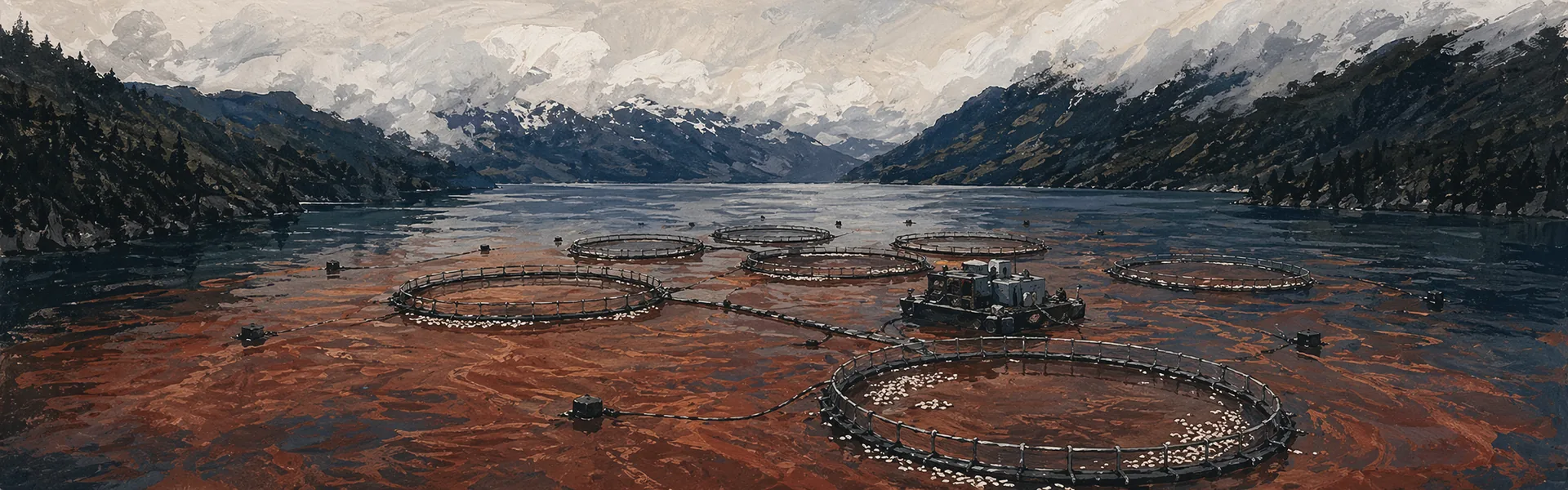
Mowi / Marine Harvest: When the Ocean Turns on the Fish Farm
Mowi (Marine Harvest)
In 2016, Marine Harvest (now Mowi) wrote down $16 million in fixed assets and absorbed a further $19 million quarterly loss after an algal bloom in Chile's Los Lagos region killed 2.7 million of its farmed salmon — effectively 93% of its fish at affected sites.1, 2, 3 The company set aside an additional $3 million in restructuring provisions and laid off up to 500 workers.1 Industry-wide, the bloom destroyed 27 million farmed salmon and trout and generated approximately $800 million in total losses — the largest farmed-fish mortality event ever recorded.4, 5 Marine Harvest stated that all affected fish were covered by insurance, but the write-downs, workforce reductions, and operational disruption flowed through its accounts regardless.3
Marine Harvest operated open-net salmon pens in Chile's Patagonian fjords, a farming model in which the fish live in direct contact with the surrounding seawater and depend entirely on the ocean to supply clean, oxygenated water at the right temperature.6, 7 Chile's Los Lagos region — Region X — was the country's principal salmon-farming zone, and Marine Harvest was one of the largest producers operating there.8 Atlantic salmon breathe through gills in continuous contact with ambient seawater; they cannot be isolated from waterborne toxins, temperature shifts, or drops in dissolved oxygen. The business model's economics — no walls, no filtration, minimal infrastructure compared with land-based recirculating systems — made it extraordinarily efficient under normal conditions and extraordinarily exposed when conditions changed.
The salmon-farming industry's own growth intensified the ecological pressures on the fjords it depended on, creating a feedback loop in which nutrient discharge from densely stocked pens degraded the water quality that fish health required.4 By 2016, Chile had become the world's second-largest salmon producer, concentrating hundreds of farming concessions in the semi-enclosed waters of western Patagonia. Organic waste, uneaten feed, and chemical treatments flowed directly from open-net pens into the fjords. Scientists and local communities raised concerns that aquaculture-driven nutrient loading — eutrophication, in technical terms — was altering the fjord ecosystems in ways that could favour harmful algal species.4 The industry depended on the fjords for clean, well-oxygenated water, but its own operations were progressively reducing the likelihood that such conditions would persist.
In the austral summer of 2016, the strongest El Nino event since 1948 pushed sea-surface temperatures in the Reloncavi Sound to 15-16 degrees Celsius, slashed freshwater inflows, and stratified the water column — creating ideal conditions for a bloom of the toxic microalga Pseudochattonella verruculosa.4, 5 The El Nino's intensity, measured by the Nino 3.4 index at +2.1 degrees Celsius, was the second highest recorded value since 1948.4 Drought reduced the region's normal freshwater discharge into the fjord system, allowing more saline subsurface water — carrying nutrients from deeper layers — to reach the sunlit zone where algae grow.5 The Reloncavi Sound's flushing rate slowed to 121-200 days, meaning that any bloom that developed would persist rather than being diluted and flushed out to the open ocean.5
The bloom reached cell densities of 7,000-20,000 cells per millilitre, more than seven thousand times the threshold at which farmed salmon begin to show distress, and the toxins it produced attacked the fishes' gill tissue, causing respiratory failure across 45 farming sites in roughly two weeks.5, 9 Research published in Harmful Algae established that farmed Atlantic salmon show anomalous behaviour at concentrations below one cell per millilitre of Pseudochattonella; the 2016 bloom exceeded this threshold by four orders of magnitude.9 The algal cells contained elevated concentrations of ichthyotoxic long-chain polyunsaturated fatty acids, which damaged gill membranes and impaired the fishes' ability to extract oxygen from the water.5 The event unfolded with a speed that left farmers with almost no time to respond — from the first reports of abnormal fish behaviour to mass mortality took approximately 14 days.
Marine Harvest lost 2.7 million out of 2.9 million fish at its Los Lagos operations, and its Chile division reported an operational loss of EUR 1.55 per kilogramme — compared with profits of EUR 1.85 per kilogramme in Norway and EUR 1.95 in Canada during the same quarter.3, 10 The contrast in regional performance laid bare the geographic concentration of the risk: the same company, running the same farming model, posted healthy margins in the North Atlantic while suffering near-total losses in the South Pacific. Chile had produced 15,000 tonnes of salmon for Marine Harvest in Q1 2016, but the per-kilogramme economics were deeply negative, with the algal bloom alone contributing approximately EUR 0.60 of the per-kilogramme loss.10 The remaining deficit reflected the cascading costs of workforce reductions, site clean-up, and operational disruption.
Industry-wide, the 2016 algal bloom killed an estimated 27 million farmed salmon and trout — some 39,000 tonnes representing 12% of Chile's annual salmon production — and generated total losses of approximately $800 million.4, 5 Nine companies were affected across the Los Lagos region, with combined biomass losses exceeding 24,000 tonnes in the immediate aftermath.3, 7 Insurance brokers estimated total payouts to covered farmers at roughly $175 million, leaving the majority of the $800 million in losses unrecovered.6 The event triggered a major social upheaval, with local communities and national stakeholders questioning whether the rapid expansion of salmon farming had contributed to the ecological conditions that made such blooms more likely and more severe.4
Marine Harvest laid off up to 500 workers and set aside a $3 million restructuring provision, while across the wider Chilean aquaculture sector 4,500 of 35,000 workers lost their jobs as the industry haemorrhaged an estimated $9 million per day during the crisis.1, 7 The workforce reductions were not temporary furloughs; they reflected the elimination of farming operations at sites where restocking would take 18-24 months. For a region where aquaculture was the dominant employer, the labour-market consequences extended well beyond the companies' own payrolls. Marine Harvest's $16 million write-down of fixed assets in Q1 2016 and $19 million Q2 charge reflected not merely the value of dead fish but the impairment of physical infrastructure — pens, moorings, and support facilities — at sites that could not be immediately reused.1, 2
The industry's response to the mass die-off compounded the ecological damage: approximately 4,700 tonnes of rotting salmon carcasses were dumped offshore near Chiloe Island, and Lagrangian ocean-current simulations later confirmed that the decomposing biomass likely fuelled a second, even more toxic bloom along the Pacific coast weeks later.11 The dumping was authorised by Chilean regulators as an emergency disposal measure, but it became a source of intense public controversy. Researchers used oceanographic modelling to show that near-surface currents carried nutrient-rich pollution from the dump site back toward the coast, feeding an Alexandrium catenella bloom of extreme toxicity.11 The sequence — algal bloom kills fish, dead fish dumped at sea, dumped fish feed another bloom — illustrated with unusual clarity how the industry's operations and the marine ecosystem had become entangled in a destructive cycle.
The 2016 algal bloom was not Marine Harvest's first ecosystem-driven crisis in Chile: in 2007-08, an outbreak of infectious salmon anaemia had forced the company to close six freshwater sites, 21 sea sites, and two processing plants, laying off 1,866 employees — demonstrating that recurrent biological shocks are a structural feature of open-net aquaculture in these waters.8 The ISA crisis had already cost the wider Chilean salmon industry 2.8 billion Norwegian kroner and prompted a regulatory overhaul, including mandatory fallowing periods and density limits.8 Marine Harvest rebuilt its Chilean operations after the ISA outbreak, only to face an even larger biologically driven loss eight years later. The pattern suggests that these are not one-off events but recurring risks inherent to a production model that leaves fish fully exposed to ambient environmental conditions.
For investors and lenders assessing nature-related financial risk in aquaculture, the Marine Harvest case illustrates that open-net salmon farming in ecologically sensitive fjords carries a latent exposure to catastrophic loss events that no amount of insurance can fully offset — because the industry's own operations degrade the marine environment on which every pen of fish depends. Marine Harvest's Chilean operations generated reliable profits in normal years, but the tail risk was severe: a single bloom erased years of accumulated margin and required costly restructuring. The double bind — that the industry both depends on and degrades the fjord ecosystem — means that each production cycle incrementally raises the probability of the next crisis. Climate change, which is increasing the frequency and intensity of El Nino events, adds a compounding variable. For any financial institution with exposure to open-net aquaculture, the question is not whether another bloom will occur, but when.
Footnotes
-
Marine Harvest Q1/Q2 2016 quarterly reports, financial data via Mowi investor relations. https://mowi.com/investors/reports-and-presentations/ ↩
-
Undercurrent News, "Marine Harvest to take $19m Q2 hit in Chile as South American losses widen," 2016. https://www.undercurrentnews.com/2016/05/11/marine-harvest-to-take-19m-q2-hit-in-chile-as-south-american-loses-widen/ ↩
-
The Fish Site, "Harmful algal blooms kill millions of salmon in Chile," 2016. https://thefishsite.com/articles/harmul-algal-blooms-kill-millions-of-salmon-in-chile ↩
-
Leon-Munoz, J. et al., "Hydroclimatic conditions trigger record harmful algal bloom in western Patagonia (summer 2016)," Scientific Reports, 2018. https://pmc.ncbi.nlm.nih.gov/articles/PMC5777999/ ↩
-
Mardones, J.I. et al., "Disentangling the environmental processes responsible for the world's largest farmed fish-killing harmful algal bloom: Chile, 2016," Science of the Total Environment, 2021. https://pubmed.ncbi.nlm.nih.gov/33421787/ ↩
-
Undark, "Chile's Salmon Industry Is Being Strangled by Algae," 2016. https://undark.org/2016/03/08/chiles-salmon-industry-strangled-algae/ ↩
-
MercoPress, "Algae bloom in southern Chile causing massive losses in the salmon farms," 2016. https://en.mercopress.com/2016/03/08/algae-bloom-in-southern-chile-causing-massive-losses-in-the-salmon-farms ↩
-
The Fish Site, "The Impact of the ISA Virus in Chile." https://thefishsite.com/articles/the-impact-of-the-isa-virus-in-chile ↩
-
Mardones, J.I. et al., "Quantifying harmful algal bloom thresholds for farmed salmon in southern Chile," Harmful Algae, 2018. https://pubmed.ncbi.nlm.nih.gov/30005802/ ↩
-
The Fish Site, "Marine Harvest reports better than expected harvest volumes," 2016. https://thefishsite.com/articles/marine-harvest-reports-better-than-expected-harvest-volumes ↩
-
Garces-Vargas, J. et al., "The 2016 red tide crisis in southern Chile: Possible influence of the mass oceanic dumping of dead salmons," Marine Pollution Bulletin, 2019. https://pubmed.ncbi.nlm.nih.gov/31784267/ ↩