Malaysia's Pig Farming Industry: When Deforestation Unleashed a Virus, an Industry Collapsed
Malaysian pig farming industry
In 1999, Malaysia's pig farming industry suffered an estimated $450-550 million in economic losses after the emergence of the Nipah virus forced the government-ordered culling of over one million pigs and destroyed the livelihoods of nearly 1,900 farms across two states.1, 2 The outbreak, which began in late 1998 in the state of Perak before spreading to Negeri Sembilan, killed 105 people, infected 265, and triggered an immediate shutdown of pork exports to Singapore and other regional markets.3, 4 The episode was not a random act of nature. It was the consequence of a specific, traceable chain of ecological degradation: the clearing of tropical forests that had kept disease-carrying wildlife separated from intensive livestock operations. For an industry that had never considered forest cover a business input, the destruction was total and largely irreversible.
Malaysia's pig farming sector -- 1,885 farms raising 2.4 million pigs, concentrated in the states of Negeri Sembilan and Perak -- depended on a natural buffer that most operators never thought about: intact tropical forests that kept fruit bat populations fed and spatially separated from livestock operations.1, 5 The industry was overwhelmingly composed of small-to-medium family farms, predominantly run by ethnic Chinese (Foochow) families operating herds of 50 to 3,000 pigs each.6 In Malaysia's majority-Muslim context, pig farming occupied a cultural and regulatory niche: no pig farming or pork processing company has ever been publicly listed on Bursa Malaysia, and the sector operated largely outside the formal corporate governance structures that might have identified ecological risks.6 The farms clustered in tight geographic concentrations, often adjacent to fruit orchards -- an arrangement that maximised land use efficiency but placed livestock in direct proximity to the foraging ranges of Pteropus fruit bats, the natural reservoir hosts of what would become the Nipah virus.5
The same agricultural expansion that fed the growth of Malaysia's pig farms also stripped away the ecological barrier that kept disease at bay: approximately five million hectares of tropical forest across Malaysia and Indonesia were cleared or burned between 1997 and 1998, destroying the foraging habitat of Pteropus fruit bats and driving them into cultivated areas.5, 7 The clearing was driven by multiple pressures -- palm oil plantation expansion, timber extraction, and the conversion of forest to cropland and orchards -- compounded by the severe El Nino drought of 1997-1998, which triggered catastrophic fires across Borneo and Sumatra.5, 7 The pig farming industry itself contributed to this pattern: farms expanded into cleared forest margins, and the fruit orchards planted alongside piggeries offered an alternative food source for displaced bat populations.5 The industry was, in effect, degrading the very ecological system -- intact forest habitat for wildlife reservoir species -- that had kept a lethal pathogen from reaching its animals. This feedback loop, in which an agricultural sector's growth undermines the natural conditions required for its own viability, went entirely unrecognised until the virus emerged.
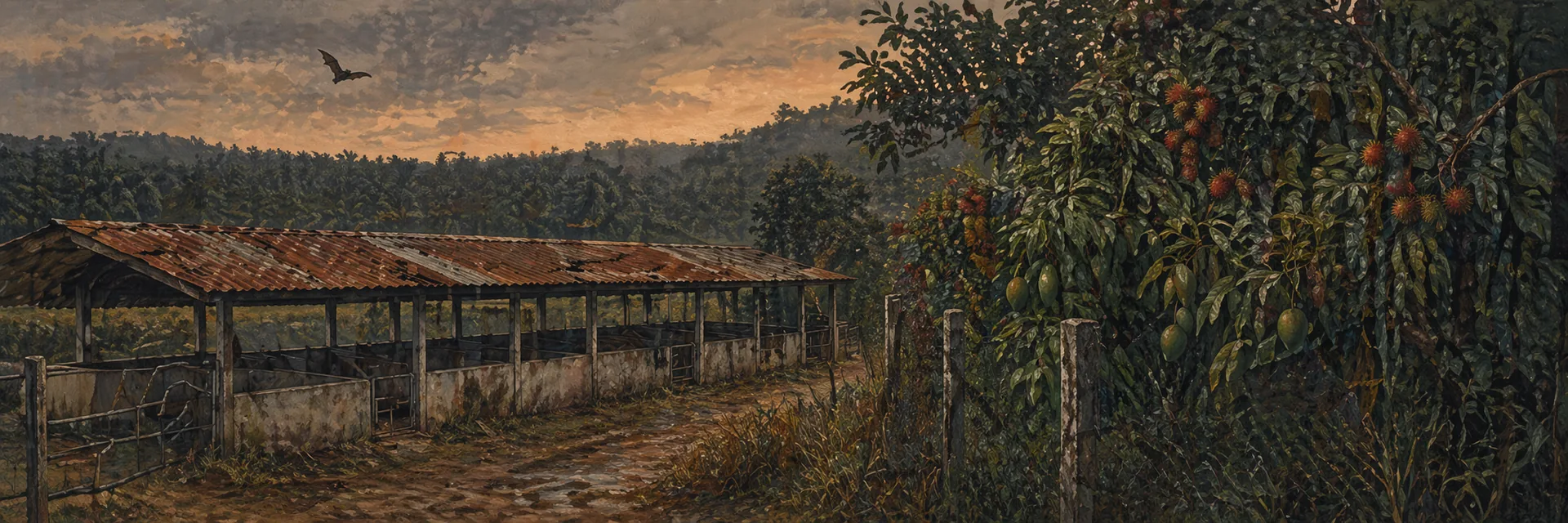
When displaced fruit bats roosted and fed in orchards adjacent to pig farms, their urine, faeces, and partially eaten fruit contaminated pig feed and farm environments, introducing a previously unknown paramyxovirus -- later named Nipah -- into dense livestock populations with no immunity.5, 8 The mechanism was straightforward: bats carrying the virus shed it through bodily fluids; fruit contaminated by bat saliva or urine fell into pig pens or was consumed by pigs foraging beneath orchard trees; and the virus amplified rapidly through pig-to-pig transmission in the crowded conditions of intensive farming operations.5, 8 The close physical proximity of orchards and piggeries -- a feature of the industry's land use pattern -- meant that the spatial buffer which had historically prevented such cross-species transmission had been eliminated. Epidemiological research later confirmed that deforestation and agricultural encroachment were the primary drivers of the spillover event, not a spontaneous mutation or an unforeseeable natural disaster.5, 7
The outbreak spread rapidly through pig populations in Negeri Sembilan and Perak, and the Malaysian government responded with a mass culling programme that destroyed more than one million pigs -- roughly half the national herd -- while 265 people contracted the virus and 105 died.1, 3, 4 The virus was initially misidentified as Japanese encephalitis, delaying the public health response by several critical months and allowing the pathogen to spread across farm clusters through the movement of infected pigs between operations.4, 8 When the true cause was identified in early 1999, the government ordered an immediate halt to all pig movements and began systematic culling in affected areas. Military personnel were deployed to enforce the cull, and entire farming districts in Negeri Sembilan were emptied of livestock.3, 4 The human toll fell disproportionately on farm workers and pig handlers who had direct contact with infected animals, with a case fatality rate exceeding 39%.3
The total economic cost to Malaysia reached an estimated $450-550 million, encompassing the direct value of culled livestock, compensation payments to farmers, veterinary and public health expenditures, and the collapse of domestic pork demand driven by consumer panic.1, 2 The government paid compensation of approximately MYR 50 per pig culled, a fraction of market value, leaving most farming families with unrecoverable losses.6 Beyond the direct costs, the outbreak devastated ancillary industries -- feed suppliers, transport operators, slaughterhouse workers, and pork retailers -- that depended on the pig farming sector. Domestic pork consumption fell sharply as consumers, already anxious about the virus, avoided pork products entirely, even from unaffected regions.3 The economic damage was concentrated in a sector with no access to capital markets, no crop or livestock insurance coverage of pandemic risk, and no financial buffers to absorb a loss of this magnitude.
Singapore, Malaysia's largest pork export market, imposed an immediate import ban that persisted for years, and Malaysia's share of the regional pork trade never recovered to pre-outbreak levels -- transforming a temporary biosecurity crisis into a permanent loss of competitive position.2, 6 Before the outbreak, Malaysia exported significant volumes of live pigs and processed pork to Singapore, generating steady foreign exchange revenue for the sector. The ban was a rational biosecurity response by Singapore's authorities, but its persistence reflected a deeper reputational damage: Malaysian pork had become associated with zoonotic risk in the minds of regulators and consumers across Southeast Asia.2 Even after partial lifting of restrictions, competing suppliers -- notably from Australia and the Netherlands -- had filled the gap, and Malaysian producers found themselves permanently displaced from markets they had served for decades.
In the aftermath, the Malaysian government imposed strict zoning regulations, biosecurity requirements, and farm consolidation mandates that effectively ended the small-scale, family-run model of pig farming that had prevailed for decades.6, 3 New regulations required pig farms to be located away from fruit orchards and forest margins, eliminating the land use pattern that had enabled the spillover. Minimum farm sizes were increased, biosecurity standards were tightened, and the number of licensed farms was dramatically reduced.6 Many displaced farming families never returned to the industry. The regulatory response was, in essence, an acknowledgement of the ecological dependency that the industry had ignored: the spatial relationship between forests, wildlife, orchards, and livestock was a material risk factor that required active management. The new framework attempted to recreate artificially -- through zoning and physical separation -- the buffer that intact forests had once provided naturally.
More than two decades later, Malaysia's pig farming industry in Negeri Sembilan has never been rebuilt, pig numbers nationally remain well below pre-outbreak levels, and the Nipah episode stands as one of the clearest documented cases of an agricultural sector being destroyed by the degradation of the ecological systems it unknowingly depended on.3, 6 The industry that existed before 1998 -- fragmented, informal, and deeply embedded in the rural economies of two states -- was permanently erased. For investors and policymakers assessing nature-related financial risk, the case carries a specific lesson: the pig farming sector's dependence on intact forest ecosystems was invisible in any conventional risk assessment, yet its disruption produced losses in the hundreds of millions of dollars and the complete destruction of an industry. The Nipah outbreak demonstrated that when an agricultural sector degrades the ecological systems that regulate disease transmission, the resulting costs can be catastrophic, irreversible, and borne entirely by those least equipped to absorb them.
Footnotes
-
Wave 1 research brief, compiled from Chua et al. (2002), Patz et al. (2004), FAO, PNAS, Malaysian Insight, and CGTN reporting. file://wave2/briefs/17_malaysian_pig_farms.md ↩
-
CGTN, "How Nipah affects pig exports in Malaysia," 2020. https://news.cgtn.com/news/2020-02-17/How-Nipah-affects-pig-exports-in-Malaysia--O08EFOujok/index.html ↩
-
FAO, "Japanese encephalitis/Nipah outbreak in Malaysia," accessed 2026. https://www.fao.org/4/ab455e/ab455e.htm ↩
-
American Association of Swine Veterinarians, "Dx Notes: Nipah virus outbreak in Malaysia, 1998-1999." https://www.aasv.org/shap/issues/v9n6/v9n6p295.html ↩
-
Chua et al., "Anthropogenic deforestation, El Nino and the emergence of Nipah virus in Malaysia," 2002. https://pubmed.ncbi.nlm.nih.gov/16329551/ ↩
-
The Malaysian Insight, "Pig farming in Malaysia forever changed 20 years after Nipah outbreak," 2019. https://www.themalaysianinsight.com/s/152295 ↩
-
Daszak et al., "Interdisciplinary approaches to understanding disease emergence: The past, present, and future drivers of Nipah virus emergence," PNAS, 2012. https://www.pnas.org/doi/10.1073/pnas.1201243109 ↩
-
Chua et al., "Nipah virus: a recently emergent deadly paramyxovirus," Science, 2000. Referenced via Wave 1 brief epidemiological sources. ↩