H&M: When Cotton Crops Failed, Fast Fashion Paid the Price
Hennes & Mauritz (H&M)
In 2011, Hennes & Mauritz (H&M) reported a SEK 4.1 billion decline in annual profit -- a 16% drop -- after simultaneous cotton crop failures across Pakistan, China, and India drove raw material costs to levels its CEO called "beyond our influence."1, 2 Full-year profit after financial items fell from SEK 25.0 billion to SEK 20.9 billion, gross margin compressed 2.8 percentage points, and operating margin dropped four full points from 23.1% to 19.0%.2, 3 The episode exposed a structural vulnerability in H&M's business: the world's second-largest fashion retailer had built its operations on an agricultural commodity sourced predominantly from regions where the farming practices used to grow it were steadily degrading the water systems, soils, and biological processes on which production depended.
H&M's business model is built on a single agricultural fibre -- cotton, which constitutes 55% of all material in its products -- and that fibre requires reliable water, healthy soils, and natural pest control to produce consistent yields.4 Approximately 60% of H&M's garments contain cotton, and the company sources roughly 75% of its clothing from Asia, with 35% from China, concentrating supply chain exposure in the regions that produce most of the world's cotton and that experienced the 2010-2011 supply shock.5 A Harvard Business School case study described H&M as "one of the largest consumers of cotton globally."5 H&M itself states the dependency plainly: "Our sourcing of raw materials, such as cotton, and our production activities are dependent on healthy ecosystems."6 For investors accustomed to analysing H&M as a retail and logistics operation, this framing redefines the company's cost structure: it is anchored to the biological productivity of farmland in South and Central Asia, farmland whose capacity to produce cotton depends on water, soil, and ecological processes that rarely appear in a financial model.
The cotton farming that supplies H&M systematically degrades each of the natural systems it relies on, creating a feedback loop in which intensive cultivation weakens the ecological foundations of future harvests. Cotton occupies just 2.5% of global arable land but consumes 24% of the world's insecticides and 11% of all pesticides, while requiring up to 20,000 litres of water per kilogram produced.7, 8 The chemical load damages pollinator populations -- an estimated 20% of honeybee colonies are negatively affected in cotton-growing regions, with 5% killed outright, costing roughly $210 million annually in reduced crop yields from pollination losses.7 At landscape scale, the consequences are stark: the Aral Sea, once the world's fourth-largest freshwater lake, lost 90% of its volume after its feeder rivers were diverted to irrigate cotton in Central Asia -- a disaster the UNDP called "the most staggering of the twentieth century."9, 10 H&M acknowledges this dynamic, noting that its value chain depends on "fertile soils, forests, clean water and pollinators" and that "conventional production methods can lead to negative impacts like soil erosion, pollution and overgrazing."6, 11
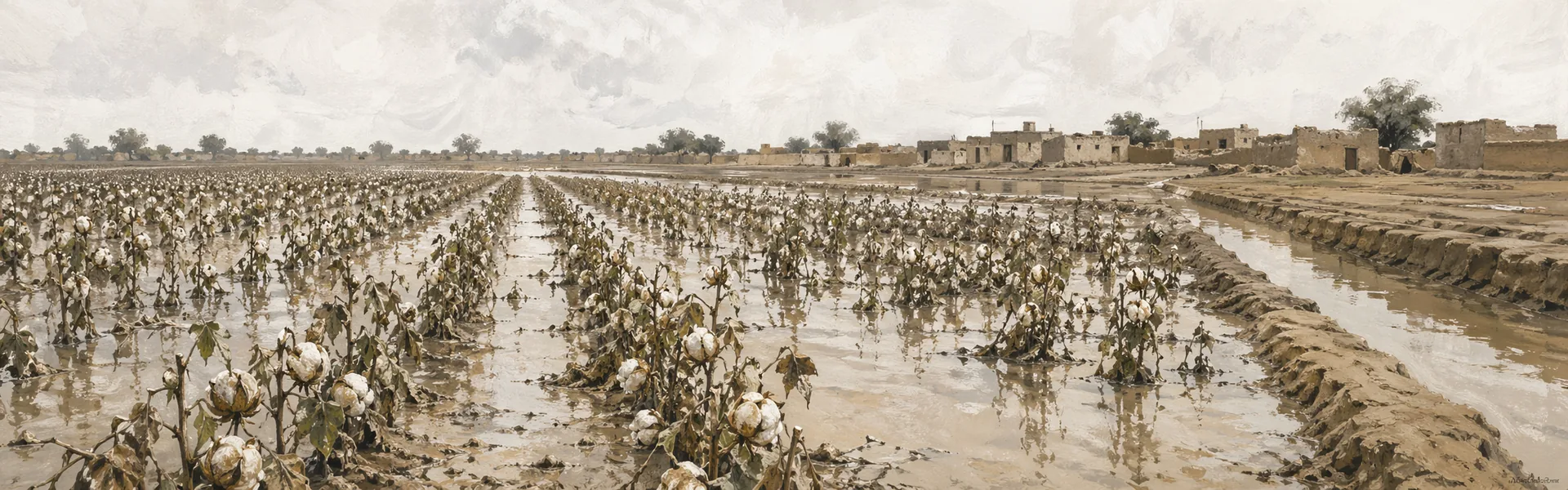
In 2010, that feedback loop produced an acute crisis when physical crop destruction struck three of the world's four largest cotton-producing nations simultaneously. Pakistan's monsoon floods -- the worst in the country's recorded history -- inundated up to one million hectares of cropland in Punjab, destroying 700,000 acres of cotton and wiping out an estimated two million bales from a projected harvest of 14 million, causing more than $2.9 billion in agricultural damage.12 In China's Xinjiang province, which produces 84% of China's cotton in an arid region receiving just 58mm of annual rainfall, an extremely severe winter snowstorm delayed the growing season and inflicted a 40% yield decline.13 India, the world's second-largest producer, simultaneously banned cotton exports to protect its domestic supply, removing another major source from global markets.1 The damage was amplified by the condition of the farming systems themselves: decades of water extraction and soil degradation had left these regions with diminished resilience to withstand exactly this kind of shock.
The supply shock drove cotton prices up 92% during 2010 to their highest level since the American Civil War, peaking at 229.7 cents per pound in March 2011.1, 14 H&M's purchasing model -- with no commodity hedging and rapid inventory turnover -- transmitted the full cost increase directly into its income statement. CEO Karl-Johan Persson flagged the pressure in the FY2010 annual report: "Raw material prices have increased; cotton prices for example almost doubled in 2010."15 The full impact arrived with a lag, as higher-cost cotton flowed through purchasing contracts into inventory and then into cost of goods sold. H&M's FY2011 report attributed margin compression to "cost inflation in the sourcing markets with high cotton prices, less spare capacity at suppliers, higher transportation costs and a negative US dollar effect."2 Unlike vertically integrated manufacturers or firms with longer purchasing lead times, H&M's rapid cycle meant it was continually buying into a rising market with no mechanism to smooth the price spike.
The financial damage was concentrated and severe: H&M's full-year gross margin fell 2.8 percentage points, from 62.9% to 60.1%, its operating margin collapsed four points to 19.0%, and at the quarterly worst, Q2 2011 delivered an 18.2% decline in net income -- even as revenue continued to grow.2, 3 In that quarter, net income fell from SEK 5.21 billion to SEK 4.26 billion, with gross margin dropping 4.2 percentage points.1 Gross profit declined in absolute terms, from SEK 68.3 billion to SEK 66.1 billion for the full year, despite top-line growth -- H&M sold more garments but earned less on each one.2, 15 Management attributed the increased purchasing costs "partly to higher cotton prices at the time for sourcing for the quarter compared to the corresponding sourcing period the previous year."2
Competitor Inditex, parent of Zara, saw its operating margin rise from 16.0% to 18.3% during the same period, isolating H&M's heavy cotton concentration and Asian sourcing as specific amplifiers of a risk that a more diversified peer absorbed.3, 16 Both companies are global fast-fashion retailers sourcing from many of the same regions. But Inditex uses less cotton as a proportion of total material, operates a more vertically integrated supply chain with significant European manufacturing, and runs a closer-to-market production model that allows faster adjustment to input cost shifts. The divergence -- H&M's margin falling four points while Inditex's rose two -- suggests that the damage was not an industry-wide inevitability but a consequence of H&M's specific concentration in a single natural fibre sourced overwhelmingly from ecologically stressed regions.
H&M responded by committing to source 100% of its cotton from sustainable origins -- organic, recycled, or Better Cotton Initiative-certified -- by 2020, reframing ecosystem health as a financial risk rather than a peripheral sustainability concern.5 The company started from a low base: just 13% of its cotton came from sustainable sources in 2012.5 By 2016 that share had reached 43%, and by 2019 it stood at 97%.5 H&M met its target in full by 2020, ranking third globally in the Sustainable Cotton Ranking assessed by WWF, Solidaridad, and PAN UK across 77 companies.17 The company noted that organic cotton farming could reduce water consumption by 90% and energy use by 60% compared with conventional methods.5 The transition was a direct attempt to break the degradation cycle: reducing the depletion of water systems, soil fertility, and biological pest controls that its supply chain depends on, so that future harvests would be less vulnerable to the kind of shock that cost it SEK 4.1 billion in 2011.
H&M's operating margin never returned to its pre-crisis level of 23%, settling at 18.5% in 2012 and sliding further to 17.1% by 2014.3 The cotton shock was not the sole cause of this secular decline -- fast fashion faced intensifying competition, rising Asian wages, and shifting consumer preferences in the same period. But the 2010-2011 supply disruption demonstrated that H&M's dependence on a single agricultural input, sourced from regions where decades of intensive farming had depleted water systems, degraded soil fertility, and weakened natural pest controls, constituted a material and quantifiable financial risk. The company's own pivot to sustainable cotton confirmed what the income statement had already shown: when the natural systems underpinning a supply chain deteriorate, the costs eventually reach the P&L.
Footnotes
-
Bloomberg, "H&M Profit Drops for Third Quarter as Production Costs Rise," 2011. https://www.bloomberg.com/news/articles/2011-06-22/h-m-second-quarter-profit-mises-estimates ↩
-
H&M Hennes & Mauritz AB, "Full-Year Report FY2011," January 2012. https://www.businesswire.com/news/home/20120125006717/en/H-M-HENNES-MAURITZ-AB-FULL-YEAR-REPORT ↩
-
CompaniesMarketCap, "H&M Operating Margin," accessed 2026. https://companiesmarketcap.com/h-m/operating-margin/ ↩
-
H&M Group, "Materials," accessed 2026. https://hmgroup.com/sustainability/circularity-and-climate/materials/ ↩
-
Harvard Business School, "Fast Fashion's Fast Feedback: H&M Commits to Sustainable Cotton," accessed 2026. https://d3.harvard.edu/platform-rctom/submission/fast-fashions-fast-feedback-hm-commits-to-sustainable-cotton/ ↩
-
H&M Group, "Biodiversity," accessed 2026. https://hmgroup.com/sustainability/circularity-and-climate/biodiversity/ ↩
-
University of British Columbia, "Ecological and Social Costs of Cotton Farming," accessed 2026. https://cases.open.ubc.ca/ecological-and-social-costs-of-cotton-farming/ ↩
-
TRVST, "Environmental Impact of Cotton," accessed 2026. https://www.trvst.world/sustainable-living/fashion/environmental-impact-of-cotton/ ↩
-
Earth.org, "The Aral Sea Catastrophe," accessed 2026. https://earth.org/the-aral-sea-catastrophe-understanding-one-of-the-worst-ecological-calamities-of-the-last-century/ ↩
-
UNCCD, "Witnessing Environmental Catastrophe: Reflections on the Dried Aral Sea," accessed 2026. https://www.unccd.int/news-stories/special-feature/witnessing-environmental-catastrophe-reflections-dried-aral-sea ↩
-
H&M Group, "Cotton," accessed 2026. https://hmgroup.com/sustainability/circularity-and-climate/materials/cotton/ ↩
-
ReliefWeb, "Pakistan Floods Destroy Crops, Could Cost Billions," 2010. https://reliefweb.int/report/pakistan/pakistan-floods-destroy-crops-could-cost-billions ↩
-
Li et al., "Cotton production in Xinjiang," Nature, 2024. https://www.nature.com/articles/s44264-024-00043-z ↩
-
CNN Money, "Cotton shortage could inflate clothing prices," 2010. https://money.cnn.com/2010/09/09/news/economy/cotton_shortage_could_inflate_clothing_prices/index.htm ↩
-
H&M Hennes & Mauritz AB, "Full-Year Report FY2010," January 2011. https://www.globenewswire.com/news-release/2011/01/27/198405/0/en/H-M-HENNES-MAURITZ-AB-FULL-YEAR-REPORT.html ↩
-
CompaniesMarketCap, "Inditex Operating Margin," accessed 2026. https://companiesmarketcap.com/inditex/operating-margin/ ↩
-
H&M Group, "H&M Group Sustainable Cotton Ranking 2020," accessed 2026. https://hmgroup.com/news/hm-group-sustainable-cotton-ranking-2020/ ↩