Fresh Del Monte: When a $1.5 Billion Business Depends on a Single Clone
Fresh Del Monte Produce Inc.
In 2025, Fresh Del Monte Produce Inc. recorded a $37.5 million impairment charge and abandoned two banana farms in the Philippines after a soil-borne fungus exploited the genetic uniformity of the company's sole banana cultivar, collapsing its banana segment gross margin to 1.3% in the third quarter.1, 2 The company's banana business — $1.49 billion in annual revenue, more than a third of total sales — had been built entirely on genetically identical plants, and a pathogen with no known cure was now spreading across every major growing region.3 Fresh Del Monte's experience reveals what happens when an industry's most fundamental biological input has no substitute.
Fresh Del Monte's banana segment depends on a single cultivar, the Cavendish, which accounts for over 40% of world banana production and virtually all international trade — and every commercial Cavendish plant is a genetic clone of every other.4 The company grows bananas on farms it controls in Costa Rica, Guatemala, the Philippines, Panama, and Brazil, and purchases additional volume from independent growers in Guatemala, the Philippines, Ecuador, and Colombia.3 In 2025, company-controlled farms produced approximately 47% of the banana volume Fresh Del Monte sold; the remainder came from independent suppliers growing the same cultivar.3 The company's 10-K identifies "the Cavendish variety of bananas" as "one of our principal products" — and nowhere in its filings does any non-Cavendish banana variety appear in commercial production.3 This is not a company-specific choice but an industry structure: Cavendish dominates global export because it ships well, ripens predictably, and meets consumer expectations for uniformity. The consequence is that Fresh Del Monte's $1.49 billion banana business rests on a crop with zero genetic diversity.
The global banana export industry, Fresh Del Monte included, actively narrowed the genetic base it depends on by planting Cavendish to the exclusion of all other varieties, creating the precise conditions under which a single pathogen could threaten the entire crop.5, 6 Over 1,700 different banana accessions are conserved in the world's genebanks, representing enormous potential diversity — yet the commercial industry uses only one.7 As plant pathologists have warned, "lack of genetic diversification and a sole focus on Cavendish because of its current economic importance have resulted in today's extreme level of genetic vulnerability."5 This is a textbook feedback loop: monoculture maximises short-term efficiency, but each additional hectare planted to a single clone increases the return on investment for any pathogen that can attack it. The industry's own production decisions eroded the genetic diversity that would have provided a natural buffer against disease.
This has happened before: in the mid-twentieth century, a nearly identical soil fungus wiped out the Gros Michel cultivar that then dominated the export trade, destroying tens of thousands of hectares across Central America and costing the industry at least $2.3 billion in losses.8, 9 In Honduras alone, 30,000 hectares of Gros Michel plantation in the Ulua Valley were eradicated between 1940 and 1960; in Suriname, a 4,000-hectare operation was out of business within eight years; in Costa Rica, 6,000 hectares were destroyed in twelve years.8 The industry responded not by diversifying but by switching wholesale to the Cavendish — a single cultivar that happened to resist the fungal strain then circulating.9 As researchers have noted, "the current expansion of the Panama disease epidemic is particularly destructive due to the massive monoculture of susceptible Cavendish bananas" — the same vulnerability has simply been reproduced with a different clone.9
Fusarium Tropical Race 4, first detected in Southeast Asian banana plantations in the 1990s, has now spread to over twenty countries and reached Latin America — the heart of the global export industry — with Ecuador confirming infection in September 2025.3, 10 The pathogen is soil-borne, persists in the ground for over forty years, cannot be controlled by fungicides, and cannot be eradicated by fumigation.4 Fresh Del Monte's CEO described the situation publicly as "a losing battle," noting that "you can replant and then three years later, four years later, you lose a tree again."10 In the Philippines, the country that first exposed the Cavendish's vulnerability, only 51,000 hectares of banana plantation remained productive out of an original 89,000 — a 43% loss of productive land.11 A separate estimate put the figure even lower, at 15,000 hectares still in use.12 Ecuador, the largest banana exporter in Latin America, confirmed TR4 in September 2025, raising the prospect of disruption across the region's most important supply base.3
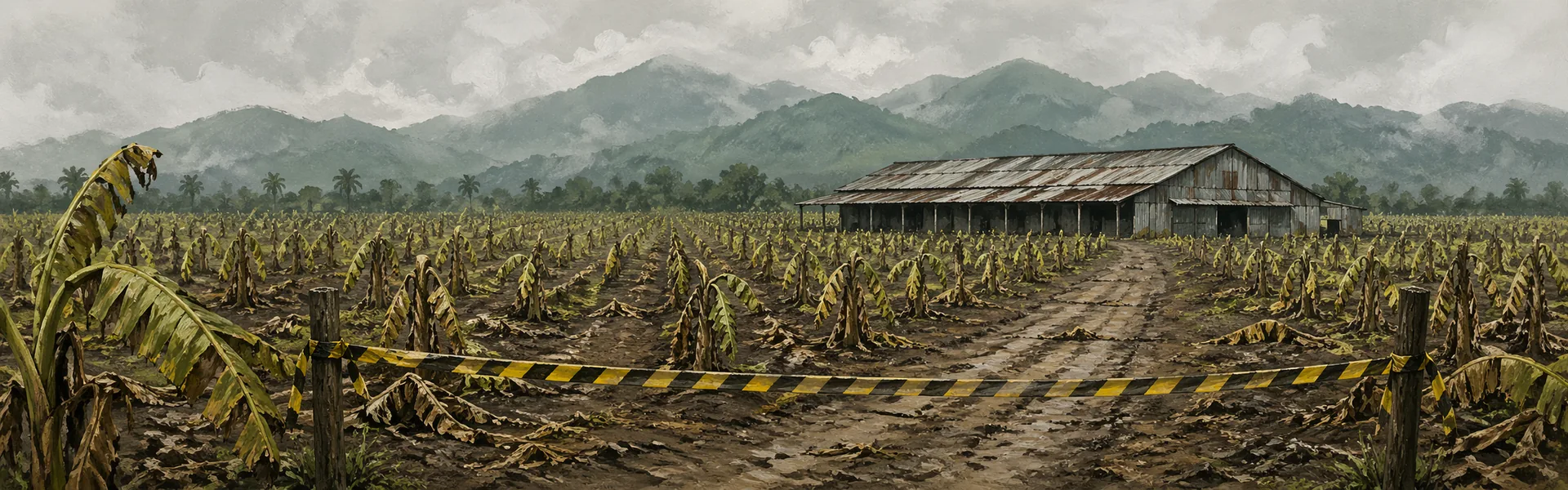
Fresh Del Monte's Philippine operations bore the earliest and most severe impact: the company's planted banana acreage on Mindanao fell 83%, from roughly 3,055 hectares to approximately 505 hectares, after it abandoned two farms in Q3 2025.3, 13 The company's 10-K disclosed the abandonment in stark terms: the farms were exited "as a result of low profitability and reduced production, including the impact of crop disease."3 Total Philippines leased acreage declined from 17,124 acres in FY2024 to 9,214 acres in FY2025.3, 13 The company began sourcing bananas from independent growers in Vietnam and Cambodia under short-term trial agreements — a geographic diversification born of necessity rather than strategy.3 Meanwhile, Costa Rica production declined 22% year-over-year, or approximately 18 million boxes lost, driven by a combination of TR4 pressure and the secondary fungal disease Black Sigatoka.1, 2
The financial toll extended well beyond the Philippines impairment: Fresh Del Monte's banana segment gross profit fell 56.5% over two years, from $163.3 million in 2023 to $71.0 million in 2025, while rising disease-management costs — including a 40-50% increase in fungicide prices — compressed margins across all growing regions.3, 10 In Q3 2025 alone, the banana segment recorded gross profit of just $4.6 million on $358 million in net sales — a margin of 1.3%, down from 6.2% the prior year.14 The company swung from a net profit of $42.1 million in Q3 2024 to a net loss of $29.1 million in Q3 2025.15 Cumulative Philippines banana impairments over FY2023-2025 totalled $42.4 million.3, 13 Fresh Del Monte's own risk disclosure was blunt: "Despite our efforts, we may be unable to prevent the spread of TR4. A long-term reduction in the supply of bananas or other important crops could lead to increased costs, decreased revenue, and charges to earnings."3
Fresh Del Monte is not alone in facing this risk; Dole, Chiquita, and every other major banana exporter grow exclusively Cavendish, and all now disclose TR4 as a material risk factor — yet none has reported impairments on the scale of Fresh Del Monte's Philippines write-downs.16, 17 Dole reported no proven TR4 cases on its own farms as of 2024 and implemented a three-year biosecurity programme from 2019, though it acknowledged that "TR4 has the potential to lower plant yields on infected farms."16 Chiquita's industry analysis estimated that Black Sigatoka alone drives "more than $100 million in annual protective costs" across the sector — and TR4 adds a separate, uncapped liability.18 The divergence in financial impact so far reflects geography rather than business-model differences: Fresh Del Monte's early concentration in the Philippines placed it at the leading edge of a wave that is now approaching all producers.
Fresh Del Monte has partnered with Queensland University of Technology and is testing gene-edited banana lines, but the company's own SEC filings acknowledge that "this research is still on-going" and no commercially viable resistant variety is available for deployment.3, 19 The company's 10-K explicitly flags the possibility that "we may need to deploy GMO or gene-edited bananas resistant to the disease to maintain a viable supply of bananas to our key markets" — a candid admission that the current cultivar may not survive.3 Field testing of TR4-resistant lines was scheduled to begin in 2025, but the gap between field trial and commercial-scale production spans years.19 In Australia, QCAV-4 became the first genetically modified Cavendish banana approved for commercial cultivation in February 2024, but no plans for large-scale production have been announced.20
The wider industry's best hope is a gene-edited TR4-resistant Cavendish from biotech firm Tropic Biosciences, which raised $105 million in Series C funding and targets commercial deployment from 2027 — but even this optimistic timeline leaves a multi-year window during which no grower has a defence against a fungus that persists in soil for over forty years.21 Chiquita's Yelloway joint venture completed a banana pan-genome in February 2026, a step that "dramatically accelerates development" of resistant hybrids, but no deployment date has been set for the resulting varieties.18 The fundamental problem is temporal: TR4 is spreading now, and the nearest realistic commercial alternative is at least two years away. Every hectare lost in the interim is contaminated soil that cannot grow Cavendish bananas again for decades.
Fresh Del Monte's banana crisis demonstrates that genetic uniformity in a commodity crop is not merely a biological curiosity but a quantifiable financial risk — one that has already produced $42.4 million in cumulative impairments, halved segment margins, and left the company racing to develop a replacement cultivar before the pathogen reaches its remaining farms.3, 13 The parallels with the Gros Michel collapse of the 1950s are exact: the same industry, the same monoculture model, the same class of soil pathogen, and the same absence of a ready substitute.9 For investors assessing nature-related financial exposure, Fresh Del Monte's experience offers a measurable case: when an enterprise depends on a biological input with no genetic diversity, it is exposed not to a tail risk but to a known, documented, and now recurring pattern of loss.
Footnotes
-
Elaine Watson, "Fresh Del Monte CEO sounds alarm as deadly Fusarium wilt hits Ecuador's banana crop: 'It's a losing battle'," AgFunder News, 30 October 2025. https://agfundernews.com/fresh-del-monte-ceo-sounds-alarm-as-deadly-fusarium-wilt-hits-ecuadors-banana-crop-its-a-losing-battle ↩
-
"Fresh Del Monte (FDP) Q3 2025 Earnings Transcript," Motley Fool, 29 October 2025. https://www.fool.com/earnings/call-transcripts/2025/10/29/fresh-del-monte-fdp-q3-2025-earnings-transcript/ ↩
-
Fresh Del Monte Produce Inc., Form 10-K, FY2025 (filed 19 February 2026). SEC EDGAR, accession no. 0001047340-26-000015. https://www.sec.gov/Archives/edgar/data/1047340/000104734026000015/fdp-20251226.htm ↩
-
Dale et al., "Transgenic Cavendish bananas with resistance to Fusarium wilt tropical race 4," Nature Communications, 2017. https://www.nature.com/articles/s41467-017-01670-6 ↩
-
"The Vulnerability of Bananas to Globally Emerging Disease Threats," Phytopathology, 2021. https://apsjournals.apsnet.org/doi/10.1094/PHYTO-07-20-0311-RVW ↩
-
"Safeguarding and using global banana diversity: a holistic approach," CABI Agriculture and Bioscience, 2020. https://cabiagbio.biomedcentral.com/articles/10.1186/s43170-020-00015-6 ↩
-
"Safeguarding and using global banana diversity," CABI Agriculture and Bioscience, 2020. https://cabiagbio.biomedcentral.com/articles/10.1186/s43170-020-00015-6 ↩
-
Ploetz, R.C., "Panama Disease: An Old Nemesis Rears its Ugly Head — Part 1," APSnet Features, 2005. https://www.apsnet.org/edcenter/apsnetfeatures/Pages/PanamaDiseasePart1.aspx ↩
-
"Worse Comes to Worst: Bananas and Panama Disease — When Plant and Pathogen Clones Meet," PLOS Pathogens, 2015. https://pmc.ncbi.nlm.nih.gov/articles/PMC4652896/ ↩
-
Elaine Watson, "Fresh Del Monte CEO sounds alarm," AgFunder News, 30 October 2025. https://agfundernews.com/fresh-del-monte-ceo-sounds-alarm-as-deadly-fusarium-wilt-hits-ecuadors-banana-crop-its-a-losing-battle ↩
-
"Philippines falls to fourth in banana exports due to TR4 and weather impacts," FreshPlaza, 2025. https://www.freshplaza.com/north-america/article/9695027/philippines-falls-to-fourth-in-banana-exports-due-to-tr4-and-weather-impacts/ ↩
-
"Banana production decline in Mindanao due to diseases and land constraints," FreshPlaza, 2025. https://www.freshplaza.com/latin-america/article/9663504/banana-production-decline-in-mindanao-due-to-diseases-and-land-constraints/ ↩
-
Fresh Del Monte Produce Inc., Form 10-K, FY2024 (filed 24 February 2025). SEC EDGAR, accession no. 0001047340-25-000009. https://www.sec.gov/Archives/edgar/data/1047340/000104734025000009/fdp-20241227.htm ↩
-
Fresh Del Monte Produce Inc., Form 10-Q, Q3 FY2025 (filed 29 October 2025). SEC EDGAR, accession no. 0001047340-25-000133. https://www.sec.gov/Archives/edgar/data/1047340/000104734025000133/fdp-20250926.htm ↩
-
"Fresh Del Monte reports Q3 net loss despite higher sales, divests Mann Packing operations," Fruitnet/Eurofruit, October 2025. https://www.fruitnet.com/eurofruit/fresh-del-monte-reports-net-loss-despite-higher-sales/269473.article ↩
-
Dole plc, "Understanding Tropical Race 4," 2020. https://www.dole.com/blog/tropical-race-4 ↩
-
Dole plc, Form 20-F Annual Report, FY2024 (filed February 2025). https://s202.q4cdn.com/638653076/files/doc_financials/2024/q4/Dole-plc-2024-20-F-Annual-Report.pdf ↩
-
"Chiquita Advances Banana Innovation with Completion of Yelloway Banana Pan-Genome," PR Newswire, 10 February 2026. https://www.prnewswire.com/news-releases/chiquita-advances-banana-innovation-with-completion-of-yelloway-banana-pan-genome-302684097.html ↩
-
Elaine Watson, "Fresh Del Monte ramps up defenses as disease threatens world banana crops," AgFunder News, 6 August 2025. https://agfundernews.com/fresh-del-monte-ramps-up-defenses-as-disease-threatens-world-banana-crops ↩
-
"QCAV-4, the first genetically modified Cavendish banana resistant to Fusarium wilt tropical race 4 approved for commercial production," Plant Biotechnology Journal, 2025. https://onlinelibrary.wiley.com/doi/full/10.1111/pbi.70178 ↩
-
"Tropic bags $105m to scale gene-edited bananas, deploy TR4 resistant bananas in 2027," AgFunder News, 2025. https://agfundernews.com/tropic-bags-105m-to-scale-gene-edited-bananas-deploy-tr4-resistant-bananas-in-2027 ↩