DRDGOLD: When Contaminated Water Undermines Gold Recovery
DRDGOLD Limited
In 2021, DRDGOLD Limited disclosed that contaminated process water had compromised gold recovery at its ERGO tailings-retreatment plant after more than a century of mining overwhelmed the Witwatersrand Basin's natural water-filtration capacity, forcing the company to choose between purchasing clean municipal water at an estimated R678 million per year or accepting reduced extraction yields.1, 2 Laboratory testing confirmed a statistically significant gap between recovery rates achieved with clean water and those achieved with the recycled process water DRDGOLD relies on — with certain contaminants cutting gold recovery by up to 50%.1 The company adopted chemical treatment as a compromise, but the episode illustrates how degraded water quality can become an embedded, ongoing cost for any operation that depends on large volumes of freshwater in a polluted landscape.
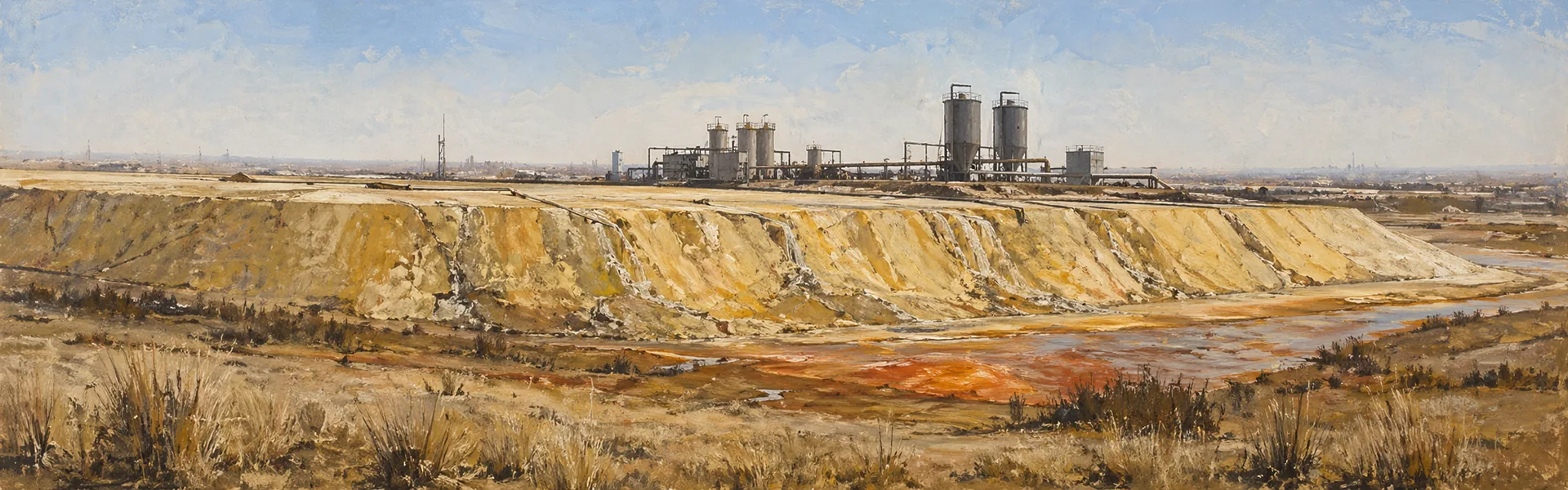
DRDGOLD's entire business model depends on water. The company does not operate conventional underground or open-pit mines; instead, its ERGO plant retreats historic gold-mine tailings dumps scattered across the East Rand of South Africa's Gauteng Province, processing approximately 64,000 tonnes of material per day.1, 3 Sand from the dumps is reclaimed using mechanical front-end loaders and re-pulped with water, while finer slime material is blasted from dump faces using high-pressure water guns.3 The resulting slurry is pumped to a central processing plant where gold is extracted using Carbon-in-Leach technology — a hydrometallurgical process that requires specific water chemistry to function efficiently.1 The plant consumes an estimated 60 megalitres of water per day, drawn almost entirely from a 95% closed-loop recycling system supplemented by approximately 8 megalitres per day of treated acid mine drainage from the state water organisation TCTA and a similar volume of treated sewage from the East Rand Water Care Company.1, 4, 5
The water that DRDGOLD recycles through this closed-loop system carries the chemical legacy of the same mining activity that created the tailings dumps the company now profits from. Over 120 years of gold extraction across the Witwatersrand Basin left behind nearly 400 square kilometres of tailings dumps in and around Johannesburg, containing crushed rock with approximately 3% pyrite content.6, 1 When this sulphide-bearing waste reacts with water and oxygen, it generates acidic, metal-laden drainage — a process that has been contaminating regional groundwater and surface water for decades.7 Each cycle through DRDGOLD's closed loop concentrates dissolved metals and sulphates further, because the recycled water picks up additional contaminants from every batch of tailings it contacts.1 The company's own metallurgical research department acknowledged that the accumulation of contaminants and reagents had "compromised leach performance and overall gold recovery."1
The Witwatersrand Basin's water contamination operates at a scale that dwarfs any single company's remediation capacity. The basin discharges approximately 202 million litres of acid mine drainage per day, with wastewater characterised by a pH range of 1.89 to 3.50, sulphate concentrations around 3,500 mg/L, and total dissolved solids between 6,000 and 8,890 mg/L.8 The first major discharges of acid drainage in Gauteng Province surfaced in 2002, and by 2005 sulphurous compounds and uranium were affecting residents' boreholes in Krugersdorp.7 The natural biogeochemical systems — soils, wetlands, and aquifer substrates — that would normally filter and neutralise such contamination have been overwhelmed by the sheer volume and chemical intensity of mining waste accumulated over more than a century.6, 7 Projections suggest the problem will persist for decades to centuries, with potential drainage volumes reaching 350 million litres per day from abandoned mines across the Witwatersrand goldfields alone.6
Laboratory research conducted specifically on ERGO's process water demonstrated the operational cost of this degraded water quality. A two-sample t-test confirmed a statistically significant difference in gold recoveries between clean municipal water (Rand Water) and untreated recycled process water, with a t-statistic of 6.26 against a critical value of 2.26 at p < 0.05.1 Spiking experiments quantified the damage individual contaminants inflict: iron at concentrations of 500 mg/L caused a 28% reduction in gold recovery; nickel at 100 mg/L caused an approximately 50% reduction; magnesium at 50 mg/L reduced recovery by 15.8%; calcium at 50 mg/L caused a 20% drop; and sulphates at 50 mg/L reduced recovery by approximately 10%.1 These are laboratory results, and actual field conditions involve complex interactions among multiple contaminants — but the direction and magnitude of the effect are clear.
DRDGOLD cannot simply switch to clean water. Rand Water, the municipal bulk supplier, charges R30.92 per kilolitre.1 At 60 megalitres per day, that translates to approximately R1.86 million daily — roughly R678 million per year — a cost that would render the tailings-retreatment operation economically unviable.1 An alternative approach — heating the full volume of process water from ambient temperature (20 degrees Celsius) to 60 degrees Celsius to improve treatment efficacy — would require approximately 2,930 MWh of energy per day, adding R2.93 million in daily energy costs.1 Neither option is financially sustainable for a business that achieved an operating margin of more than 40% at ERGO in the second half of 2020.9 The company is locked into using recycled water contaminated by the very mining legacy it exists to monetise.
The company adopted lime softening as the economically viable compromise. Lime treatment removed more than 99% of heavy metals — including zinc, iron, and nickel — from the recycled process water, and laboratory testing showed that gold recovery using lime-treated water was "negligibly different" from recovery using clean Rand Water.1 The treatment works because lime raises the pH and precipitates dissolved metals as insoluble hydroxides, effectively reversing the acid drainage chemistry that contaminated the water in the first place. But the solution is not free: lime dosing adds a permanent chemical-treatment cost to every tonne of tailings processed, and the treatment must be maintained continuously because the closed-loop system re-concentrates contaminants with every cycle. The precise annual cost of DRDGOLD's lime treatment programme has not been publicly disclosed.
DRDGOLD has continued to invest heavily in expanding its tailings-retreatment operations, committing R305 million to the Crown-Ergo pipeline — R260 million for the pipeline itself and an additional allocation for plant upgrades — to access tailings deposits in the Crown Gold Recoveries area west of Johannesburg.3 The company spent R48.4 million on rehabilitation at ERGO in the second half of 2020 alone.9 These capital commitments are predicated on the assumption that water quality can be managed at acceptable cost. Any deterioration in treatment efficacy — whether from rising contaminant concentrations in the recycled water, lime supply disruptions, or changes in the chemistry of newly accessed tailings — would directly erode the gold recovery rates on which these investments depend. The government has separately spent R2 billion on an acid mine drainage treatment plant in Springs, underscoring the scale of the regional water-quality challenge.6
The broader Witwatersrand acid mine drainage problem has no foreseeable end point. The sulphide oxidation reaction that generates acid drainage will continue as long as pyrite-bearing rock remains exposed to water and air — a condition that applies across the basin's extensive network of abandoned underground workings, surface dumps, and subsurface voids.6, 8 For DRDGOLD, this means water-treatment costs are not a one-off remediation expense but a permanent feature of the operating cost structure. Every expansion of the tailings-retreatment footprint brings the company into contact with additional contaminated material, requiring proportionate increases in water-treatment capacity. The company's 95% water-recycling rate, while impressive from a resource-efficiency perspective, actually amplifies the contaminant-accumulation problem by concentrating dissolved metals through repeated cycles.5, 1
DRDGOLD's experience reveals a pattern relevant to any extractive operation in a degraded watershed: when an industry's historical activities have destroyed the natural water-purification capacity of a region, even well-managed successor operations inherit a chronic cost burden. The company recycles 95% of its water, supplements with treated waste streams, and applies lime treatment to restore extraction performance — yet it remains fundamentally dependent on managing a water-quality problem it cannot solve.1, 5 For investors assessing nature-related financial risk in the mining sector, the lesson is that water-quality degradation does not always manifest as a sudden shutdown or regulatory penalty. It can instead appear as a quiet, persistent drag on recovery rates — a line item that never goes away, embedded in every tonne of ore processed and every ounce of gold extracted.
Footnotes
-
Narain, D. et al., "Beneficiation of recycled process water at DRDGOLD's ERGO plant, and its effect on gold recovery," Journal of the Southern African Institute of Mining and Metallurgy, 2021. http://www.scielo.org.za/scielo.php?script=sci_arttext&pid=S2225-62532021000700005 ↩
-
DRDGOLD Limited, "Our Business — Ergo." https://www.drdgold.com/our-business/ergo ↩
-
DRDGOLD Limited, "Our Business — Ergo" (Crown-Ergo pipeline details). https://www.drdgold.com/our-business/ergo ↩
-
Mining Decisions, "Under Control" (DRDGOLD AMD water reuse). https://www.miningdecisions.com/sustainability/under-control/ ↩
-
Crux Investor, "DRDGOLD: Sustainable Gold Production from Mine Waste." https://www.cruxinvestor.com/posts/drdgold-sustainable-gold-production-from-mine-waste-expanding-operations-with-renewable-energy-focus ↩
-
Earth Magazine, "All That Glitters: Acid Mine Drainage — The Toxic Legacy of Gold Mining in South Africa." https://www.earthmagazine.org/article/all-glitters-acid-mine-drainage-toxic-legacy-gold-mining-south-africa/ ↩
-
British Geological Survey, Earthwise, "Case Study: Acid Mine Drainage, South Africa." https://earthwise.bgs.ac.uk/index.php/Case_Study_Acid_Mine_Drainage_South_Africa ↩
-
Springer, "AMD characterisation in the Witwatersrand Basin," 2024. https://link.springer.com/article/10.1007/s10230-024-00994-2 ↩
-
DRDGOLD Limited, "DRDGOLD's Ergo Cleans Up — Sustaining Reclamation, Liberating Land for Sustainable Use," 2021. https://www.drdgold.com/media-insights/media-releases/2021/560-drdgold-s-ergo-cleans-up-sustaining-reclamation-liberating-land-for-sustainable-use ↩