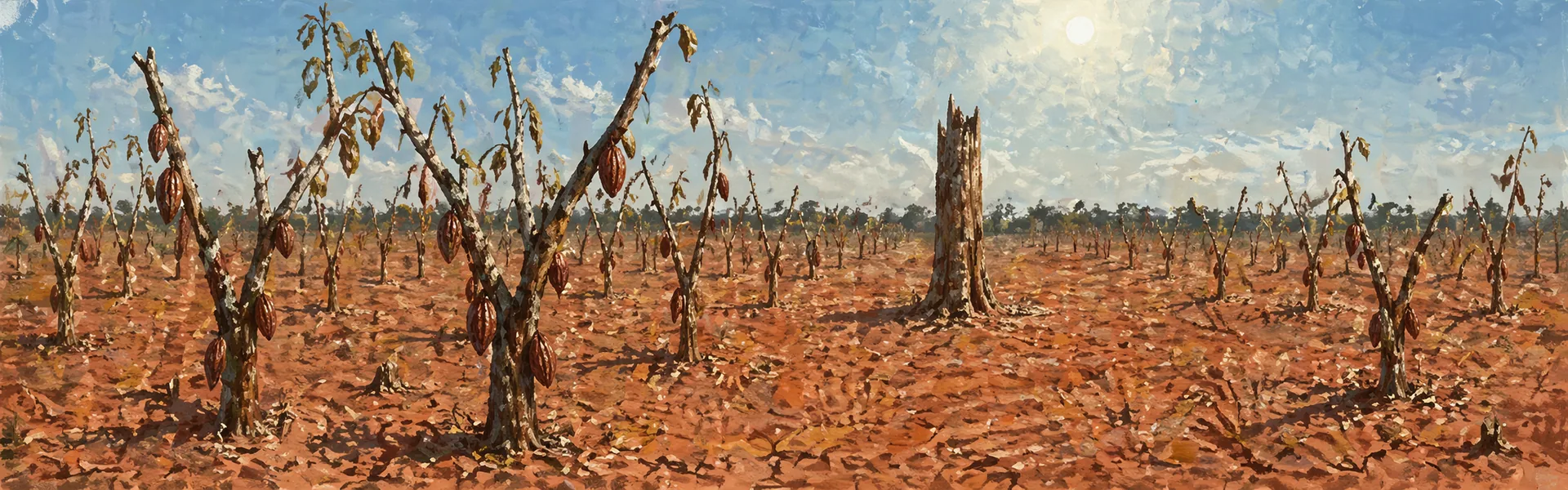
West African Cocoa: When Deforestation Strips the Shade That Beans Need
Barry Callebaut, Cargill
In 2025, Barry Callebaut reported a 35.9% decline in recurring net profit to CHF 249.6 million after deteriorating cocoa bean quality and collapsing West African harvests drove sales volumes down 6.8% and pushed free cash flow to negative CHF 312 million.1 Cargill simultaneously halted cocoa grinding at its Cote d'Ivoire plant — the first non-maintenance shutdown in the facility's history — after bean rejection rates surged to five times their normal level.2 Both companies were caught in the same trap: decades of forest clearance for cocoa farming had stripped away the shade cover that cocoa trees require to produce commercially viable beans, and rising temperatures exposed the full cost of that loss.
Barry Callebaut and Cargill sit at the centre of a global cocoa supply chain that depends on West African forests producing beans of consistent quality, and that dependency begins with the biology of the cocoa tree itself. Cocoa (Theobroma cacao) evolved as a tropical understory species, with photosynthesis peaking between 31 and 33 degrees Celsius and carbon assimilation declining sharply when atmospheric moisture drops.3 Shade trees in cocoa plantations reduce temperature swings by roughly 1.1 degrees Celsius and raise humidity by 2.7%, maintaining the conditions under which pods develop properly.3 When those conditions hold, beans meet commercial standards — around 103 beans per 100 grams, with shell content of roughly 10%.4 When shade is absent, beans from the same regions grade far worse: 123 to 135 beans per 100 grams, with shell content nearly doubling to 18-20%.4 For processors such as Cargill and Barry Callebaut, whose grinding equipment is calibrated for beans within narrow quality bands, this difference determines whether a shipment is profitable to process or must be rejected outright.
The cocoa industry's own expansion drove the deforestation that is now undermining bean quality and harvest volumes across its two largest sourcing countries. Cote d'Ivoire, the world's top producer, lost more than 80% of its original forest cover over the past 50 years, primarily to cocoa farming.5 Farmers adopted a full-sun cultivation model, deliberately killing shade trees to maximise short-term yields.5 In Ghana, the second-largest producer, nearly two million of 2.3 million hectares of cocoa land now operate under low or no shade.6 Satellite analysis published in Nature Food found that cocoa occupies 4.45 million hectares in Cote d'Ivoire — 13.8% of the country's total land area — and 2.71 million hectares in Ghana, figures roughly 40% higher than official estimates.7 Within protected areas in Cote d'Ivoire, cocoa accounts for 37.4% of all forest loss since 2000.7 The industry built its supply base by converting forest to farmland, and in doing so dismantled the microclimate regulation that its crop requires.
In September 2025, Cargill suspended grinding at its Cote d'Ivoire facility after incoming beans showed critically low fat content, elevated acidity, and excessive waste material — defects directly linked to heat stress during pod development on shade-stripped farms.2 The company had been rejecting 5-6% of deliveries in preceding weeks, compared with the normal threshold of roughly 1%.2 The problem was not confined to Cargill: across Cote d'Ivoire, grinding volumes fell 31.2% year-on-year in July 2025, to 39,301 metric tonnes.8 One grinding director told reporters that beans were "mediocre this year," with facilities "rejecting a large quantity due to a lack of fat and a high acidity level."8 Bean arrivals at Ivorian ports between April and mid-August 2025 dropped 30%, from 500,000 tonnes the prior year to 350,000 tonnes.8 The mid-crop was forecast at 400,000 tonnes — a 9% decline from the previous year's 440,000 tonnes.2
Barry Callebaut's FY 2024/25 results laid bare how supply-chain disruption translates into financial damage for the world's largest cocoa processor. Group sales volume fell 6.8% to 2,125,420 tonnes, with the Global Cocoa division suffering a 12.8% volume decline — accelerating to a 22.6% drop in the third quarter alone.1, 9 Revenue rose 49% to CHF 14.8 billion, but the increase was driven entirely by soaring input costs passed through to customers, not by growth.1 Free cash flow swung to negative CHF 312 million for the full year, and net debt to EBITDA peaked at 6.5 times before recovering to 4.5 times.1 The company acknowledged that the 2024/25 West African crop had started strongly but "quickly deteriorated into below normal arrivals beginning in February 2025 and lasting through the mid crop."1 Recurring net profit of CHF 249.6 million represented a 35.9% decline in local-currency terms — a direct measure of the margin compression caused by processing fewer, costlier, and lower-quality beans.1
Cocoa prices surged 136% between July 2022 and February 2024, reaching record levels above $12,000 per tonne as global production fell into sustained deficit.10, 11 By mid-April 2024, futures hit $11,578 per tonne, up from $2,831 just thirteen months earlier.12 Even after partial correction, prices remained at $7,391 per tonne in September 2025.2 The global cocoa deficit reached 462,000 tonnes in 2024, and supply had lagged 8.5% behind demand for three consecutive years.11, 13 Ghana, which targets 820,000 tonnes annually, saw output fall nearly 40% below that benchmark, prompting the government to raise farmgate prices by 60% in August 2025 and a further 12% in October.11, 12 For processors, these price levels created a compounding problem: not only were beans scarcer and more expensive, but the quality of available beans had deteriorated to the point where a growing share could not be processed at all.
Climate change has added approximately 40 extra days per year of excessive heat across West African cocoa regions, but the damage is amplified by the systematic removal of the shade trees that once buffered those temperatures.10 Over the past decade, two-thirds of cacao-growing areas experienced at least six additional weeks of temperatures exceeding the 32-degree-Celsius threshold above which cocoa photosynthesis declines; one-third faced eight or more additional weeks.14 In unshaded monocultures, these temperatures cause direct physiological harm: reduced chlorophyll content, damaged photosystem II function, and lower maximum photosynthesis rates.3 The visible result is shrivelled flowers and smaller, decaying pods.14 In Cote d'Ivoire, the 2024 season brought a "worst of both worlds" rainfall pattern — 40% above-normal precipitation in July followed by drought in December — layered on top of chronic heat stress that shade-stripped farms could no longer buffer.10
Cote d'Ivoire has lost more than 80% of its original forest cover in the past 50 years, primarily to cocoa expansion, and cocoa now occupies 4.45 million hectares — nearly 14% of the country's total land area.5, 7 In the Bas-Sassandra region, cocoa covers 43% of all land; in Ghana's Western Region, the figure is 44.6%.7 These are not landscapes with residual forest buffers — they are effectively wall-to-wall monoculture. Since independence in 1960, Cote d'Ivoire has lost roughly 90% of its rainforest, and cocoa is the dominant driver.13 The scale of conversion means that restoring microclimate regulation across the cocoa belt is not a matter of planting a few trees on individual farms; it requires landscape-level reforestation across millions of hectares that have been systematically stripped of canopy.
Without intervention, up to 50% of Cote d'Ivoire's current cocoa-growing area could become unsuitable for production by 2060, and 50% of shade tree species are projected to lose their range by 2040.15, 16 When modelling is restricted to deforestation-free land — excluding the possibility of simply clearing new forest — suitable cocoa area shrinks by an additional 14.5%.16 Scientists have warned that "without serious intervention, cocoa-growing regions in West Africa could become completely unsuitable for production by 2050."6 For Barry Callebaut and Cargill, this is not an abstract environmental projection. It describes the progressive erosion of the physical conditions on which their sourcing models are built, over a timeframe shorter than a single corporate planning cycle.
Early evidence from agroforestry trials suggests that restoring shade cover can reverse some of the yield and quality decline, but the scale of the challenge dwarfs current efforts. An FAO pilot project in Cote d'Ivoire saw yields rise from 120-150 kilograms per hectare to more than 250 kilograms per hectare after farms adopted shade-tree integration.17 Shaded systems also store up to 2.5 times more carbon than unshaded ones, offering a potential climate co-benefit.6 Barry Callebaut has distributed 390,000 shade trees through its sustainability programmes, but set against nearly two million hectares of shade-depleted cocoa land in Ghana alone, this represents less than one tree per five hectares of the problem.6 The mismatch between the pace of adaptation and the pace of degradation defines the sector's forward risk profile.
The West African cocoa crisis demonstrates that when an agricultural supply chain systematically removes the natural infrastructure it depends on, the resulting quality and yield collapse can deliver simultaneous damage across procurement, processing margins, and commodity pricing — a feedback loop that intensifies with each degree of warming. Cargill's grinding halt and Barry Callebaut's profit decline are not isolated events but symptoms of an ecosystem service — microclimate regulation provided by forest canopy — being withdrawn from a crop that evolved to depend on it. For investors and lenders exposed to cocoa-dependent companies, the implication is that conventional supply-risk models, which treat weather as an exogenous shock, systematically understate the risk when the industry's own land-use practices have degraded the landscape's capacity to absorb climate stress.
Footnotes
-
Barry Callebaut Group, "Full-Year Results Fiscal Year 2024/25," barry-callebaut.com, accessed 20 March 2026. ↩
-
"Cargill Halts Cocoa Grinding in Cote d'Ivoire as Bean Quality Deteriorates," CocoaRadar, accessed 20 March 2026. ↩
-
A. Asante et al., "Impact of common shade tree species on microclimate and cocoa growth in agroforestry systems in Ghana," Agroforestry Systems (2024), Springer. ↩
-
"Shade effects on cocoa bean physical and biochemical quality," PMC (2024). ↩
-
"The Real Price of a Chocolate Bar: West Africa's Rainforests," Yale Environment 360, accessed 20 March 2026. ↩
-
UNEP-WCMC, "Mapping the potential for cocoa agroforestry in Ghana for climate change adaptation and mitigation," accessed 20 March 2026; Green Economy Coalition, "Choc-free by 2050?" accessed 20 March 2026. ↩
-
K. Kalischek et al., "Cocoa plantations are associated with deforestation in Cote d'Ivoire and Ghana," Nature Food (2023). ↩
-
"Ivory Coast Cocoa Grind Down 31.2% Year-on-Year in July," CNBC Africa, accessed 20 March 2026. ↩
-
"Barry Callebaut revenue up 49% but sales down, as cocoa price hikes hit industry leader," Confectionery News, 5 November 2025. ↩
-
Climate Central, "Climate and Cocoa 2025," climatecentral.org, accessed 20 March 2026. ↩
-
Corporate Accountability Lab, "Spooky Sweets: The Frightening Reality of the 2025 Cocoa Market," 30 October 2025. ↩
-
NTU Centre for AI and Sustainability, "Cocoa Production in Ghana and Cote d'Ivoire Collapses," accessed 20 March 2026. ↩
-
"Bittersweet: The Harsh Realities of Chocolate Production in West Africa," Harvard International Review, accessed 20 March 2026. ↩
-
"Climate Change, Cacao Crops, West Africa," CBS News, accessed 20 March 2026. ↩
-
Wageningen University & Research, "Climate change puts African cocoa production under pressure," wur.nl, accessed 20 March 2026. ↩
-
"Vulnerability of cocoa-based agroforestry systems to climate change in West Africa," Scientific Reports (2023). ↩
-
FAO, "Setting up Cote d'Ivoire's cocoa sector for climate resilience," fao.org, accessed 20 March 2026. ↩