Case 3: Chilean Andes Water System — Anglo American and Arauco
Anglo American, Arauco
In 2019, Anglo American lost an estimated US$144 million in copper revenue after a record drought in central Chile forced production cuts at its Los Bronces mine. The company reported that copper output at Los Bronces fell 24,000 tonnes below plan that year, entirely because of water constraints.1 The loss was not a one-off shock. It was the sharpest year of a chronic problem that had already cost Anglo American tens of millions of dollars and would continue to constrain output into the 2020s.2 In the same drought-stressed landscape, a second major company — Arauco, one of the world's largest pulp producers — suffered an estimated US$50 million in losses when wildfires destroyed swathes of its plantation forests in early 2023.3 Together, the two cases illustrate how a single environmental system in decline can generate correlated financial losses across unrelated industries.
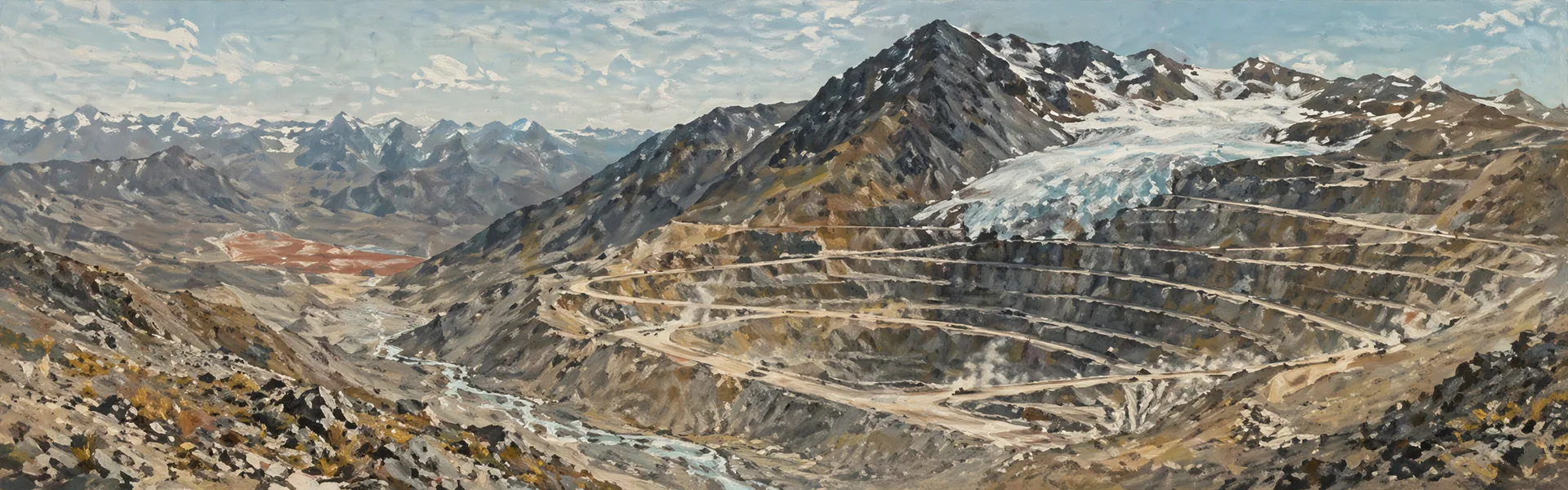
Anglo American's Los Bronces mine, high in the central Chilean Andes, depends on river water and snowmelt-fed aquifers for every stage of copper ore processing — from crushing and grinding to flotation concentration and dust suppression. Copper cannot be extracted without large and reliable volumes of water: the ore must be crushed to fine particles, mixed into a slurry, and passed through flotation cells where chemical reagents separate copper-bearing minerals from waste rock.4 Each of these steps is water-intensive, and when supply drops, plant throughput must be reduced proportionally. Los Bronces sits at approximately 3,500 metres elevation and draws its water from rivers and aquifers recharged by Andean snowpack and seasonal rainfall — sources that have been diminishing for more than a decade.2
The same Andean watersheds that Anglo American draws on have been deteriorating for more than a decade, and the company's own extraction adds to the pressure on a shrinking resource. Central Chile's water system is under stress from multiple users — agriculture, cities, mining, and hydropower — all competing for flows that have fallen well below historical norms.4 Mining operations extract water from rivers and underground aquifers, reducing the volumes available for recharge and downstream use. Anglo American has acknowledged this dynamic: the company has committed to eliminating freshwater use at Los Bronces by 2030, an implicit recognition that its current extraction pattern is unsustainable in a basin where supply is contracting.5 This two-way relationship — depending on a resource while contributing to its depletion — is a defining feature of nature-related financial risk.
Chile's megadrought — the worst in an estimated thousand years — has persisted since roughly 2010, with rainfall across central Chile falling more than 30 per cent over two decades.4 By 2019, reservoir capacity across the region had dropped to approximately 30 per cent of normal levels.2 River flows feeding the Los Bronces mine fell well below the volumes needed for full-capacity ore processing. The drought is not merely a cyclical dry spell; climate research attributes it to a combination of long-term warming trends and changes in Pacific atmospheric circulation patterns, suggesting that the conditions are structural rather than temporary.6 For any business whose operations depend on predictable freshwater supply in central Chile, this represents a permanent shift in the operating environment.
The financial damage at Los Bronces accumulated over several years: water constraints cost an estimated US$90–95 million in lost revenue in 2015, and the problem worsened as the drought deepened.4 By 2019, the 24,000-tonne production shortfall at prevailing copper prices of roughly US$6,000 per tonne translated into approximately US$144 million in forgone revenue.1 Anglo American warned investors in early 2022 that water shortage would continue to hit copper output that year, signalling that the constraint had become a recurring feature of the company's guidance rather than an exceptional disclosure.2 Over the period from 2015 to 2022, the cumulative revenue impact at Los Bronces ran well into the hundreds of millions of dollars, making water scarcity one of the most material operational risks in Anglo American's portfolio.
Roughly 500 kilometres south of Los Bronces, the same megadrought exposed an entirely different industry to nature-related financial loss: Arauco, one of the world's largest pulp producers, lost an estimated US$50 million when catastrophic wildfires swept through its plantation forests in early 2023.3 In January and February of that year, temperatures in southern Chile reached 40 degrees Celsius, and drought-dried vegetation ignited across central Chile, ultimately burning more than 430,000 hectares.7 Arauco's plantations and the area around its Nueva Aldea pulp mill in the Biobio region were directly affected, with timber stocks destroyed and mill operations disrupted.3 CMPC, another major Chilean pulp producer, suffered similar impacts, demonstrating that the losses were landscape-wide rather than company-specific.3
Arauco's plantations — nearly one million hectares of pine and eucalyptus across the Biobio, Maule, and Araucania regions — illustrate a particularly clear feedback loop between business activity and nature degradation.8 Pine and eucalyptus monocultures consume significantly more water than Chile's native forests, reducing soil moisture and groundwater levels in the surrounding landscape.9 The same species are also more flammable than native vegetation, meaning that the plantations simultaneously dry out the landscape and provide more combustible fuel when fires do ignite.9 Arauco's business model — converting native forest and agricultural land into fast-growing plantation monoculture — has, over decades, contributed to the very conditions that made the 2023 fires so destructive. This feedback loop between land-use decisions and fire risk is well documented in the scientific literature on Chilean forestry.10
The 2023 fires were not an isolated event but the latest in a pattern of escalating fire seasons linked to the megadrought and the expansion of plantation monocultures. In 2017, Chile experienced what were then its worst-ever wildfires, burning more than 500,000 hectares and causing significant damage to Arauco's operations.11 The US Department of Agriculture documented the scale of destruction to Chile's agricultural and forestry sectors that year.12 Research published in peer-reviewed journals has established that the expansion of plantation area in central and southern Chile has significantly increased fire susceptibility across the landscape, creating conditions for recurrent mega-fire events.10 Each fire season destroys timber that takes 15–25 years to regrow, meaning that the financial damage compounds over time rather than resetting annually.
Anglo American's response to chronic water scarcity illustrates how nature-dependency risk eventually reprices itself in the capital budget. In November 2022, the company announced that it had secured a desalinated water supply for Los Bronces, contracting for seawater to be desalinated on the coast and piped uphill to the mine at 3,500 metres elevation.13 Anglo American has also stated its intention to stop using fresh water at Los Bronces entirely by 2030, replacing it with desalinated and recycled water.5 These investments represent a significant capital outlay — desalination and high-altitude pipeline infrastructure is expensive to build and energy-intensive to operate.14 In effect, the company is internalising a cost that was previously externalised: the reliable supply of freshwater, once provided free by the Andean hydrological cycle, must now be manufactured and transported at industrial scale.
Arauco's adaptation path has been slower and more constrained, reflecting the difficulty of restructuring a business model that is, in effect, a monoculture land-use strategy. While the company maintains firefighting capacity and has invested in fire detection technology, the fundamental vulnerability — vast tracts of flammable monoculture in a drying climate — remains largely unchanged.8 Industry observers have noted that the crisis in the Chilean forestry sector is structural, driven by the intersection of drought, fire risk, and declining productivity in plantation areas.15 Diversifying species mix, restoring native forest buffers, or shifting to less water-intensive land use would require decades and could reduce near-term timber yields, creating a tension between short-term financial performance and long-term resilience. Investors in Arauco, including global asset managers, face the challenge of valuing a business whose core asset — standing timber — is increasingly exposed to climate-amplified destruction.16
The Chilean Andes landscape demonstrates that nature-dependency risk is not confined to a single company or sector but can cascade across an entire regional economy when a shared environmental system degrades. Anglo American and Arauco operate in different industries, produce different commodities, and sell into different markets. Yet both depend on the same hydrological system — the rainfall, snowmelt, and river flows of central and southern Chile — and both have been financially damaged by its deterioration. The megadrought has simultaneously constrained copper production in the Andes and amplified wildfire destruction in the lowland forests, generating correlated losses that would not be captured by conventional single-company risk assessment. For investors and regulators, the Chilean case underscores the need to assess nature-related risk at the landscape level, recognising that ecosystem degradation can create systemic exposure across otherwise unrelated portfolio holdings.
Footnotes
-
Anglo American plc, "Q4 2019 Production Report," 23 January 2020. https://www.angloamerican.com/media/press-releases/2020/23-01-2020 ↩
-
S&P Global Commodity Insights, "Anglo American warns water shortage to hit 2022 copper output," 28 January 2022. https://www.spglobal.com/commodityinsights/en/market-insights/latest-news/metals/012822-anglo-american-warns-water-shortage-to-hit-2022-copper-output ↩
-
EUWID Pulp and Paper, "Chile wildfires impact pulp production at Arauco and CMPC," 9 February 2023. https://www.euwid-paper.com/news/companies/wild-fires-impact-pulp-production-at-arauco-und-cmpc-090223/ ↩
-
CRU Group, "Water — a major disrupter to copper supply," 2020. https://www.crugroup.com/en/communities/thought-leadership/2020/water-a-major-disrupter-to-copper-supply ↩
-
Mining.com, "Anglo American to stop using fresh water at Los Bronces by 2030." https://www.mining.com/web/anglo-american-to-stop-using-fresh-water-at-los-bronces-by-2030/ ↩
-
Gonzalez et al., "Extreme fire weather in Chile driven by climate change and El Nino-Southern Oscillation (ENSO)," Nature Scientific Reports, 2024. https://www.nature.com/articles/s41598-024-52481-x ↩
-
Wikipedia, "2023 Chile wildfires." https://en.wikipedia.org/wiki/2023_Chile_wildfires ↩
-
Celulosa Arauco y Constitucion S.A., "20-F Annual Report," 2017. https://www.sec.gov/Archives/edgar/data/1004156/000119312518126662/d573136d20f.htm ↩
-
Environmental Paper Network, "Forest fires in Chile — chronicle of a catastrophe foretold," February 2024. https://environmentalpaper.org/2024/02/forest-fires-in-chile-chronicle-of-a-catastrophe-foretold/ ↩
-
Gonzalez et al., "Human-environmental drivers and impacts of the globally extreme 2017 Chilean fires," Environmental Research Letters, 2019. https://pmc.ncbi.nlm.nih.gov/articles/PMC6411810/ ↩
-
USDA Foreign Agricultural Service, "Wildfires Damage Agricultural and Forest Areas — Chile," May 2017. https://apps.fas.usda.gov/newgainapi/api/Report/DownloadReportByFileName?fileName=Wildfires+Damage+Agricultural+and+Forest+Areas+_Santiago_Chile_5-24-2017.pdf ↩
-
USDA Foreign Agricultural Service, "Wildfires Damage Agricultural and Forest Areas — Chile," May 2017. https://apps.fas.usda.gov/newgainapi/api/Report/DownloadReportByFileName?fileName=Wildfires+Damage+Agricultural+and+Forest+Areas+_Santiago_Chile_5-24-2017.pdf ↩
-
Anglo American plc, "Anglo American secures desalinated water supply for Los Bronces copper mine in Chile," 23 November 2022. https://www.angloamerican.com/media/press-releases/2022/23-11-2022 ↩
-
Mining Weekly, "Anglo looks to the sea as water scarcity hits Chile copper mines," 29 March 2022. https://www.miningweekly.com/article/anglo-looks-to-the-sea-as-water-scarcity-hits-chile-copper-mines-2022-03-29/rep_id:3650 ↩
-
ACOFORAG, "The crisis in the sector is real, but Chile remains a global benchmark," November 2024. https://www.acoforag.cl/en/noticias/2024/11/29/the-crisis-in-the-sector-is-real-but-chile-remains-a-global-benchmark/ ↩
-
Vanguard SOS, "Conflict and controversy swirl around Vanguard investments in Chilean pulp giant Arauco." https://vanguard-sos.com/conflict-and-controversy-swirl-around-vanguard-investments-in-chilean-pulp-giant-arauco/ ↩