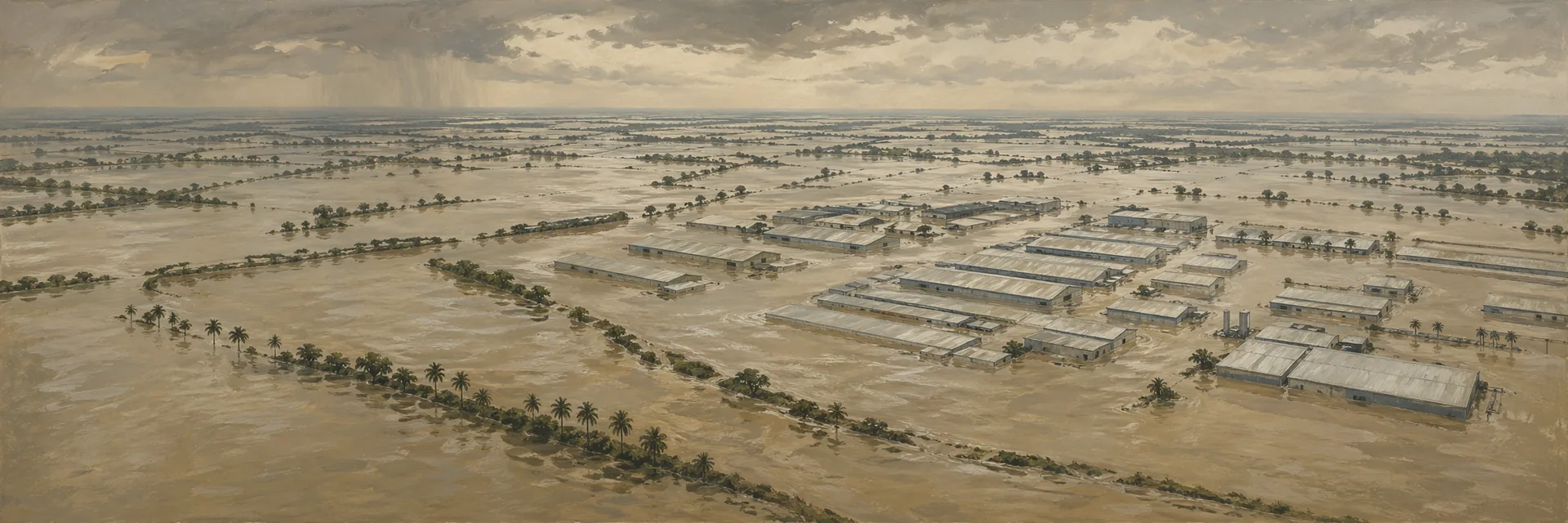
Chao Phraya Basin: When the Floodplain Fought Back
Honda Motor Co., Western Digital, Nikon
In 2011, Honda Motor Co. saw its annual operating income fall 59% -- a decline of more than Y338 billion -- after monsoon flooding submerged its largest Southeast Asian assembly plant for 45 days, halting production of 200,000 vehicles and triggering a $650 million factory rebuild.1, 2, 3 Audited results for the fiscal year ending March 2012 showed operating income of Y231.3 billion, down from Y569.7 billion, and net income of Y211.4 billion, down 60.4% from Y534.0 billion.1 Honda attributed the decline to "decreased automobile production due to the Great East Japan Earthquake, the floods in Thailand and negative foreign currency translation effects," but the Thailand flooding was the dominant driver of the production shortfall.1, 4 The episode was not unique to Honda. Two other major manufacturers -- Western Digital and Nikon -- suffered comparable disruption in the same basin during the same weeks, revealing a shared vulnerability rooted in a common landscape.
Honda, Western Digital, and Nikon had each concentrated critical manufacturing capacity in industrial parks built on the Chao Phraya floodplain north of Bangkok, staking production on the assumption that upstream forests, wetlands, and rice paddies would continue to absorb monsoon rainfall and keep flood levels below the threshold that would reach their factory floors.5, 6, 7 Honda Automobile (Thailand) operated a 240,000-vehicle-per-year assembly plant at Rojana Industrial Park in Ayutthaya -- its largest facility in Southeast Asia.4 Western Digital's Thai plants produced roughly a quarter of global hard-disk drive supply and accounted for 43% of the worldwide HDD manufacturing base.8, 9 Nikon (Thailand) manufactured 90% of the company's SLR cameras at a separate facility within the same Rojana complex.7 In each case, the business model depended on a landscape-level service -- the capacity of the upstream watershed to absorb and delay monsoon peak flows -- that appeared in none of their risk disclosures.
The landscape that these manufacturers depended on had been systematically degraded over five decades: Thailand's forest cover fell from 53% in 1961 to roughly 25% by 2000, with northern headwater regions particularly affected, and the floodplain rice paddies that once absorbed seasonal water were paved over to build the very industrial estates that now needed protection from flooding.10, 11 The deforestation rate between 1965 and 1989 averaged 2.6% per year.10 Six of the seven industrial estates that flooded in 2011 were built on former rice paddies, replacing permeable agricultural land with impervious surfaces that could no longer store or slow floodwater.5, 11 The Yom River floodplain, a major Chao Phraya tributary, had been "largely deforested for rice cultivation and its natural seasonal flow modified by flood control and irrigation infrastructure."12 Each conversion -- forest to farm, farm to factory -- removed another layer of the basin's capacity to buffer extreme rainfall.
When exceptional monsoon rains arrived in 2011, the depleted watershed could not attenuate peak flows, and seven major industrial estates were submerged under up to three metres of water, shuttering nearly 1,000 factories and generating $45.7 billion in economy-wide damages -- the costliest flood event in global insurance history.13, 14, 15 The World Bank's rapid assessment found that the manufacturing sector alone accounted for $32 billion of total losses, or 71% of the national damage figure.13 Insured losses reached $12-15 billion, dwarfing prior flood-insurance records globally.14 The concentration of damage in manufacturing -- rather than agriculture or housing -- reflected the fact that industrial estates had been sited precisely where natural flood absorption had been highest and was now gone.
Honda's Rojana Industrial Park plant was submerged under 2.5 metres of floodwater from 8 October, destroying 80% of its manufacturing equipment, including every robotics system, and forcing the company to scrap 1,055 completed vehicles that could not be sold or salvaged.2, 3, 16 Production had been suspended on 4 October due to parts-supply disruptions; four days later, floodwater entered the facility and remained for 45 days.4, 2 Honda's initial estimate of twelve months' downtime was reduced to five months through intensive recovery efforts by Japanese engineers and Thai workers, with the plant resuming operations on 26 March 2012.2, 3 The disruption cascaded globally: Honda's Japanese factories at Suzuka and Saitama began production adjustments on 7 November 2011 due to limited Thai parts supply.4 Honda considered relocating the plant but concluded that relocation costs and delays were prohibitive, choosing instead to rebuild in place.2
Western Digital's Bang Pa-In plant sat under six feet of water from 15 October, cutting the company's hard-drive shipments from 52.2 million to 28.5 million units in a single quarter and removing 45% of global HDD assembly capacity from the market.6, 8, 9 The company pumped its facility dry by 17 November, restored main power by 26 November, and restarted hard-drive production on 30 November -- a 46-day recovery that became a widely studied example of crisis management.6 Gross flood charges totalled $225-275 million for the December 2011 quarter, with a net cost after insurance of $199 million.6, 8 Hard-drive industry shipments for the quarter were limited to approximately 120 million units against estimated demand of 170-180 million, creating the supply deficit that would reshape Western Digital's financial trajectory for the following year.6
Nikon, which manufactured 90% of its SLR cameras at its Rojana facility, suspended production on 6 October and booked an extraordinary loss of Y10.9 billion on destroyed fixed assets and inventory, with an estimated Y65 billion in lost sales and Y25 billion in lost operating income for the fiscal year.7, 17, 18 All buildings' first floors were submerged, and water was not fully removed until 26 November.19 Nikon achieved a partial restart on 3 January 2012 -- earlier than expected -- and normalised production by March, assisted by emergency manufacturing at Japanese group facilities and Thai partner factories.20, 19 The company's initial insurance recovery was just Y500 million of the Y10.9 billion loss, with additional payments pending.17
The financial outcomes diverged in ways that illuminate how supply-chain structure mediates nature-dependency risk: Honda's profit fell 60% and it spent $650 million rebuilding; Western Digital absorbed $199 million in net flood costs yet posted its most profitable year ever as the global HDD shortage doubled prices; Nikon's Precision Equipment division offset imaging losses, and the company doubled its dividend.1, 3, 21, 17 Western Digital's fiscal year 2012 revenue reached $15.64 billion, up 67% from $9.34 billion, and its third quarter alone produced $483 million in net income -- what CEO John Coyne called "the strongest revenue and profit performance in the company's 42-year history."21, 22 The paradox is instructive. Western Digital's direct flood costs were real and large, but the industry-wide supply destruction allowed surviving capacity to command premium pricing. Honda, selling into a competitive auto market with no comparable supply constraint, absorbed the full loss. The same flood, in the same basin, produced opposite financial outcomes depending on market structure -- but the underlying nature dependency was identical.
Peer-reviewed research has since quantified the link between upstream deforestation and flood severity in the Chao Phraya basin: each 1% reduction in forest cover increases annual streamflow by 1.9% basin-wide and by 2.5-5.4% in upstream sub-basins, confirming that forest loss was not merely correlated with flooding but hydrologically causal.23 Thailand lost roughly half its forest cover between 1961 and 2000, implying a substantial and measurable increase in the volume and speed of monsoon runoff reaching downstream industrial areas.10 The 1988 floods, which killed 350 people, had already demonstrated the link between deforestation and flood severity, prompting a national logging ban -- but forest recovery was slow, and floodplain conversion to impervious surfaces continued.10 The 2011 event was not an unforeseeable natural disaster. It was the predictable consequence of decades of cumulative watershed degradation, amplified by an unusually heavy monsoon.
The corporate response was entirely engineering-based: Rojana Industrial Park invested $63.7 million in a 75-kilometre concrete flood wall designed to a 100-year-plus-climate-change standard, and the seven flooded estates collectively spent approximately $163 million on perimeter defences, with the Thai government covering two-thirds of the cost.24, 25 Rojana's system now features triple-layer protection: an outer ring dike, an inner ring highway embankment, and a self-protective dike, all engineered to +6.0 metres above mean sea level based on JICA-advised standards.24 These investments are substantial and may prove effective against future flooding. But they address the symptom -- water arriving at the factory perimeter -- rather than the cause: the continuing loss of the upstream watershed's capacity to store and slow that water. None of the three companies' annual reports, 10-K filings, 20-F disclosures, or sustainability reports mentioned upstream deforestation, wetland loss, or ecosystem degradation as a risk factor.26, 27
The Chao Phraya case demonstrates a pattern likely to recur wherever manufacturers concentrate production on degraded floodplains: the natural systems that historically buffered industrial areas from extreme weather have been eroded by decades of land-use change, yet corporate risk frameworks continue to treat flooding as an exogenous hazard rather than a consequence of measurable ecosystem decline. Honda, Western Digital, and Nikon collectively lost billions of dollars because the forests and wetlands upstream of their factories had been cleared. Their response -- concrete walls rather than watershed restoration -- may reduce the probability of a repeat event at these specific sites. But it does nothing to address the underlying dynamic: industrial production sited in landscapes whose natural defences are being dismantled. For investors and regulators assessing nature-related financial risk, the lesson is that flood exposure on a degraded floodplain is not a static hazard to be engineered around. It is a dynamic risk that increases as the ecosystem continues to decline.
Footnotes
-
Honda Motor Co., "FY2012 Financial Results," April 2012. https://global.honda/en/newsroom/news/2012/c120427eng.html ↩
-
GoAuto, "Thai flood nightmare ends for Honda," April 2012. https://www.goauto.com.au/news/honda/thai-flood-nightmare-ends-for-honda/2012-04-02/18840.html ↩
-
The Truth About Cars, "Thai Flood: Honda Plant Pulled Out of the Water Dead," January 2012. https://www.thetruthaboutcars.com/2012/01/thai-flood-honda-plant-pulled-out-of-the-water-dead/ ↩
-
Honda Motor Co., "About the Impact of Flooding in Thailand on Honda Operations (as of October 31, 2011)," October 2011. https://global.honda/en/newsroom/news/2011/c111031aeng.html ↩
-
Facts and Details, "2011 Thailand Floods," accessed 2026. https://factsanddetails.com/southeast-asia/Thailand/sub5_8h/entry-3325.html ↩
-
Western Digital, "WD Updates December Quarter Outlook, Reports on Recovery Effort in Thailand," November 2011. https://www.prnewswire.com/news-releases/wd-updates-december-quarter-outlook-reports-on-recovery-effort-in-thailand-134877193.html ↩
-
Nikon Corporation, "3rd Notice on the damage from the flood in Thailand," November 2011. https://www.nikon.com/company/news/2011/1104_01_e.html ↩
-
StorageReview, "Western Digital Offers Update on Thailand Factory Recovery Efforts and Market Effects," 2011. https://www.storagereview.com/news/western-digital-offers-update-on-thailand-factory-recovery-efforts-and-market-effects ↩
-
Columbia University Earth Institute, "Floods, Companies, and Supply Chain Risk," November 2014. https://news.climate.columbia.edu/2014/11/17/floods-companies-and-supply-chain-risk/ ↩
-
Facts and Details, "Deforestation in Thailand," accessed 2026. https://factsanddetails.com/southeast-asia/Thailand/sub5_8h/entry-3327.html ↩
-
PA Times, "Lessons Learned from the 2011 Flooding in Thailand," accessed 2026. https://patimes.org/lessons-learned-2011-flooding-thailand/ ↩
-
Mongabay, "Thailand tries nature-based water management to adapt to climate change," December 2023. https://news.mongabay.com/2023/12/thailand-tries-nature-based-water-management-to-adapt-to-climate-change/ ↩
-
World Bank, "World Bank Supports Thailand's Post-Floods Recovery Effort," December 2011. https://www.worldbank.org/en/news/feature/2011/12/13/world-bank-supports-thailands-post-floods-recovery-effort ↩
-
Insurance Journal, "Thailand Flood Losses," December 2011. https://www.insurancejournal.com/magazines/mag-features/2011/12/05/226165.htm ↩
-
Asian Development Bank / SEA-DS, "Managing Floods and Droughts in Thailand's Chao Phraya," accessed 2026. https://seads.adb.org/articles/managing-floods-and-droughts-thailands-chao-phraya-ensuring-river-health-must ↩
-
IndustryWeek, "Honda Scraps 1,000 Flood-Ravaged Cars in Thailand," 2012. https://www.industryweek.com/the-economy/article/21933684/honda-scraps-1000-flood-ravaged-cars-in-thailand ↩
-
Nikon Corporation, "Extraordinary Losses Due to the Flooding in Thailand," February 2012. https://www.nikon.com/company/news/2012/0203_01.html ↩
-
Nikon Corporation, "4th Notice on the damage from the flood in Thailand," December 2011. https://www.nikon.com/company/news/2011/1201_01_e.html ↩
-
Nikon Corporation, "4th Notice on the damage from the flood in Thailand," December 2011. https://www.nikon.com/company/news/2011/1201_01_e.html ↩
-
Nikon Corporation, "Update on recovery from the flood in Thailand," January 2012. https://www.nikon.com/company/news/2012/0110_01_e.html ↩
-
The Register, "WD Q3 FY2012 Results," April 2012. https://www.theregister.com/2012/04/27/wd_q3fy2012/ ↩
-
CompaniesMarketCap, "Western Digital Revenue," accessed 2026. https://companiesmarketcap.com/western-digital/revenue/ ↩
-
Zhong et al., "Impact of forest cover change on streamflow in the Upper Chao Phraya River Basin," Journal of Hydrology, 2022. https://www.sciencedirect.com/science/article/pii/S0022169422000075 ↩
-
Rojana Industrial Park, "Flood Protection," accessed 2026. https://rojana.com/whyinvestrojana/0-5-FLOOD-PROTECTION ↩
-
The Nation Thailand, "Industrial estates go all out to avoid repeat of 2011 flood disaster," 2012. https://www.nationthailand.com/news/general/40042196 ↩
-
Western Digital, "Form 10-K FY2012," SEC EDGAR. https://www.sec.gov/Archives/edgar/data/106040/000119312512361018/d356205d10k.htm ↩
-
Honda Motor Co., "Form 20-F Risk Factors," accessed 2026. https://global.honda/en/investors/library/form20_f.html ↩