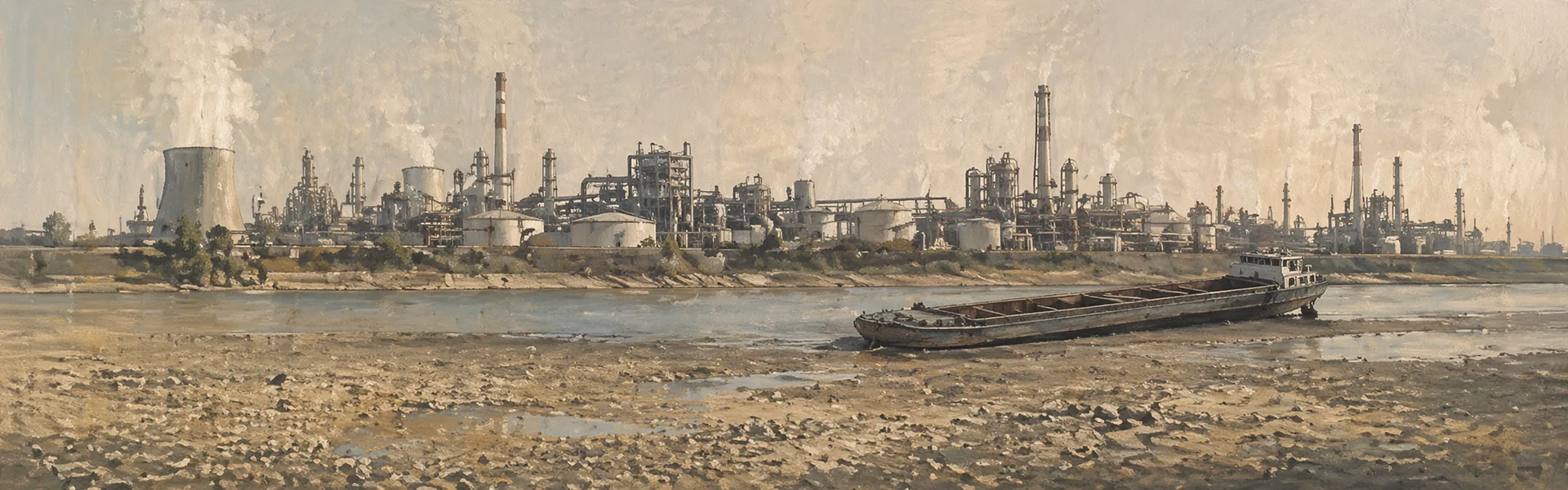
BASF: When the Rhine Ran Dry, Europe's Largest Chemical Plant Shut Down
BASF SE
In 2018, BASF SE saw its annual earnings fall by approximately EUR 250 million after an unprecedented drought reduced the Rhine to historic lows, forcing production shutdowns at the world's largest integrated chemical complex.1 Full-year group earnings before special items dropped 17% to EUR 6,353 million, with the Chemicals segment -- hardest hit by the Rhine disruption -- recording a 20% decline in operating profit.2, 3 On 7 December, BASF issued a profit warning that doubled its forecast earnings decline, triggering a 5.5% share price fall and wiping approximately EUR 3.1 billion from the company's market capitalisation.4, 5 The episode exposed a dependency that had been hiding in plain sight: Europe's largest chemical company had built its flagship operation on the assumption that the Rhine would always flow.
BASF's Ludwigshafen Verbund site -- a single complex contributing to EUR 62.7 billion in group sales -- depends on the Rhine River for two functions that have no ready substitute: transporting 40% of its incoming raw materials by barge, and supplying 1.7 billion cubic metres of water annually for industrial cooling.6, 7, 8 BASF's own annual report describes the Rhine as "the most important transportation route for incoming raw materials."7 The site uses 87% of its vast water intake -- drawn predominantly from the Rhine -- for cooling processes, after which it is recirculated back to the river.8 Under the regulatory framework of the International Commission for the Protection of the Rhine, industrial facilities are prohibited from discharging heated cooling water when river temperatures exceed 28 degrees Celsius, meaning that both the volume and the temperature of the Rhine directly constrain production capacity.9 For a facility of this scale, reliable river conditions are as fundamental to operations as electricity supply.
The same industrial model that relies on stable river flows contributes to the climate forcing that destabilises them. BASF is one of the world's largest chemical producers, and the chemical industry's greenhouse gas emissions contribute to the global warming that is shifting the Rhine's hydrological baseline. Data from the International Commission for the Protection of the Rhine show that average Rhine water temperatures increased 1 to 1.5 degrees Celsius between 1978 and 2011, with an upward trend in the number of days exceeding 22 degrees Celsius.9 BASF's 2024 annual report acknowledges the feedback loop explicitly: "the transportation of key raw materials and products depends materially on water levels on the River Rhine," while the company's own operations contribute to the atmospheric carbon loading that drives the droughts and heatwaves making those water levels less reliable.10 This is the signature of a double materiality problem -- the company both depends on and degrades the natural system that underpins its business.
From April through August 2018, a persistent high-pressure system over northern Europe produced the warmest summer on record in northern Germany, the lowest rainfall ever measured in central Germany, and drought conditions across 90% of German territory.11 Rhine water levels fell to historic lows at gauging stations along the river's entire navigable length. At Kaub -- the critical chokepoint approximately 100 kilometres downstream of Ludwigshafen -- water depth fell to 25 centimetres in October, an all-time record.12 At Worms, near Ludwigshafen itself, the level dropped to just 10 centimetres.12 The Rhine waterway was closed to goods transport for a total of 132 days during 2018.13 River temperatures simultaneously climbed toward the 28-degree regulatory threshold, compressing the window during which BASF could legally discharge heated cooling water.9
The drought struck BASF through two simultaneous channels. Large chemical barges, which typically carry 1,000 metric tons and require at least 40 centimetres of water depth, could not navigate at all; even smaller barges carrying 300 to 400 metric tons need 20 to 25 centimetres.12 BASF's own results announcement confirmed that "for much of the third and fourth quarter, it was nearly impossible to receive deliveries of raw materials via ship."1 At the same time, regulations prevented BASF from running its cooling systems at full capacity because Rhine water was too warm. The company acknowledged that "not all of its plants can be sufficiently cooled for them to operate at full output."14 The two constraints reinforced each other: even where raw materials could be sourced by alternative means, cooling limitations independently constrained how much BASF could produce.
BASF's operational response escalated in three phases. In August, the company began reducing production at Ludwigshafen because cooling water from the Rhine was insufficient under regulatory temperature limits.14, 15 In October, as water levels continued to fall, BASF declared force majeure on methacrylic acid and other products, a contractual step signalling that disruption had exceeded normal business risk.16 By November, BASF was forced to shut its Ludwigshafen TDI (toluene diisocyanate) production facility entirely, because "despite maximum shift to alternative transport (pipeline, trucks, rail), not all raw materials could be supplied."17 CEO Martin Brudermüller stated that "throughout the entire third quarter, we had to struggle with this, which led to production cutbacks and higher transportation costs."18 The modal shift to road and rail -- attempting to replace river barges with trucks -- raised transport costs sharply even where it was physically possible.
The financial damage was precise and disclosed. BASF quantified the Rhine low-water impact at approximately EUR 50 million in the third quarter and EUR 200 million in the fourth, totalling EUR 250 million for the year.1, 18, 19 On 7 December, the company issued a profit warning, revising its full-year EBIT forecast from a "slight decline of up to 10%" to a "considerable decrease of 15% to 20%," explicitly citing the Rhine as a major factor.4 The share price fell from EUR 60.69 to a year-low of EUR 58.40 by 10 December; the European chemicals sector index (SX4P) fell 2.3%, making it the worst-performing sector on the day.5 Full-year European EBIT fell 22% to EUR 3,210 million, with BASF's annual report attributing the decline to "higher raw materials prices, temporary plant shutdowns as well as the low water levels on the Rhine River."20 The Rhine impact alone -- EUR 250 million -- represented 19% of the company's total EUR 1,292 million earnings decline.2
The disruption extended well beyond BASF. Evonik cut production at all six of its German chemical facilities dependent on Rhine shipping.12 Covestro warned of lower profits. The Kiel Institute for the World Economy estimated that a month of sustained low water levels reduced German industrial production by approximately 1%, and Deutsche Bank Research calculated that the 2018 drought reduced German GDP by 0.2%.13 The Rhine carries roughly 80% of Germany's inland waterway freight, and its failure as a transport corridor rippled through automotive, steel, and energy supply chains along its 1,230-kilometre length. BASF was the most exposed because of its scale and concentration, but it was far from alone.
Before 2018, BASF's risk framework treated Rhine low water as a routine logistics contingency -- one sub-case of weather-related supply interruption, managed by "switching to unaffected logistics carriers."21 The 2018 event overwhelmed that framework. Historical precedents -- the 2003 heatwave and the 2013 flood -- had prompted earlier resilience investments, but 2018 "exceeded the capacity of existing mitigation measures."22 In its 2019 annual report, BASF acknowledged the shift in risk category explicitly, stating that it could "no longer rule out the effects of extreme low-water situations caused by climate change at our Verbund site in Ludwigshafen."23 The language marked a transition from treating low water as an operational nuisance to recognising it as a structural threat to the company's most important production facility.
BASF invested EUR 23 million from 2019 to 2022 in Ludwigshafen resilience measures, split roughly evenly between logistics adaptations and cooling capacity expansion.22 On the logistics side, the company expanded on-site storage tanks to buffer against supply interruptions, developed an early warning system for low water levels, made loading stations more flexible, and commissioned a purpose-built low-water barge -- the Stolt Ludwigshafen, 135 metres long and 30 metres wide, capable of carrying 650 metric tons even at 1.6 metres of water depth, compared with 2,500 metric tons at normal flow.7, 23, 24 On the cooling side, BASF commissioned a new recooling plant in 2020 that "makes the site less dependent on changes in water temperature and water levels on the Rhine."25 The investment proved effective: when a subsequent low-water episode occurred in 2022, it had "negligible impact on production capacity."22
The BASF case demonstrates a pattern increasingly visible across European heavy industry: companies whose business models were designed around the assumption of stable natural systems -- navigable rivers, predictable rainfall, temperate summers -- face escalating physical risk as climate change erodes the environmental conditions their operations were built to exploit. BASF's EUR 23 million adaptation spend was modest relative to the EUR 250 million the 2018 event cost, and the company's 2024 annual report confirms that it is "currently working to more precisely determine the scope of materiality of this risk."10 For investors, the lesson is that physical climate risk is not a future scenario but a present-day earnings driver -- one that can move from a footnote in a risk report to a profit warning in the space of a single dry summer. As of 2024, BASF has set a threshold: for site-specific risks exceeding EUR 10 million, adaptation plans are mandatory.10 The Rhine event cleared that bar by a factor of twenty-five.
Footnotes
-
BASF SE, "BASF posts slight increase in 2018 sales and decline in earnings," press release, 26 February 2019. https://www.basf.com/global/en/media/news-releases/2019/02/p-19-141 ↩
-
BASF SE, Annual Report 2018, "Income from Operations." https://report.basf.com/2018/en/managements-report/basf-group-business-year/results-of-operations/income-from-operations.html ↩
-
BASF SE, Annual Report 2018, "Chemicals Segment Business Review." https://report.basf.com/2018/en/managements-report/segments/chemicals/business-review.html ↩
-
BASF SE, "BASF updates forecast for fiscal year 2018," press release, 7 December 2018. https://www.basf.com/global/en/media/news-releases/2018/12/p-18-399.html ↩
-
Euronews, "European stocks tumble as investors shun risk; BASF hit by profit warning," 10 December 2018. https://www.euronews.com/2018/12/10/european-stocks-tumble-as-investors-shun-risk-basf-hit-by-profit-warning ↩
-
BASF SE, Annual Report 2018, "Sales." https://report.basf.com/2018/en/managements-report/basf-group-business-year/results-of-operations/sales.html ↩
-
BASF SE, Annual Report 2018, "Transportation and Storage." https://report.basf.com/2018/en/managements-report/responsibility-along-the-value-chain/environmental-protection-health-and-safety/transportation-and-storage.html ↩
-
BASF SE, Annual Report 2018, "Water." https://report.basf.com/2018/en/managements-report/responsibility-along-the-value-chain/environmental-protection-health-and-safety/water.html ↩
-
International Commission for the Protection of the Rhine (ICPR), "Temperature," accessed 2026. https://www.iksr.org/en/topics/water-quality/surface-waters/temperature ↩
-
BASF SE, Annual Report 2024, "E1 -- Climate Change." https://report.basf.com/2024/en/combined-managements-report/consolidated-sustainability-statement/environment/e1-climate-change.html ↩
-
Phys.org, "Low river water chaos in Germany," October 2018. https://phys.org/news/2018-10-river-chaos-germany.html ↩
-
Chemical & Engineering News (C&EN), "Low-flowing Rhine shuts BASF plant," November 2018. https://cen.acs.org/business/economy/Low-flowing-Rhine-shuts-BASF/96/i48 ↩
-
Clean Energy Wire, "Low water levels on Rhine River a threat to German economic recovery," accessed 2026. https://www.cleanenergywire.org/news/low-water-levels-rhine-river-threat-german-economic-recovery-analysts ↩
-
Plastics News, "BASF reducing production due to low river levels," 6 August 2018. https://www.plasticsnews.com/article/20180806/NEWS/308069996/basf-reducing-production-due-to-low-river-levels ↩
-
BASF SE, "Heat and drought: A challenge for production and logistics at the Ludwigshafen site," press release, August 2018. https://www.basf.com/global/en/media/news-releases/2018/08/p-18-287 ↩
-
ICIS, "BASF declares force majeure on MAA at Ludwigshafen on low River Rhine levels," 25 October 2018. https://www.icis.com/explore/resources/news/2018/10/25/10268592/basf-declare-force-majeure-on-maa-at-ludwigshafen-germany-on-low-river-rhine-levels/ ↩
-
BASF SE, press release, November 2018. https://www.basf.com/global/en/media/news-releases/2018/11/p-18-388 ↩
-
BASF SE, "BASF reports third quarter 2018 results," press release, 24 October 2018. https://www.basf.com/global/en/media/news-releases/2018/10/p-18-343.html ↩
-
BASF SE, "BASF updates forecast for fiscal year 2018," press release, 7 December 2018. https://www.basf.com/global/en/media/news-releases/2018/12/p-18-399.html ↩
-
BASF SE, Annual Report 2018, "Regional Results." https://report.basf.com/2018/en/managements-report/regional-results.html ↩
-
BASF SE, Annual Report 2018, "Opportunities and Risks Report." https://report.basf.com/2018/en/managements-report/forecast/opportunities-and-risks-report/short-term-opportunities-and-risks.html ↩
-
Planet Tracker, "BASF Climate Transition Analysis," December 2024. https://planet-tracker.org/wp-content/uploads/2024/12/BASF-CTA-Update.pdf ↩
-
BASF SE, Annual Report 2019, "Opportunities and Risks Report." https://report.basf.com/2019/en/managements-report/forecast/opportunities-and-risks-report/short-term-opportunities-and-risks.html ↩
-
Chemical & Engineering News (C&EN), "BASF builds ship for low-flow Rhine," February 2021. https://cen.acs.org/business/petrochemicals/BASF-builds-ship-low-flow/99/i4 ↩
-
BASF SE, Annual Report 2020, "Water." https://report.basf.com/2020/en/managements-report/responsibility-along-the-value-chain/environmental-protection-health-and-safety/water.html ↩