ArcelorMittal: When a Mining Giant's Expansion Met a Forest-Borne Epidemic
ArcelorMittal
In 2014, ArcelorMittal suspended a $1.7 billion mine expansion and incurred $10.6 million in direct costs after the Ebola epidemic swept through Liberia, forcing the evacuation of 2,400 contractors and halting construction at the company's largest iron ore growth project for seven years.1, 2 The Phase 2 expansion at ArcelorMittal's Yekepa mine in Nimba County was designed to triple iron ore production from five to fifteen million tonnes per year and accounted for two-thirds of the mining division's planned 2015 growth.2, 3 Instead, the project sat idle from August 2014 until 2021, when the company announced it would require roughly $800 million in fresh capital to restart construction.4 ArcelorMittal's CEO of mining, Bill Scotting, called the outbreak "a classic black swan" — yet the science linking deforestation to zoonotic disease emergence was already well established, and the mine sits adjacent to one of the world's most significant Ebola reservoir habitats.2
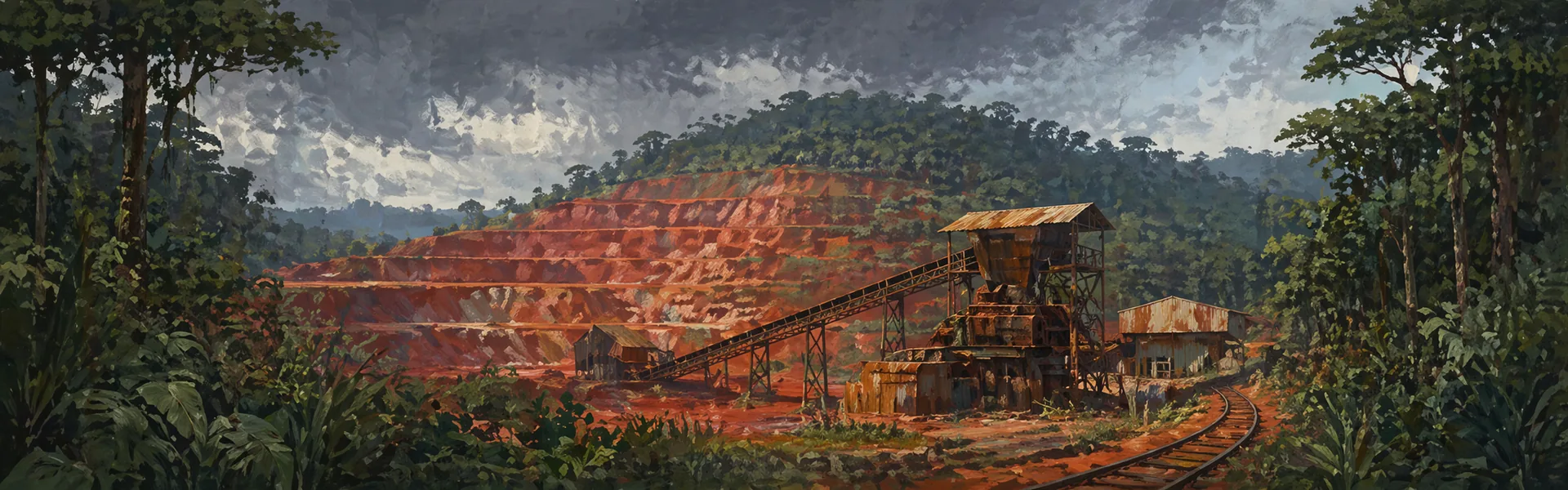
ArcelorMittal's Liberian iron ore operation — producing five million tonnes per year from the Yekepa mine in Nimba County, with a 4,500-person local workforce and 200 expatriates operating around the clock in a tropical forest region — depends on healthy workers, open transport links, and the natural disease-suppression function that intact forest ecosystems provide by separating human populations from wildlife pathogens.2, 3 The company had invested $700 million to refurbish the mine and its 243-kilometre railway to the port at Buchanan, making ArcelorMittal the largest private employer in a country where the company's 2013 revenues of $79 billion were forty times Liberia's entire GDP.2 The mine sits adjacent to the Nimba Nature Reserve, a UNESCO World Heritage Site, in the heart of the Upper Guinea Forest — one of the most biodiverse regions on earth and home to bat populations that host filoviruses including Ebola.5, 6 The operation's viability depends not only on geological reserves but on the surrounding ecosystem remaining stable enough to support a large, continuously present workforce in a remote tropical setting.
Mining, logging, and agricultural encroachment across the Upper Guinea Forest had stripped more than 100 square kilometres of tree cover from ArcelorMittal's concession alone since 2000 — roughly 22 per cent of the forest that existed at the start of the century.5 This deforestation fragmented the habitat of bat species that carry Ebola, driving them closer to human settlements and increasing the probability of zoonotic spillover.6, 7 As Bausch and Schwarz wrote in PLoS Neglected Tropical Diseases, Guinea's Forest Region had been "systematically plundered and the forest decimated by clear-cut logging," while poverty drove people "deeper into mines to extract minerals, enhancing their risk of exposure to Ebola virus."8 Extractive operations contribute to this dynamic directly: the UCL study that analysed ArcelorMittal's costs noted that mining "necessarily brings about changes in the social and natural environments such as advancing into new uninhabited areas where operations like exploration, extraction/mining activities and developing transportation networks in these remote areas lead to increasing contact with wildlife."1 Nationally, Liberia lost approximately 400,000 hectares of forest — 4.4 per cent of its total tree cover — between 2001 and 2012.5
When Liberia declared a state of emergency on 6 August 2014, ArcelorMittal's $1.7 billion Phase 2 expansion collapsed within days.2, 3 Contractors on the construction project invoked force majeure clauses and 2,400 workers departed almost immediately.2 By 17 August, British Airways and Kenya Airways had suspended flights to Liberia, and 130 of the company's expatriate staff were evacuated.2 Supply lines from neighbouring Guinea — itself the origin point of the epidemic — closed, forcing ArcelorMittal to charter aircraft to fly in food and essential supplies.2 Phase 1 mining continued under severe constraints: the company imposed temperature screening, restricted movement with curfew permits, fenced off operational areas, and paid hazard premiums to the local workforce that remained on site.1, 2 Eighteen employees were placed under medical observation after potential exposure; one ArcelorMittal employee, Patrick Sawyer, had already died of Ebola on 24 July after contracting the virus from his infected sister, and he became the index case for Nigeria's subsequent outbreak.2
A peer-reviewed UCL study later calculated ArcelorMittal's direct Ebola-related expenditure at $10.6–11.1 million, broken down across six categories: within-fence preventive measures at $3.29 million (30–31 per cent of the total), salary and hazard pay for retained staff at $2.41 million (23 per cent), construction-related costs at $1.56 million (14–15 per cent), evacuation of non-essential personnel at $1.27 million (11–12 per cent), external donations to the Ebola response at $1.27 million (11–12 per cent), and relational costs of $0.78–1.30 million (7–12 per cent).1 The donations went primarily to the Red Cross (56 per cent), regional task forces (28 per cent), and local hospitals (11 per cent), while ArcelorMittal also distributed 500 sets of personal protective equipment to hospitals across Liberia.1, 3 These were the measurable, auditable costs — the expenses that could be tracked through invoices and payroll records.
The direct costs, however, were dwarfed by the strategic damage. The Phase 2 expansion, designed to triple output to 15 million tonnes per year and representing two-thirds of the mining division's planned 2015 growth, did not restart until 2021 — a seven-year delay.2, 4 At 2014 iron ore prices of roughly $90 per tonne, the foregone production capacity of approximately ten million additional tonnes per year represented hundreds of millions of dollars in annual revenue potential, though the concurrent collapse in iron ore prices complicates any precise calculation.9 When ArcelorMittal finally announced the restart in 2021, it estimated the remaining capital requirement at $800 million — nearly half the original expansion budget — to complete a project that should have been producing ore by the end of 2015.4 The company also downsized its Liberian workforce by 20 per cent in the aftermath.9
Two independent studies published in Scientific Reports in 2017 established a statistically significant relationship between recent forest loss and Ebola outbreaks. Olivero et al. found that Ebola emergence events along the edges of the rainforest biome "were significantly associated with forest losses within the previous 2 years," with a model achieving a p-value of 0.000033 and an AUC of 0.910.6 Rulli et al. showed that eight of eleven Ebola index-case events occurred in forest fragmentation hotspots, with significance levels ranging from 90 to 99 per cent confidence.7 The 2013 West African epidemic's index case — a child in Meliandou, Guinea, roughly thirty miles from ArcelorMittal's Yekepa mine — emerged in an area that Rulli et al. described as "not in the proximity to core forest areas but surrounded by a landscape strongly reshaped by plantations and other human activities."7 ProPublica reported a 61 per cent increase in forest fragmentation around Meliandou between 2013 and 2021, even after the epidemic.10
Researchers subsequently identified genetic material of the epidemic Ebola strain in bats roosting in abandoned mining tunnels on ArcelorMittal's own concession — specifically in Nimba long-fingered bats whose habitat overlaps with the company's operational footprint.11, 5 A 2023 Reuters investigation described the ArcelorMittal site as "one of the most likely places in the world" for the next zoonotic spillover, and BankTrack warned that the company's expansion plans risked "bringing humans and bats into closer contact."11, 5 This finding transforms the case from one of external misfortune to one of reflexive risk: the mining activity that generates ArcelorMittal's revenue simultaneously degrades the ecological buffer — intact forest separating bat colonies from human workers — that protects the operation from disease-driven shutdown. The Harvard Business School published a teaching case (Case 718-001) on ArcelorMittal's Ebola response, treating it as a canonical example of operational risk in extractive industries.12
The outbreak cost West Africa an estimated $2.2 billion in lost GDP in 2014 alone, according to the World Bank.13 In Liberia, where mining accounted for seven per cent of national GDP and 57 per cent of extractive tax revenue, the economic damage was acute.9 The epidemic coincided with a sharp collapse in global iron ore prices — from roughly $130 to $70 per tonne during 2014 — compounding the commercial rationale for delaying the expansion and making it difficult to isolate Ebola's precise contribution to the seven-year suspension.9 Yet the sequence of events is clear: it was the force majeure declarations and contractor evacuations triggered by the public health emergency, not the commodity price decline, that physically halted construction in August 2014.2, 3 The iron ore price crash may have reduced the urgency of restarting, but the epidemic provided the proximate cause of the stoppage.
ArcelorMittal's Liberian experience demonstrates that for extractive operations located in tropical forest ecosystems, the integrity of surrounding habitat is not an environmental externality but an operational prerequisite. The company spent $10.6 million responding to a disease outbreak whose emergence has been statistically linked to the kind of deforestation that mining operations — including ArcelorMittal's own concession — have driven across the region.1, 6, 5 The $1.7 billion expansion that was meant to be ArcelorMittal's most significant growth project sat idle for seven years, and researchers have warned that the conditions for a recurrence remain in place.10, 11 For investors assessing nature-related financial risk in the extractive sector, the lesson is straightforward: the cost of a single zoonotic spillover event can exceed, by orders of magnitude, any plausible investment in maintaining the ecological buffers that prevent one.
Footnotes
-
Tariq, H. et al., "Economic impact of Ebola virus disease outbreak on an extractive firm: a case study," UCL Open Environment, 2020. https://journals.uclpress.co.uk/ucloe/article/id/1354/ ↩
-
Fortune, "Business in the hot zone: How one global corporation has managed the Ebola epidemic," 30 October 2014. https://fortune.com/2014/10/30/arcelormittal-business-liberia-ebola-outbreak/ ↩
-
ArcelorMittal, "ArcelorMittal statement on operations in Liberia," August 2014. https://corporate.arcelormittal.com/media/press-releases/arcelormittal-statement-on-operations-in-liberia ↩
-
Mining Weekly, "ArcelorMittal restarts Liberia Phase 2 expansion," 2021. https://www.miningweekly.com/article/arcelormittal-restarts-liberia-phase-2-expansion-2021 ↩
-
BankTrack, "ArcelorMittal Liberia iron ore mine," 2023. https://www.banktrack.org/project/arcelormittal_liberia_iron_ore_mine ↩
-
Olivero, J. et al., "Recent loss of closed forests is associated with Ebola virus disease outbreaks," Scientific Reports, 2017. https://pmc.ncbi.nlm.nih.gov/articles/PMC5662765/ ↩
-
Rulli, M.C. et al., "The nexus between forest fragmentation in Africa and Ebola virus disease outbreaks," Scientific Reports, 2017. https://pmc.ncbi.nlm.nih.gov/articles/PMC5307336/ ↩
-
Bausch, D.G. and Schwarz, L., "Outbreak of Ebola Virus Disease in Guinea: Where Ecology Meets Economy," PLoS Neglected Tropical Diseases, 2014. https://pmc.ncbi.nlm.nih.gov/articles/PMC4117598/ ↩
-
Africa at LSE, "Reforming Liberia's Mining Sector Post-Ebola," 27 April 2015. https://blogs.lse.ac.uk/africaatlse/2015/04/27/reforming-liberias-mining-sector-post-ebola/ ↩
-
ProPublica, "The Next Deadly Pandemic Is Just a Forest Clearing Away," 2023. https://www.propublica.org/article/pandemic-spillover-outbreak-guinea-forest-clearing ↩
-
Reuters, "Global pandemic bats spillover investigation," 2023. https://www.reuters.com/investigates/special-report/global-pandemic-bats-spillover/ ↩
-
Harvard Business School, "ArcelorMittal and the Ebola Outbreak in Liberia," Case 718-001, 2018. https://www.hbs.edu/faculty/Pages/item.aspx?num=53982 ↩
-
World Bank, "The Economic Impact of the 2014 Ebola Epidemic: Short and Medium Term Estimates for West Africa," 2014. https://www.worldbank.org/en/region/afr/publication/the-economic-impact-of-the-2014-ebola-epidemic-short-and-medium-term-estimates-for-west-africa ↩