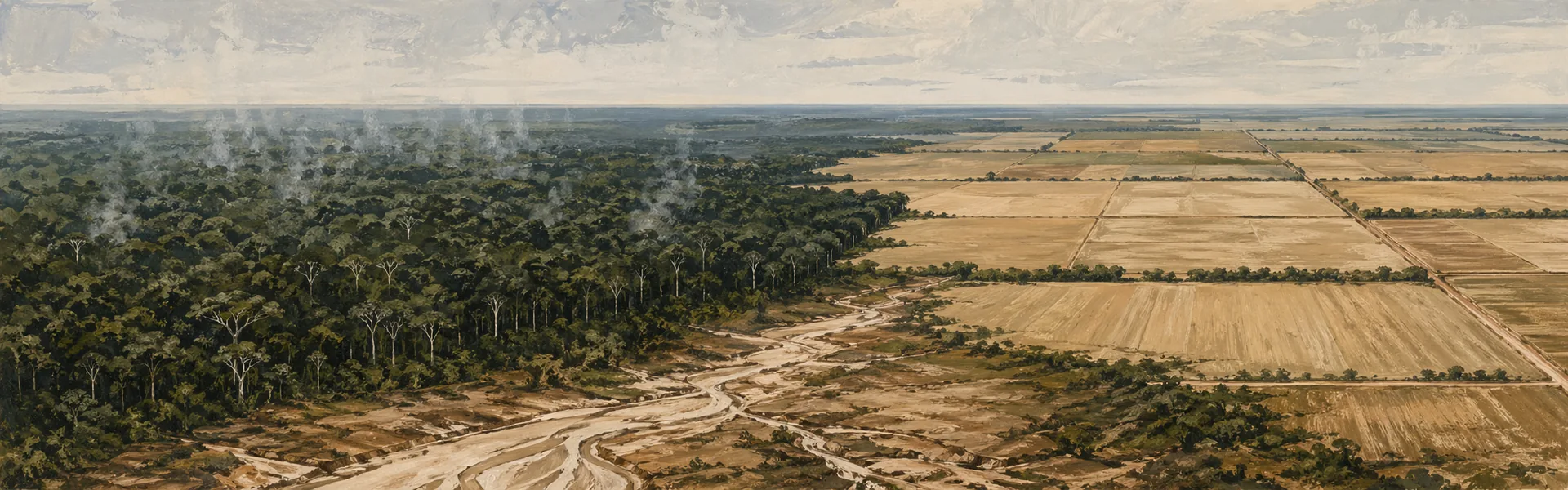
Amazon Flying Rivers: When the Forest Stopped Making Rain
Norte Energia, Cooperacre, SLC Agricola
In 2024, three unrelated Brazilian companies -- Norte Energia, Cooperacre, and SLC Agricola -- suffered combined losses exceeding $2.5 billion after the progressive destruction of Amazon rainforest disrupted the atmospheric moisture recycling that sustains rainfall across interior South America, collapsing hydropower generation, wild harvest yields, and crop productivity simultaneously. Norte Energia's Belo Monte Dam fell to 1.3% of installed capacity during the dry season.1 Cooperacre's Brazil nut harvest declined 71% -- the worst year in four decades.2 SLC Agricola's soybean gross result dropped 59.3% in Q1 2024.3 The three cases span hydropower, wild-harvest food processing, and industrial agriculture, yet share a single root cause: the forests that generate the rain these businesses depend on are being cleared at a rate that has measurably reduced precipitation across the basin.
These three companies operate in different sectors -- hydropower, wild-harvest food processing, and industrial-scale agriculture -- yet each depends on the same invisible infrastructure: the rainfall generated when Amazon forests recycle moisture into the atmosphere, carrying the equivalent of 200,000 cubic metres of water vapour per second across the continent.4 Norte Energia's Belo Monte Dam generates electricity only when the Xingu River flows strongly enough to turn its turbines -- and the Xingu's flow is sustained by basin-wide rainfall.5 Cooperacre's 3,000-plus families collect wild Brazil nuts from uncultivated forest; the trees cannot be commercially cultivated and depend on regular rainfall for fruit development.6 SLC Agricola cultivates over 660,000 hectares of rainfed soybean, corn, and cotton across the Cerrado, where seasonal rainfall originates largely as moisture recycled from Amazon vegetation.7 In each case, the business model is anchored to a natural process that appears nowhere in a standard financial model.
The Amazon has lost approximately 690,000 square kilometres of forest since 1985, and this deforestation has directly reduced the rainfall that all three companies depend on -- roughly 75% of the observed decline in regional precipitation is attributable to forest clearing rather than climate variability alone.8, 9 Trees directly transpire 20% of all Amazon rainfall, and 32% of the basin's annual precipitation originates as evapotranspiration within the forest itself; moisture may recycle five or six times as air masses move westward from the Atlantic.10, 11 In heavily deforested areas, the rainy season onset has been delayed by up to 76 days over a twenty-year period, with cumulative rainfall reductions of 360mm and temperature increases of 2.5 degrees Celsius.12 Research published in Nature Communications identified a critical threshold: once forest loss exceeds 55-60% within a given area, rainfall declines precipitously rather than gradually.13 As of 2019, a quarter of the southern Amazon had already crossed that threshold.13 The 2023-2024 El Nino compounded this structural decline, producing the worst drought in recorded Amazon history.
Norte Energia's Belo Monte Dam, the world's fourth-largest hydropower plant with 11,233 MW of installed capacity and a construction cost of R$40 billion (approximately US$7 billion), has never delivered its contracted minimum assured energy in any year of operation.14, 15 Belo Monte is a run-of-river plant with no significant reservoir to buffer seasonal variation.16 In September-November 2024, at the peak of the dry season, the dam generated an average of just 145 MW per day -- 1.3% of capacity -- with only one of eighteen turbines operating by late August.1 The 2024 capacity factor fell to 23%, compared with a design expectation of 40%.14 Generation fell 28% to 22,690 GWh from 31,521 GWh the prior year.17
A peer-reviewed analysis by CPI/PUC-Rio estimated that deforestation has cost Norte Energia an average of US$110 million per year in lost generation revenue -- roughly 21% of EBITDA -- accumulating to US$2.3 billion over the 2002-2022 study period.5 Within the 25% of forest area most influential for Belo Monte's rainfall (1.66 million square kilometres), 12.8% has been deforested; in the most critical 5%, deforestation reaches 27.5%.5 The financial damage continues to compound: Norte Energia's FY2024 net loss nearly doubled to R$1.67 billion, up from R$850.8 million in 2023, despite net operating revenue increasing to R$6.2 billion.16 Combined with Brazil's Itaipu Dam, deforestation-induced losses at the country's two largest hydropower plants exceed US$200 million annually -- equivalent to the annual electricity consumption of an entire Brazilian state.18 The dam's operating licence expired in November 2022; it continues to operate on a temporary licence as the structural viability of the project faces deepening scrutiny.19
Cooperacre, a cooperative linking over 3,000 families who collect wild Brazil nuts from intact Amazon forest in Acre state, saw the 2024/2025 harvest collapse by 71% across the Amazon basin -- a 40-year low -- after prolonged drought caused century-old Brazil nut trees to abort their fruit for the first time on record.2, 20 The El Nino-driven drought lasted from August 2023 through May 2024, with soil moisture falling 45% below the historical average and temperatures during the flowering period rising 3 degrees Celsius above normal.20 Brazil nut trees expected to produce 200 pods yielded just 80.20 In some communities the losses were total: the Karipuna Indigenous Territory harvested zero nuts; the Wai Wai territory collected 200 bags compared with 3,500 the previous year -- a 94% decline.2 Cooperacre, which typically generates R$40 million annually from Brazil nut sales and exports to eleven countries, faced a production shortfall that its processing infrastructure could not absorb.21, 22
Global Brazil nut supply fell 35% to 67,260 tonnes, prices surged to four times their normal level, most processing facilities closed four months early, and some downstream buyers delisted Brazil nuts entirely.23, 24 The R$1.2 billion global market, employing more than 60,000 people through 127 community associations, experienced its most severe disruption in modern history.2, 25 Cooperacre projected the 2025 harvest would be a further 30-40% below 2024 levels.22 Brazil nut trees require decades to mature and cannot be replicated on plantations, making every hectare of deforestation a permanent subtraction from the productive base.6
SLC Agricola, one of Brazil's largest crop producers with over 660,000 hectares of rainfed soybean, corn, and cotton across the Cerrado biome, reported a 59.3% decline in soybean gross result and an 11.8% decline in net revenue to approximately R$2 billion in Q1 2024, after drought in Mato Grosso cut yields well below budget.3 Corn gross result fell 59.2% in the same period.3 The damage extended into FY2024: soybean yields came in 17% below budget at 3,264 kg per hectare, cotton yields were 26% below budget due to atypical water stress in March through May, and second-crop corn yields missed projections by 6.5%.26 Q4 2023 produced a net loss of R$153 million ($25.5 million), followed by a Q4 2024 loss of R$51.4 million.26 SLC's geographic diversification strategy -- spreading production across 22 units in multiple states -- partially mitigated the damage, but could not offset the structural rainfall decline concentrated in its most productive region.27
SLC Agricola's case is distinguished by double materiality: the company cleared over 39,887 hectares of native Cerrado vegetation between 2011 and 2017 -- including over 30,000 hectares classified as Cerrado forest -- and continued clearing 1,355 hectares at a single farm in 2019 and 4,667 hectares at another in 2020.28, 29 Research shows that for every tonne of soy produced on newly cleared land, three tonnes are lost from existing fields due to deforestation-induced rainfall decline.7 Peer-reviewed modelling estimates that Cerrado soybean yields are approximately 6.6% lower annually than they would be without deforestation-induced rainfall disruption, and that the region has foregone an estimated US$9.4 billion in soy production since 2008 as a direct consequence of land clearing.7, 30 This is the feedback loop at its starkest: SLC Agricola's three largest customers -- Cargill, Amaggi, and Bunge, accounting for 63% of revenues -- all hold zero-deforestation commitments, yet the clearing that expands planted area actively degrades the rainfall upon which all existing production depends.28 Brazilian researchers have termed this dynamic "agro-suicide."12
The convergence of these three losses in a single year across different sectors demonstrates that Amazon deforestation is not an environmental externality but a correlated financial risk embedded in the landscape -- and with 20% of the biome already cleared and scientists warning of a tipping point at 20-25% forest loss, the exposure is worsening for every business that depends on interior Brazilian rainfall.8, 31 Seventeen of Brazil's twenty largest hydropower plants sit in the path of atmospheric moisture flows from the Amazon.4 Brazil grows more than a third of the global soybean supply, overwhelmingly on rainfed land.32 The Brazil nut sector is entirely dependent on standing forest. When rainfall declines, these exposures do not diversify -- they correlate, as 2024 demonstrated. Amazon hydroelectric dams are projected to lose up to 40% of generation capacity over the next two to three decades, while the area suitable for low-risk soy farming could shrink by 40% within fifty years.1, 33
Brazil's energy regulator estimates the country will need R$144 billion ($28 billion) in additional generation capacity to compensate for declining hydropower.1 Peer-reviewed research projects up to US$5.6 billion in cumulative soy productivity losses and US$180.8 billion in beef productivity losses by 2050 under continued deforestation.13 Hotter temperatures from clearing already cost Brazilian soybean farmers more than US$3 billion per year.32 SLC Agricola has begun investing in irrigation -- R$62.2 million in FY2024 -- as a hedge against rainfall decline, but irrigation substitutes for an ecosystem service rather than restoring it.26 For Norte Energia, there is no substitute: when the river dries, the turbines stop. For Cooperacre, Brazil nut trees fruit in wild forest or not at all. The financial system's exposure to forest loss is not hypothetical or distant -- it is materialising now, across the balance sheets of companies that have no viable alternative to the rainfall the forest provides.
Footnotes
-
Mongabay, "Falling Amazon river flows trigger reality check at Belo Monte power plant," March 2026. https://news.mongabay.com/2026/03/falling-amazon-river-flows-trigger-reality-check-at-belo-monte-power-plant/ ↩
-
Mongabay, "Iconic Brazil nut crop plunges after extreme drought, skyrocketing prices," July 2025. https://news.mongabay.com/2025/07/iconic-brazil-nut-crop-plunges-after-extreme-drought-skyrocketing-prices/ ↩
-
Revista Cultivar, "SLC Agricola records a drop in its financial results in the first quarter of 2024." https://revistacultivar.com/news/slc-agricola-records-a-drop-in-its-financial-results-in-the-first-quarter-of-2024 ↩
-
CPI/PUC-Rio, "Cutting Down the (Hydropower) Plants: How the Amazon Deforestation is Jeopardizing Electricity Generation in Brazil." https://www.climatepolicyinitiative.org/publication/cutting-down-the-hydropower-plants-how-the-amazon-deforestation-is-jeopardizing-electricity-generation-in-brazil/ ↩
-
CPI/PUC-Rio, "Deforestation Cuts the Lights: Itaipu, Belo Monte, and the Cost of Forest Loss." https://www.climatepolicyinitiative.org/publication/deforestation-cuts-the-lights-itaipu-belo-monte-and-the-cost-of-forest-loss/ ↩
-
World Bank, "How the Brazil nut shows a path for sustainable development in the Amazon." https://blogs.worldbank.org/en/latinamerica/how-brazil-nut-shows-path-sustainable-development-amazon ↩
-
Zero Carbon Analytics, "Deforestation in Brazil's Cerrado reduces soy production and threatens supply chains." https://zerocarbon-analytics.org/insights/briefings/deforestation-in-brazils-cerrado-reduces-soy-production-and-threatens-supply-chains/ ↩
-
Conservation International, "Deforestation linked to dramatic decline in Amazon rainfall." https://www.conservation.org/news/news-spotlight-deforestation-linked-to-dramatic-decline-in-amazon-rainfall ↩
-
CPI/PUC-Rio, "When the River Runs Dry: How Amazon Deforestation Threatens the Brazilian Economy." https://www.climatepolicyinitiative.org/publication/when-the-river-runs-dry-how-amazon-deforestation-threatens-the-brazilian-economy/ ↩
-
MAAP, "Amazon Flying Rivers." https://www.maapprogram.org/amazon-flying-rivers/ ↩
-
Tian et al., "Precipitation in the Amazon," PMC, 2022. https://pmc.ncbi.nlm.nih.gov/articles/PMC9291838/ ↩
-
Agencia Publica, "Agrossuicidio: desmatamento na Amazonia ja afeta plantio duplo de soja e milho," February 2024. https://apublica.org/2024/02/agrossuicidio-desmatamento-na-amazonia-ja-afeta-plantio-duplo-de-soja-e-milho/ ↩
-
Leite-Filho et al., "Deforestation reduces rainfall and agricultural revenues in the Brazilian Amazon," Nature Communications, 2021. https://www.nature.com/articles/s41467-021-22840-7 ↩
-
Sumauma, "Eight stories about Belo Monte that Norte Energia didn't tell." https://sumauma.com/en/oito-historias-sobre-belo-monte-que-a-norte-energia-nao-contou-na-viagem-patrocinada-a-altamira/ ↩
-
Context News, "Brazil mega dams promised a green future. Then came climate change." https://www.context.news/climate-risks/brazil-mega-dams-promised-a-green-future-then-came-climate-change ↩
-
Canal Energia, "Prejuizo da Norte Energia aumenta e vai a R$ 1,67 bilhao." https://www.canalenergia.com.br/noticias/53305223/prejuizo-da-norte-energia-aumenta-e-vai-a-r-167-bilhao ↩
-
ESG Inside, "Norte Energia invested R$290 million in socio-environmental and sustainability actions in 2024." https://esginside.com.br/2025/08/06/norte-energia-investiu-r-290-milhoes-em-acoes-socioambientais-e-de-sustentabilidade-em-2024/ ↩
-
CPI/PUC-Rio, "Amazon deforestation threatens Brazil's energy security and generates billions in losses for the electricity sector." https://www.climatepolicyinitiative.org/press-release/amazon-deforestation-threatens-brazils-energy-security-and-generates-billions-in-losses-for-the-electricity-sector-2/ ↩
-
Yale Environment 360, "Belo Monte: Volta Grande Flows." https://e360.yale.edu/features/belo-monte-volta-grande-flows ↩
-
O Alto Acre, "Seca historica e El Nino causam queda recorde na producao de castanha da Amazonia." https://oaltoacre.com/seca-historica-e-el-nino-causam-queda-recorde-na-producao-de-castanha-da-amazonia/ ↩
-
AC24Horas, "O paradoxo da castanha," February 2025. https://ac24horas.com/2025/02/09/o-paradoxo-da-castanha/ ↩
-
AC24Horas, "O paradoxo da castanha" (Cooperacre production data and projections). https://ac24horas.com/2025/02/09/o-paradoxo-da-castanha/ ↩
-
Mundus Agri, "Brazil nuts 2026 bring relief," 2026. https://www.mundus-agri.eu/news/brazil-nuts-2026-bring-relief.n36213.html ↩
-
RedWire Business, "Brazil Nut Shortage 2025: Causes, Impacts & Outlook." https://redwirebusiness.com/brazil-nut-shortage/ ↩
-
Food Navigator, "Brazil nut prices rise as shortage takes hold," July 2025. https://www.foodnavigator.com/Article/2025/07/08/brazil-nut-prices-rise-as-shortage-takes-hold/ ↩
-
GuruFocus, "SLC Agricola S.A. Q4 2024 Earnings Call Highlights," 2025. https://www.gurufocus.com/news/2791749/slc-agricola-sa-slcjy-q4-2024-earnings-call-highlights-strategic-expansion-amid-revenue-challenges ↩
-
SLC Agricola, "Sustainability." https://www.slcagricola.com.br/en/sustentabilidade/ ↩
-
Chain Reaction Research, "SLC Agricola clears 1,355 hectares of Cerrado vegetation." https://chainreactionresearch.com/the-chain-slc-agricola-clears-1355-hectares-of-cerrado-vegetation-despite-customer-zero-deforestation-commitments/ ↩
-
Chain Reaction Research, "SLC Agricola moves forward with clearing 5,200 hectares of native vegetation." https://chainreactionresearch.com/the-chain-slc-agricola-moves-forward-with-clearing-5200-hectares-of-native-vegetation/ ↩
-
Pires et al., "Deforestation-induced changes in rainfall decrease soybean-maize yields in Brazil," Ecological Modelling, 2023. https://www.sciencedirect.com/science/article/pii/S0304380023002636 ↩
-
Lovejoy and Nobre, "Amazon Tipping Point," Science Advances, 2018. https://www.science.org/doi/10.1126/sciadv.aat2340 ↩
-
NPR, "Why Clearing Brazil's Forests For Farming Can Make It Harder To Grow Crops," July 2021. https://www.npr.org/2021/07/13/1015373344/why-clearing-brazils-forests-for-farming-can-make-it-harder-to-grow-crops ↩
-
Mongabay, "Amazon tipping point puts Brazil's agribusiness, energy sector at risk," February 2020. https://news.mongabay.com/2020/02/amazon-tipping-point-puts-brazils-agribusiness-energy-sector-at-risk-top-scientists/ ↩