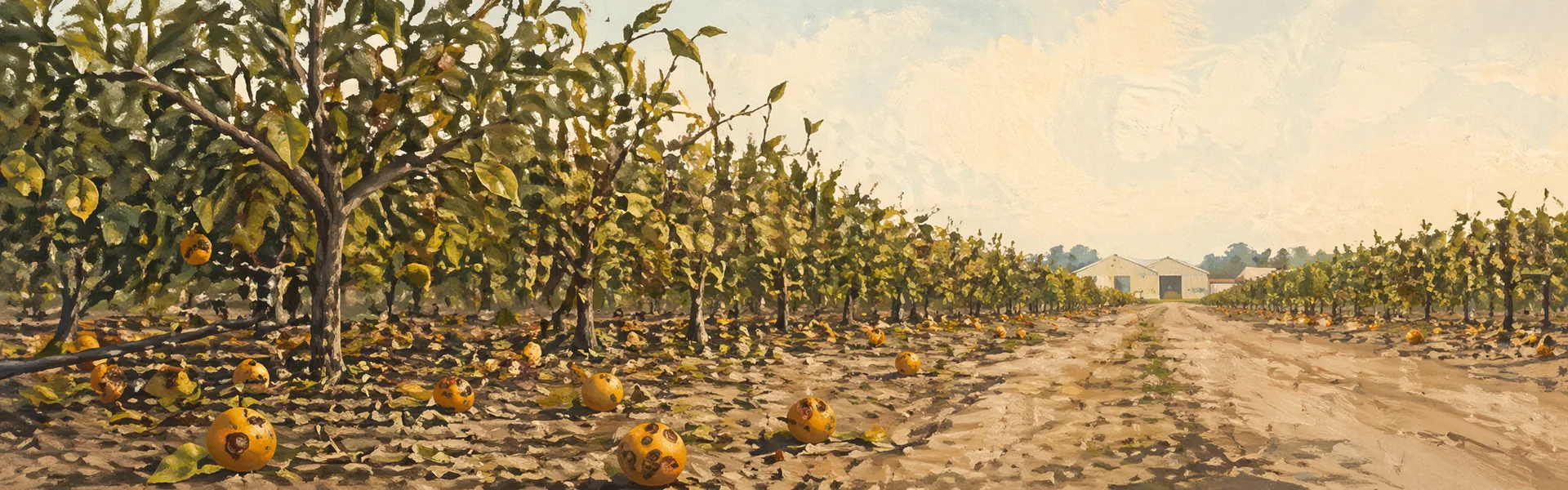
Alico: When Pest Control Collapsed, a Century-Old Citrus Giant Died on the Tree
Alico, Inc.
In 2025, Alico, Inc. recorded a net loss of $147.5 million and exited citrus farming entirely after a two-decade pest epidemic destroyed 77.5% of its production and rendered Florida's largest citrus operation economically unviable.1, 2 The company wrote down $269 million in citrus tree assets over the course of a single fiscal year, as trees that had once been the foundation of a profitable agricultural business were reclassified as liabilities.1 Total assets fell 49.5%, from $398.7 million to $201.5 million, and loss per share reached $(19.29) against net income of $0.91 the prior year.1 After more than a century of continuous citrus production, Alico's board determined that "growing citrus is no longer economically viable for us in Florida" and announced a strategic transformation into a land management and development company.3
Alico's century-old business model rested on a single crop -- citrus -- grown across 53,000 acres of Florida groves, and that crop depended on natural pest suppression to keep disease-carrying insects below damaging levels.3, 4 Citrus accounted for 96% of Alico's operating revenues in fiscal 2025 and 92% in 2024, a concentration that left almost no buffer against disruption to its core agricultural input.1 In healthy citrus ecosystems, populations of pest insects are held in check by predatory and parasitic species -- wasps that lay eggs inside the pests, beetles that consume them, and other organisms that collectively prevent any single insect from overwhelming the crop.5, 6 For decades, this balance was maintained at tolerable levels in Florida's groves, and Alico's business plan was built on the assumption that it would continue. The company was, in effect, drawing on a biological service that appeared free and permanent but was neither.
Commercial citrus farming in Florida inadvertently undermined its own pest defences: the broad-spectrum insecticide programmes used to fight the psyllid killed the very parasitoid wasps and predatory insects that could have suppressed the pest biologically, creating a feedback loop of rising chemical costs and declining natural control.5, 7 University of Florida researchers documented that in "highly disturbed habitats" -- groves treated with broad-spectrum pesticides such as methomyl -- the beneficial parasitoid "was unable to persist," while in untreated plantings the same species maintained psyllid populations at low levels.5 The economics of this feedback loop were punishing. Pre-disease production costs in Florida citrus ran approximately $800 per acre; after the pest epidemic took hold, insecticide programmes alone cost "$1,000 or more per acre each year," with an additional $200 to $600 per acre for foliar nutrient applications to compensate for the damage disease-weakened trees could no longer resist on their own.8 The industry's attempt to replace a free biological service with purchased chemicals more than doubled operating costs per acre -- and still failed to control the pest.
The crisis began when the Asian citrus psyllid arrived in Florida without the co-evolved natural enemies that keep it in check across its native Asian range, opening a biological vacuum that allowed the insect to spread a lethal bacterial disease -- huanglongbing, commonly known as citrus greening -- to virtually every citrus tree in the state.5, 6 In Asia, parasitoid wasps suppress psyllid populations at parasitism rates of 79-88%, keeping the insect well below the threshold at which it can transmit disease widely.6 In Florida, no comparable natural enemy existed. The psyllid carries a bacterium, Candidatus Liberibacter asiaticus, that infects citrus trees through the insect's feeding. Once infected, a tree's fruit becomes green, misshapen, and bitter -- unsuitable for fresh sale or juice processing -- and the tree typically dies within three to five years.9 There is no known cure.9
State and federal agencies attempted to close the gap by releasing millions of parasitoid wasps, but field parasitism rates in Florida's chemically treated groves remained far too low to suppress the pest, and a three-year controlled study found the releases produced no measurable reduction in psyllid populations.5, 6, 7 The Florida Department of Agriculture and Consumer Services began releasing Tamarixia radiata near Fort Pierce in July 1999, starting with 100-200 parasites per site.5 Between 1999 and 2001, nearly 37,000 adult wasps were released; in subsequent years, millions more followed.5, 7 The parasitoid "dispersed quickly and established throughout the major citrus-growing regions," but average parasitism rates in commercial groves reached only 20% in spring and summer and 39-56% in autumn -- well below the 79-88% observed in Puerto Rico, where the same wasp species operates without pesticide interference.6 A peer-reviewed study found that "releases of the new haplotypes did not cause any measurable reduction in Asian citrus psyllid population levels" and that in groves with even occasional pesticide use, "psyllid densities were higher and parasitism was lower."7, 6
For Alico, the consequences cascaded through every line of the income statement: production fell from a peak of 10 million boxes in fiscal 2015 to 2.2 million in fiscal 2025, citrus revenue shrank from $137 million to $41 million, and the company recorded $163 million in accelerated depreciation as it wrote down citrus trees whose productive life had been cut short by disease.1, 10 The decline was not linear but accelerating. Hurricane Ian in 2022 and Hurricane Milton in 2024 compounded the damage, striking trees "already weakened from years of citrus greening disease" and triggering a 51.4% single-year production collapse in fiscal 2023.3, 11 By the first half of fiscal 2025, quarterly production was falling 20.6% year on year.4 The citrus tree line on Alico's balance sheet tells the story most starkly: gross book value fell from $319.1 million in September 2024 to $50.0 million one year later, a $269 million destruction of biological capital.1
In January 2025, Alico's board concluded that further investment could not reverse the decline and announced a full exit from citrus, terminating its supply contract with Tropicana, eliminating 172 jobs, and pivoting to land development on holdings it valued at $650-750 million.3, 12, 13 The company completed its last major citrus harvest in April 2025.4 Management framed the decision in terms that acknowledged the futility of continued spending: "We've explored all available options to restore our citrus operations to profitability, but the long-term production trend and the cost needed to combat citrus greening disease no longer supports our expectations for a recovery."3 The pivot to land sales was projected to exceed $50 million in fiscal 2025, and in November, Alico unveiled Corkscrew Grove Villages, a 9,000-home development on former citrus land in Collier County -- a tangible marker of the transition from agricultural producer to real estate developer.3, 14
Alico's collapse was not an isolated misfortune but the sharpest expression of a statewide reckoning: Florida's total citrus output fell from over 250 million boxes in the early 2000s to 12 million in the 2024-25 season, its lowest level in more than a century, imposing cumulative losses that academic researchers estimated at $4.5 billion in the first five years alone.8, 15, 16 The 2024-25 USDA forecast of 12 million boxes represented a 33% decline from the prior season and fell below the 13.9 million boxes recorded in 1919-20.15, 16 An industry that once supported 76,336 jobs across growing, processing, and fresh marketing was contracting at every level.8 Fruit droppage for non-Valencia oranges exceeded the historical maximum at 56%, a physical indicator that disease had compromised the trees' ability to hold fruit to maturity.16 Alico, as one of the state's largest single operators, was a bellwether: its decision to exit signalled that if scale and capital could not overcome the pest, the economics of Florida citrus had fundamentally changed.
The company's 10-K filings trace a decade of increasingly desperate countermeasures -- from foliar nutrients and antibiotic treatments to experimental bactericide applications on 4.5 million trees -- each of which bought time but failed to alter the underlying trajectory, because no chemical programme could substitute for the missing ecological pest control.1, 9, 17 In 2022, Alico began testing oxytetracycline hydrochloride (OTC), an antibiotic that mitigated some symptoms of citrus greening and reduced fruit drop.9 By fiscal 2024, the company had treated "substantially all" of its approximately 4.5 million producing trees with OTC.9 But its own filings noted the limitation plainly: the treatment "is not a cure and whether its mitigation benefits would continue in the longer term remains uncertain."9 Each new intervention added cost -- the annual expense of managing HLB exceeded $1,200 per acre when insecticides and foliar nutrients were combined -- while the biological asset continued to depreciate beneath the chemical overlay.8 Depreciation expense leapt from $15 million in fiscal 2024 to $177 million in fiscal 2025, a twelve-fold increase that reflected the acceleration of tree death and the decision to stop replacing lost stock.1
Alico's exit from citrus confirms that when a business depends on a biological service -- in this case, the natural suppression of a crop pest -- and the ecosystem that once provided that service has been disrupted, the financial cost is not a one-off shock but a progressive, ultimately terminal erosion of the asset base.1, 3 The company spent decades and hundreds of millions of dollars attempting to replace a natural function with purchased inputs, and each year the gap between the cost of the substitute and the value of the output widened. Its total assets halved in a single year; its equity shrank from $251 million to $130 million; and a business line that generated $137 million in annual revenue a decade earlier was shut down entirely.1, 4, 10 For investors and risk analysts, the case offers a precise illustration of nature-dependency risk: Alico's financial statements did not break until the biological system underneath them broke first. The pest was the proximate cause, but the underlying vulnerability was a business model built on an ecological service it could neither control nor replace.
Footnotes
-
Alico, Inc., "10-K Annual Report, Fiscal Year Ended September 30, 2025," SEC filing. https://www.sec.gov/Archives/edgar/data/3545/000000354525000140/alco-20250930.htm ↩
-
Alico, Inc., "10-K Annual Report, Fiscal Year Ended September 30, 2016," SEC filing. https://www.sec.gov/Archives/edgar/data/3545/000000354516000188/alco-93016x10k.htm ↩
-
Alico, Inc., "Alico, Inc. Announces Strategic Transformation of Agriculture Operations to Unlock Value in Land Holdings," press release, January 6, 2025. https://www.alicoinc.com/news/detail/1424/alico-inc-announces-strategic-transformation-of ↩
-
Alico, Inc., "Financial Results for the Second Quarter Ended March 31, 2025," press release. https://www.stocktitan.net/news/ALCO/alico-inc-announces-financial-results-for-the-second-quarter-ended-3m8njuugr2ih.html ↩
-
University of Florida IFAS, "Classical Biological Control of Asian Citrus Psyllid in Florida," accessed 2026. https://ipm.ifas.ufl.edu/agricultural_ipm/psyllid.shtml ↩
-
University of Florida IFAS EDIS, "Asian Citrus Psyllid Biological Control," Publication IN858, accessed 2026. https://ask.ifas.ufl.edu/publication/in858 ↩
-
Florida Department of Agriculture and Consumer Services, "Asian Citrus Psyllid Biological Control," accessed 2026. https://www.fdacs.gov/Agriculture-Industry/Pests-and-Diseases/Plant-Pests-and-Diseases/Biological-Control/Asian-Citrus-Psyllid-Biological-Control ↩
-
Choices Magazine, "The Potential Economic Cost and Response to Greening in Florida Citrus," accessed 2026. https://www.choicesmagazine.org/choices-magazine/submitted-articles/the-potential-economic-cost-and-response-to-greening-in-florida-citrus ↩
-
Alico, Inc., "10-K Annual Report, Fiscal Year Ended September 30, 2024," SEC filing. https://www.sec.gov/Archives/edgar/data/3545/000000354524000128/alco-20240930.htm ↩
-
Alico, Inc., "10-K Annual Report, Fiscal Year Ended September 30, 2016," SEC filing. https://www.sec.gov/Archives/edgar/data/3545/000000354516000188/alco-93016x10k.htm ↩
-
Alico, Inc., "10-K Annual Report, Fiscal Year Ended September 30, 2023," SEC filing. https://www.sec.gov/Archives/edgar/data/3545/000000354523000030/alco-20230930.htm ↩
-
Citrus Industry Magazine, "Alico Citrus to Cease Operations After This Season," January 7, 2025. https://citrusindustry.net/2025/01/07/alico-citrus-cease-operations-after-this-season/ ↩
-
WUSF Public Media, "A major Florida grower is exiting the citrus business," January 6, 2025. https://www.wusf.org/economy-business/2025-01-06/a-major-florida-grower-is-exiting-the-citrus-business ↩
-
WGCU, "Alico abandons citrus after 125 years in favor of developer role," November 18, 2025. https://www.wgcu.org/environment/2025-11-18/alico-abandons-citrus-after-125-years-in-favor-of-developer-role-wildlife-protection-is-one-action ↩
-
CBS News Miami, "Florida citrus production lowest in century, USDA says," accessed 2026. https://www.cbsnews.com/miami/news/florida-citrus-production-lowest-in-century-usda-says/ ↩
-
FreshPlaza, "USDA forecasts 33% drop in Florida citrus production for 2024-2025 season," accessed 2026. https://www.freshplaza.com/north-america/article/9694193/usda-forecasts-33-drop-in-florida-citrus-production-for-2024-2025-season/ ↩
-
Qureshi et al., "Evaluation of parasitism by Tamarixia radiata on Asian citrus psyllid in Florida," Journal of Economic Entomology, 2015. https://pubmed.ncbi.nlm.nih.gov/26470246/ ↩