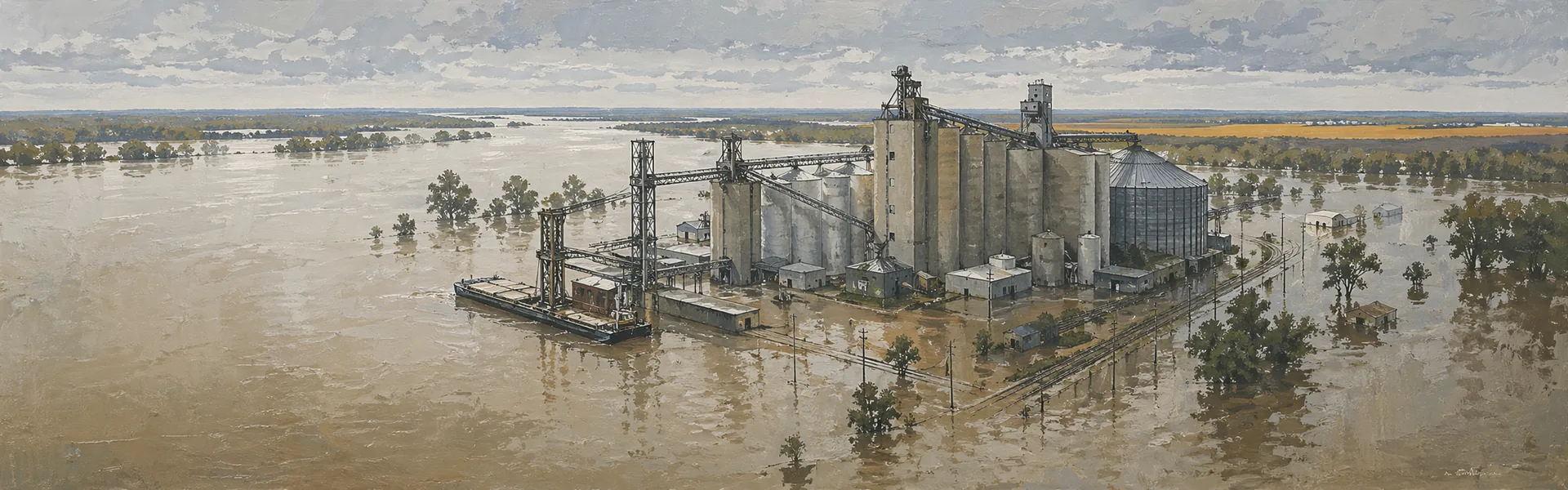
ADM: When Draining Wetlands Removes the Flood Protection a Company Needs
Archer Daniels Midland
In 2019, Archer Daniels Midland reported a $125 million operating-profit loss across the first half of the year after the most prolonged Mississippi River flooding since 1927 shut down processing facilities and paralysed barge transport across the US Midwest.1 CEO Juan Luciano disclosed the figure on the company's second-quarter earnings call, describing "extreme weather that had a negative impact of $65 million in the second quarter and $125 million in total."1 The damage spanned ADM's core operating segments — grain origination, corn processing, and bioproducts — and struck facilities in Illinois and Nebraska simultaneously. First-quarter adjusted earnings per share fell 32 percent; second-quarter EPS dropped 41 percent.2, 1 ADM, the world's largest publicly traded grain trader, had built its Midwest infrastructure on the assumption that the landscape around it would absorb floodwater. In 2019, the landscape failed.
ADM's business model concentrates high-value grain storage, corn processing, and ethanol production in floodplain locations chosen for proximity to farmland and river transport, making the company inherently dependent on the surrounding landscape's capacity to absorb peak water flows.3, 4 Major facilities at Columbus, Nebraska, Quincy, Illinois, and the Decatur, Illinois complex sit along rivers that double as the company's primary freight corridors.2, 5 Barge transport on the Mississippi and Missouri river systems is central to ADM's cost structure: it is the cheapest way to move millions of tons of grain from inland elevators to Gulf Coast export terminals. As ADM's own spokesperson acknowledged, high river levels "raise transportation costs and lower the volume of freight we can carry to and through ports, and to customers."5 The company's operating model thus depends not only on water for processing but on river systems remaining within navigable bounds — a function performed, upstream, by wetlands and natural vegetation that slow and store rainfall before it reaches main channels.
The agricultural system that ADM's processing facilities serve has systematically destroyed the natural flood protection those facilities depend on.6, 7 Between 2001 and 2016, approximately 330,000 hectares of wetlands in the US Upper Midwest were drained and converted to cropland — the same cropland that produces the corn and soybeans flowing through ADM's elevators and mills.6 The loss is cumulative and vast: roughly 13 million of the region's original 20 million prairie potholes have been eliminated over the longer history of agricultural expansion.8 These small, shallow depressions once functioned as natural sponges, intercepting rainfall and snowmelt across millions of acres. Their removal consolidates surface water into fewer, larger basins that, as USGS research documents, are "more likely to spill over and allow flooding" downstream.7 The feedback loop is direct: more farmland for ADM to source from means less natural water storage to protect ADM's own facilities.
Peer-reviewed research quantifies the hydrological consequences of this wetland loss. A 2022 study published in Hydrology and Earth System Sciences modelled Prairie Pothole Region basins and found that median annual runoff potentially tripled under typical conditions with high degrees of wetland drainage, while maximum annual runoff more than doubled.9 The study's most striking finding was that "no threshold could be identified below which wetland drainage has no effect on the runoff regime," with measurable impacts appearing at drainage levels as low as 10 percent of a basin's area.9 Separate field data from a Saskatchewan watershed showed that 50 years of wetland drainage increased annual stream flows by 29 percent and peak flood levels by 32 percent.8 These are not marginal changes. They represent a structural amplification of flood risk embedded in the landscape that ADM's Midwest infrastructure occupies.
When record rainfall hit the Midwest in spring 2019 — the wettest twelve-month period on record for the contiguous United States — the degraded landscape could not absorb the water, and rivers stayed above flood stage for months.10 The Mississippi experienced its most prolonged flooding since the catastrophic 1927 event, with water levels remaining elevated from March through July 2019.10, 11 The flooding was not a single crest but a sustained, rolling inundation across the Missouri and Mississippi systems, repeatedly overwhelming levees, closing navigation locks, and submerging low-lying infrastructure. For a company with processing plants, grain elevators, and barge-loading terminals sitting in these floodplains, there was no way to operate through it.
ADM's Columbus, Nebraska corn mills suffered the most severe damage, with flooding reducing production volumes, increasing manufacturing costs, and triggering one-time remediation expenses that cost roughly $30 million in the first quarter alone.2 The Columbus complex houses both wet and dry corn-milling operations — capital-intensive facilities that cannot be easily relocated or quickly restarted after inundation. The Decatur, Illinois complex, ADM's global headquarters and largest processing site, was also affected as floodwaters slowed corn deliveries into the facility.2 Management warned on the first-quarter call that residual weather impacts would carry an additional $10 million to $20 million into the second quarter in Carbohydrate Solutions alone.2 The physical damage to equipment was compounded by the cost of lost production days at facilities designed to run continuously.
The second quarter proved worse. High water conditions cut $40 million from ADM's grain origination business by limiting the volume of grain the company could move and sell across North America.1 The Quincy, Illinois facility absorbed a further $10 million hit from persistent high water.1 In Carbohydrate Solutions, severe weather impacts totalled approximately $15 million, split two-thirds in bioproducts and one-third in starches and sweeteners.1 CFO Ray Young provided the segment-level breakdown that made the dominance of water-related losses clear: of the $65 million in second-quarter weather impacts, the vast majority traced directly to flooding and high water rather than to other weather events.1 Dying river conditions compressed barge margins and limited volumes even in segments that were not physically inundated.
Beyond individual facilities, the flooding collapsed the river logistics network on which ADM's entire Midwest operation depends.11 St. Louis Harbor, a critical node in the inland waterway system, closed for 38 consecutive days between May and June 2019.11 Grain barge shipments fell 31 percent year-over-year through late April, with traffic at "a virtual standstill all spring."5 A US Coast Guard analysis estimated that approximately 6.3 million tons of grain worth nearly $1 billion went unshipped on the Upper Mississippi River during the flood period.11 ADM and Cargill "have seen commodity stocks piling up" as halted barge traffic prevented grain from reaching export terminals.5 For ADM, the logistics collapse was as costly as the facility damage: grain that cannot move cannot be sold, and storage costs mount while margins on forward contracts evaporate.
ADM's earnings reflected the cumulative damage across both quarters.2, 3 First-quarter adjusted EPS of $0.46 represented a 32 percent decline from $0.68 in the prior year; second-quarter adjusted EPS of $0.60 represented a 41 percent decline from $1.02.2, 1 The severity of the weather-related losses prompted ADM management to publicly consider spinning off its ethanol business, partly to insulate the rest of the company from recurring weather vulnerability.3 CEO Luciano acknowledged that conditions "proved more challenging than initially expected," a notable admission from a company whose entire business involves managing commodity-market volatility.5 The $125 million figure itself likely understates flood-specific losses, since it includes some impact from a January polar vortex; but ADM's own segment disclosures show that flooding and high water dominated the total, accounting for at least $65 million of the second quarter's impact and a substantial share of the first quarter's.1, 2
The structural economics of wetland loss suggest that ADM's exposure is not a one-off weather event but a progressively worsening risk. Resources for the Future estimates that each hectare of wetland lost adds upward of $8,000 in downstream flood damages.12 Applied to the 330,000 hectares converted in the Upper Midwest between 2001 and 2016 alone, this implies more than $2.6 billion in cumulative flood-cost transfer to downstream communities and infrastructure — costs borne by companies like ADM whose facilities sit in the path of amplified flood flows.12, 6 The USGS finding that drainage effects have no safe lower threshold means that every incremental hectare of wetland converted to cropland further degrades the flood protection available to downstream processing assets.7, 9 ADM has not publicly disclosed capital expenditure on flood resilience measures since 2019, nor has its sustainability reporting prominently addressed the link between agricultural land conversion and flood risk to its own operations.
ADM's case demonstrates that a commodity processor sited in a floodplain faces a compounding problem: the agricultural expansion that feeds its facilities simultaneously strips away the natural infrastructure that protects them, and every additional hectare of drained wetland raises the probability and severity of the next flood.6, 7, 9 The company's $125 million loss in a single half-year was not caused by an unpredictable natural disaster; it was the predictable consequence of decades of wetland removal across the very watershed where ADM chose to concentrate its processing capacity. For investors assessing nature-related financial risk in the agricultural sector, ADM illustrates a pattern in which the degradation of upstream water-absorption capacity is not an externality — it is a direct, quantifiable cost that flows through facility shutdowns, logistics failures, and compressed earnings to the balance sheet of the company whose supply chain drove the degradation in the first place.
Footnotes
-
ADM Q2 2019 earnings call transcript (CEO Juan Luciano, CFO Ray Young), 1 August 2019. https://www.fool.com/earnings/call-transcripts/2019/08/01/archer-daniels-midland-company-adm-q2-2019-earning.aspx ↩
-
ADM Q1 2019 earnings call transcript, 26 April 2019. https://www.fool.com/earnings/call-transcripts/2019/04/26/archer-daniels-midland-company-adm-q1-2019-earning.aspx ↩
-
CNBC/Reuters, "ADM considers ethanol spin-off as Q1 profit falls on severe weather," 26 April 2019. https://www.cnbc.com/2019/04/26/reuters-america-update-3-adm-considers-ethanol-spinoff-as-q1-profit-falls-on-severe-weather.html ↩
-
Investigate Midwest, "Recent flooding costs grain trader Archer Daniels Midland millions in losses," 3 April 2019. https://investigatemidwest.org/2019/04/03/recent-flooding-costs-grain-trader-archer-daniels-midland-millions-in-losses/ ↩
-
Crain's Chicago Business, "Record rains, flooding hit farmers and grain processors," 2019. https://www.chicagobusiness.com/news/record-rains-flooding-hit-farmers-and-grain-processors ↩
-
Union of Concerned Scientists, "Wetlands in Peril: How Agriculture Damages Critical Ecosystems, Increasing Flood Risk in the Upper Midwest." https://www.ucs.org/resources/wetlands-peril ↩
-
USGS, "Drainage of Prairie Pothole Wetlands Can Increase Flooding and Degrade Ecosystems." https://www.usgs.gov/news/state-news-release/drainage-prairie-pothole-wetlands-can-increase-flooding-and-degrade ↩
-
Ducks Unlimited / USGS, "USGS study says draining small PPR wetlands may increase flooding." https://www.ducks.org/newsroom/usgs-study-says-draining-small-ppr-wetlands-may-increase-flooding ↩
-
Spence et al. (2022), "Assessing runoff sensitivity of North American Prairie Pothole Region basins to wetland drainage using a basin classification-based virtual modelling approach," Hydrology and Earth System Sciences, 26, 5555-5575. https://hess.copernicus.org/articles/26/5555/2022/ ↩
-
CNBC, "The Farm Belt faces an expensive cleanup after already-costly record flooding," 29 March 2019. https://www.cnbc.com/2019/03/29/farm-belt-faces-an-expensive-cleanup-after-already-costly-record-flooding.html ↩
-
US Coast Guard, "Impacts of 2019 Upper Mississippi River Flooding on Barge Movements." https://www.dco.uscg.mil/Portals/9/Impacts%20of%202019%20UMR%20Flooding_Barge%20Movements_Fahie_1.pdf ↩
-
Resources for the Future, "Losing a Hectare of Wetlands Can Cost Upward of $8,000 in Flood Damages." https://www.rff.org/news/press-releases/losing-a-hectare-of-wetlands-can-cost-upward-of-8000-in-flood-damages/ ↩